
 Türkçe
  Ottoman Transliteration
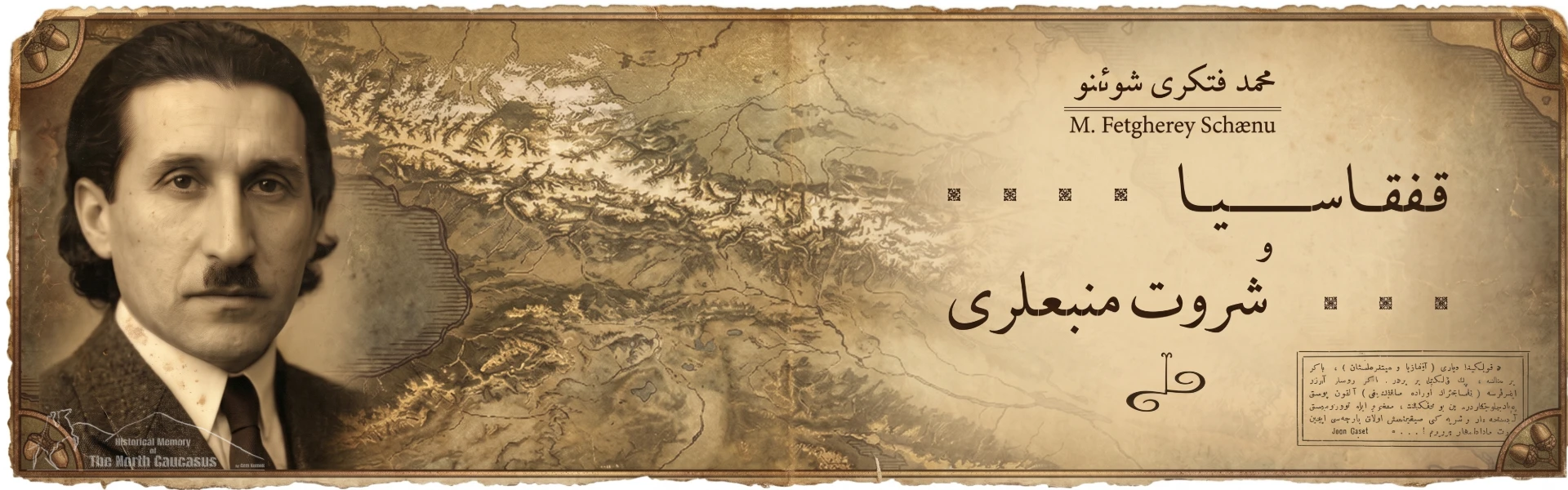
Born in 1890 in the Yanık village of Sapanca to a family displaced from Abkhazia to Anatolia during the Russo-Turkish War of 1877–1878, Mehmed Fetgerey Shoenu was orphaned at a young age and subsequently raised by his maternal uncle in Istanbul. Throughout his education, he distinguished himself through a profound aptitude for foreign languages and a keen interest in athletics. In 1913, alongside a cohort of Circassian youth that included his elder brother, Ahmet Fetgerey, he co-founded the Beşiktaş Ottoman Sports Club. He embarked upon his publishing career with his inaugural work, entitled Circassian Women in the Ottoman Social Sphere (Osmanlı İçtimai Âleminde Çerkes Kadınları), penned as a rebuttal to a derogatory article regarding Circassian women published by the journalist Celal Nuri (İleri).
Profoundly influenced by the First World War and the prevailing currents of freedom and independence sweeping across the Caucasus, Shoenu increasingly directed his intellectual focus toward national questions. Following the mass deportation of the populations of Circassian villages in the Southern Marmara region to Central Anatolia in 1923, he authored two distinct manifestos entitled Petition to the Turkish Public Conscience and the Grand National Assembly of Turkey Regarding the Circassian Question (Çerkes Meselesi Hakkında Türk Vicdan-ı Umumisine ve Türkiye Büyük Millet Meclisi’ne Arıza). He disseminated these manifestos of condemnation, drafted bilingually in Ottoman and Turkish, to both the Grand National Assembly of Turkey (TBMM) and prominent European politicians and statesmen.
Shoenu was temporarily active within the Popular Party of Free Mountaineers of the Caucasus (Kafkasya Hür Dağlıları Halk Partisi) during the early stages of factionalism within the North Caucasian political émigré movement. An impassioned address he delivered at the party’s congress in Prague on May 11, 1927, was subsequently published the following year in the party's literature under the surname "Shanba."
As his activism inevitably provoked certain centers of power, Mehmed Fetgerey Shoenu perished alongside two Circassian compatriots on January 19, 1931, following an arson attack on his office situated in the Agopyan Han in Sirkeci, Istanbul.
While Shoenu’s name remains recognized today, his treatise, entitled The Caucasus and Its Sources of Wealth (Kafkasya ve Servet Membaları), is presented here for the benefit of history enthusiasts and scholars. This presentation includes its Ottoman transliteration alongside summary translations in both English and Turkish. In light of the memoranda submitted to Western powers by the diplomatic representatives of the era's Caucasian Republics in Paris, I contend that M. Fetgerey Shoenu did not compose this work merely to impart conventional encyclopedic knowledge regarding the subterranean and surface resources of the Caucasus. Rather, it must be contextualized within the geopolitical climate of the time: Western powers, unable to recover debts owed by the Russian Empire, were actively seeking mechanisms for debt reclamation. Concurrently, representatives of the Caucasian Republics sought to curry favor with these Western powers—in the hope of securing diplomatic recognition and military assistance—by voluntarily assuming their proportionate share of the Russian imperial debt burden. Consequently, I posit that this treatise was conceived as a "cautionary" text. It was strategically designed to apprise Western powers—who had previously abandoned the fate of the Caucasus to the Russian Bolsheviks at the 1922 Genoa Conference—of the region's immense economic potential ahead of the impending Locarno Conference, urging them not to relinquish such vast wealth to the mercy of the Russian Bolsheviks.

Istanbul, 4 June 2026
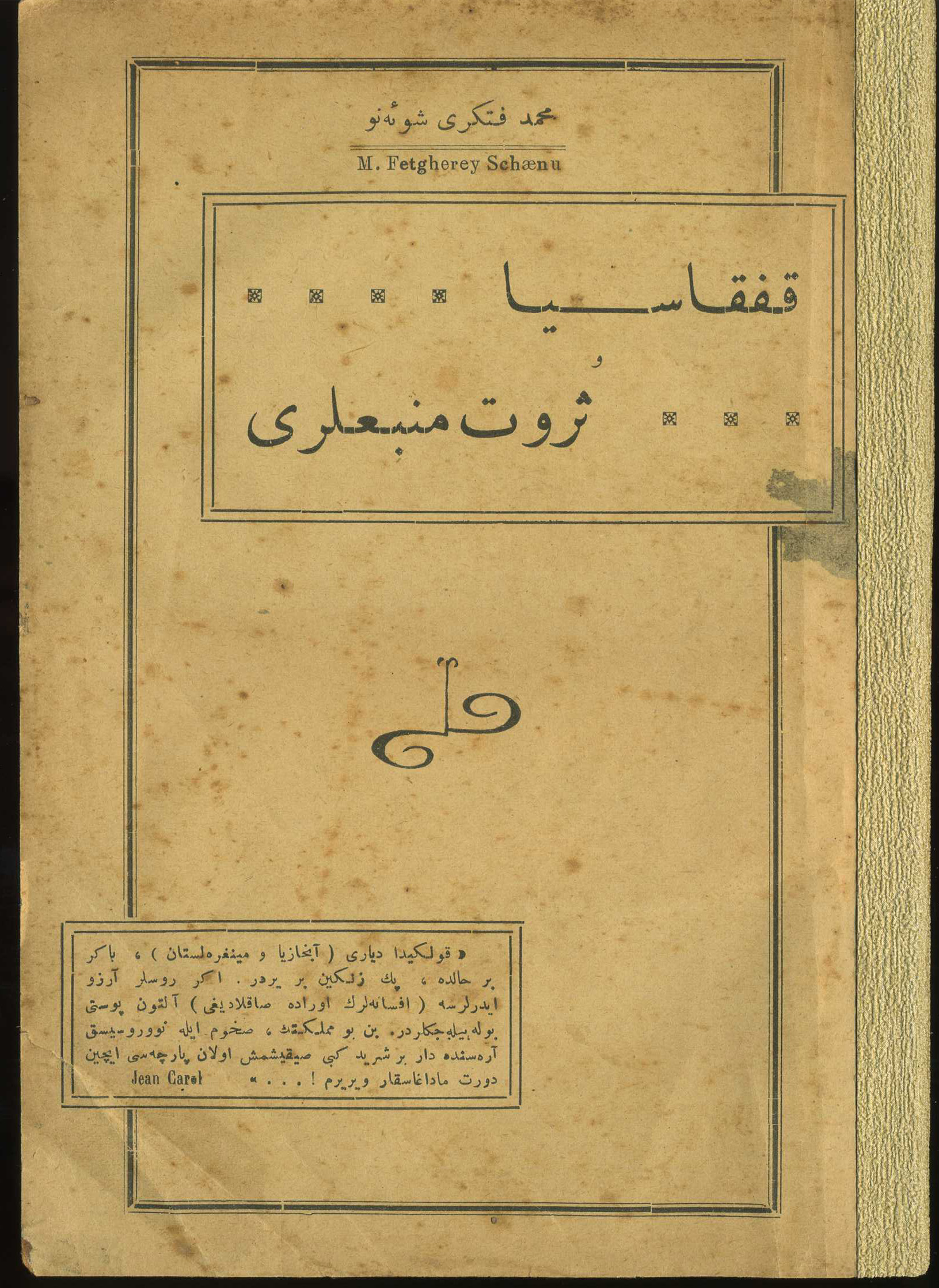
THE CAUCASUS & ITS SOURCES OF WEALTH (Summary)"The land of Colchis (Abkhazia and Mingrelia) is an exceptionally wealthy region in its pristine state. If the Russians so desire, they will be able to find the Golden Fleece concealed there by legends. I would trade four Madagascars for the narrow strip of this land wedged between Sukhum and Novorossiysk!..." — Jean Carat
Table of Contents
The Caucasus
1 — The Caucasus in Legends
2 — The Caucasus by Area and Population
3 — The Caucasus by Its Regions
4 — The Caucasus by Its Climate
5 — The Caucasus by Its Economic Structure
6 — The Caucasus by Its Northern Territories and Commercial Hubs
Caucasians
1 — Caucasians by Their Distinctive Characteristics
2 — Caucasian Mountaineers by Their Psychological Disposition
3 — Caucasian Mountaineers by Their Traditions and Customs
4 — Caucasian Mountaineers by Their Attire
5 — Caucasian Mountaineers by Their Traditions and Moral Orders
6 — Caucasian Nations by Their Prominent Social Classes
Sources of Wealth
1 — Mineral Resources: Baku, Grozny, and Mineral Wealth
2 — The Productive Significance of the Caucasus and Its Mineral Waters
3 — Agricultural Resources: Agricultural Regions and Yields
4 — Statistical Comparisons: Cotton, Tobacco, etc.
5 — Vineyards and Forests
6 — The Status of the Caucasus in Terms of Plant Geography
7 — Fauna
8 — Apiculture, Pisciculture, and Agro-Industry
The Strategic Importance of the Caucasus
From Economic, Military, and Political Perspectives
The Caucasus in LegendsThe Caucasus is not merely a realm exalted and crowned with mystical sanctities by the ancient world; it concurrently serves as the cradle of an ancient civilization. Even in the most archaic epochs, it commanded a reputation profound and expansive enough to engender enchanted and magical narratives across all Eastern mythologies.
The architects of the ancient Mediterranean civilization acknowledged Deucalion, whom they proclaimed as their progenitor, as a Caucasian emigrant; they recognized the force responsible for his existence as a divine artisan symbolizing humanity. In a certain sense, he was even the "Progenitor of Humanity" (Ebü'l-Beşer). This divine figure (Prometheus), who anchored the genesis of humankind to the Caucasus, dwelled there (specifically on Mount Kazbek or Mount Elbrus) for fifteen centuries.
Ancient Iran, one of the earliest vanguards of Eastern civilization, similarly produced and recited highly captivating epics concerning the Caucasus. According to their cosmogony, the Caucasus was the origin of humanity, the epicenter of the world, and ultimately "the pillar of the earth reaching into the heavens." It was conceptually analogous to the Meru or Pamir mountains of the Indian traditions. Mount Qaf (Kaf Dağı), a prominent feature in Eastern fables, was venerated in the sacred Zend-Avesta—the text that nurtured ancient Iranian civilization—as the greatest of all mountains and the mother of all earthly peaks.
Mount Elbrus, introduced in the Avesta as Berezad, alongside Mount Kazbek, which Mediterranean myths designated as the sacred mountain harboring the earthly paradise and the center of the gods, adorn the majestic peaks of this ancient continent—the cradle of world civilization—with divine epics. These epics evolved and became so meticulously refined within the fertile imagination of the East that fantasy and reality became utterly indistinguishable in the depiction of the Caucasus.
For instance, one legend narrates the following: "At the dawn of creation, the world perpetually rolled within the ocean, resembling a watermelon. In that state, it was unconducive to habitation and the emergence of life..." However, because divine providence willed this realm to become the stage for a new genesis, it desired the world to halt and attain tranquility. To this end, He created 76,676 mountains upon it! Yet the world, continuously rolling like a watermelon, still did not settle.
Eventually, an angel named "Sokanel" attained the blessing of receiving the divine command, and the Supreme Creator spoke to him thus: — Go forth, extract a lapis lazuli jewel from the streams of the exalted paradise, and press it around the earth so that the world may find peace! Thus, Mount Qaf materialized from that lapis lazuli jewel. The blue hue of the sky is visible merely as its reflection... However, the earth still did not find tranquility. Ultimately, by a divine decree, the "Throne Verse" (Ayat al-Kursi) was inscribed around Mount Qaf, which had been forged from the heavenly jewel. Under its benign influence, the earth stabilized, and upon the divine address, life began to proliferate across the globe. From that moment, waters began to cascade, birds to sing, and sheep to bleat everywhere; humankind began to converse in love and fervor alongside their families, accompanied by their lyres and harps!
The mythology of this miraculous mountain extends further: "This Mount Qaf was witnessed by four esteemed prophets of humanity. The first is the forefather of humanity, the Prophet Adam, who observed it by the gesture of Gabriel while descending from the exalted paradise to the earth. The second is the Prophet Solomon, sovereign of humans, jinn, and winds, who arrived and beheld that magnificent promenade as his throne was borne by the winds under his command. The third is Alexander the Great (Zülkarneyn), who saw this locale during his eastern campaign. The fourth is the Prophet Muhammad, who witnessed it as it was situated on his route during the night of the Ascension (Mi'raj)..."
As demonstrated, numerous other legends corroborate the conviction that, within the Eastern paradigm, the Caucasus has perpetually been regarded as an autonomous and distinct universe.
The Caucasus by Area and PopulationThe total terrestrial expanse of the country, crowned by towering mountains, encompasses 420,000 square kilometers. It is bounded by the Caspian Sea to the east and the Black Sea to the west. In the north, beyond the Terek River, lies its natural frontier with the Karanogay Turkmens, demarcated by the Kuma River, alongside the Yeysk and Manych rivers that discharge into the Sea of Azov. To the south, it is bordered by Turkey and Iran.
One-third of the territory within these borders (a vast expanse of approximately 140,000 square kilometers) is dominated by a mountain range that originates near the city of Anapa on the Taman Peninsula and culminates in the east on the Absheron Peninsula, the site of the Baku petroleum fields situated on the Caspian shores. These mountains bestow upon the Caucasus a topographical orientation extending from the northwest to the southeast.
Under the administrative framework of the Tsarist era, the Caucasus—which is marginally larger than the combined territories of Italy and Romania—was partitioned such that 47 percent comprised three distinct provinces: Kuban, Terek, and Dagestan. The remaining 53 percent was subdivided into seven sub-provinces (sancaks) and vilayets: Tiflis, Baku, Elizavetpol (Ganja/Karabakh), Erivan, Kutaisi, Kars, and the Black Sea (Chernomorskaya). Presently, this administrative division is defunct. Profound structural transformations ensued following the Russian Revolution.
For example, during the revolutionary upheaval of 1917, Terek, Dagestan, a segment of Kuban, in conjunction with the Black Sea region and a portion of Kutaisi, established an independent government designated as the "Mountainous Republic of the Northern Caucasus." The remaining sectors of Tiflis and Kutaisi constituted the "Republic of Georgia." Baku and a portion of Elizavetpol established the "Republic of Azerbaijan." Erivan and the remaining tracts of Elizavetpol founded the "Republic of Armenia." The environs of Kars transitioned to Turkish sovereignty as a consequence of World War I.
Regarding demographics, the aggregate population, estimated at roughly 12 million, is distributed among various ethnic cohorts in the following proportions:
— 20-25% Russians: The majority reside in urban centers, while a segment inhabits distinct, exclusively Russian villages. The urban populace consists of military personnel, civil servants, merchants, or laborers, and their settlement is generally transient. Conversely, the village inhabitants are entirely agriculturalists.
— 15% Turks and Tatars
— 15.5% Georgians
— 12.5% Armenians: This demographic proportion represents the period preceding the mass migrations of World War I.
— 20% Eastern and Western Mountaineers: This category encompasses the Circassians and affiliated groups.
— The residual demographic consists of populations such as Jews, Germans, Greeks, and Iranians.
The inhabitants of the Caucasus predominantly situate their settlements at elevations up to 1,000 meters above sea level. However, this figure serves merely as an average. A substantial proliferation of villages and towns exists even at an elevation of 2,550 meters. This phenomenon constitutes an unparalleled attribute of the Caucasus, rendering it highly viable for habitation even at altitudes 500 meters higher than the Alps.
The Caucasus by Its RegionsIn terms of its physical geography, the Caucasus is systematically bifurcated into three distinct domains, each exhibiting unique morphological and climatic attributes:
— Northern Territories (North Caucasus)
— Mountainous Territories (Greater Caucasus)
— Southern Territories (South Caucasus / Transcaucasia)
The foundational basis of this geographical taxonomy relies upon the towering, impassable mountain ranges that traverse the expanse between the two seas. Transit from the north to the south is rigorously constrained to a few specific passes; the most celebrated of these is the Darial Gorge (Daryal Geçidi), which operates as a vital military artery connecting Vladikavkaz to Tiflis.
— Northern Region: This domain is fundamentally comprised of valleys and topographical slopes extending northward from the primary mountain chain. The topography largely features flat plains and remains heavily exposed to northern wind currents. The Stavropol region, situated between the Kuban, Terek, and Kuma rivers at an approximate elevation of 730 meters, functions as the preeminent agricultural basin of the entire Caucasus.
— Mountainous Region (Greater Caucasus): Characterized by majestic, snow-capped alpine peaks. The overwhelming majority of the primary Caucasian river systems (the Terek, Kuban, and Samur in the north; the Rioni, Ingur, and Kura in the south) originate from these highly elevated catchments. The paramount elevations are represented by Mount Elbrus (5,630 m) in the west and Mount Kazbek (5,045 m) in the east. In its comprehensive orographic structure, the Caucasus mountain range possesses 25 distinct peaks that eclipse the altitude of Mont Blanc, Europe's highest mountain.
— Southern Region (Lesser Caucasus): This zone encompasses the fertile valleys of the Kura, Aras, Rioni, and Çoruh rivers. It is profoundly sheltered from northern atmospheric currents. Lake Sevan (Gökçe Gölü), which spans an area of 1,400 square kilometers and is culturally perceived as the crown jewel of the entire Caucasus, is situated within this sector. The valleys of this region, particularly the Rioni basin, maintain significantly elevated humidity levels.
The Caucasus by Its ClimateThe extreme variance in elevation and geographic positioning endows the Caucasus with an unprecedented diversity of climatic conditions and ecological landscapes. The Black Sea littoral zone sustains an exceptionally temperate maritime climate, bearing a striking resemblance to Southern Europe and the Mediterranean coasts of France and Italy. Conversely, the eastern seaboard (the Caspian littoral) is dominated by a markedly continental climate. Black Sea municipalities such as Sukhum, Sochi, and Gagra are particularly distinguished by their elevated mean temperatures and voluminous annual precipitation. The alpine climate of the mountain ranges remains receptive to the moderating maritime breezes while being robustly insulated against the frigid northern winds.
Climatic metrics for select urban centers are delineated below:
|
City |
Elevation (m) |
January Avg. (°C) |
July Avg. (°C) |
Annual Avg. (°C) |
Annual Precip. (mm) |
|
Krasnodar (Yekaterinodar) |
90 |
-2.1 |
25.2 |
12.1 |
500 |
|
Vladikavkaz |
684 |
-5.2 |
20.7 |
10.1 |
826 |
|
Batumi |
3 |
5.9 |
24.0 |
15.0 |
2400 |
|
Tiflis |
409 |
0.2 |
24.5 |
12.7 |
498 |
|
Baku |
8 |
3.4 |
26.0 |
14.5 |
247 |
|
Erivan |
994 |
-7.7 |
24.7 |
11.3 |
344 |
|
Kars |
1742 |
-16.2 |
17.3 |
3.8 |
456 |
The Caucasus by Its Economic StructureThe geographic morphology of the Caucasus has catalyzed the formation of two distinct economic paradigms, distinctly localized in the north and the south:
— South Caucasus: Predominantly functions as an industrialized region characterized by a proletarian demographic. Plentiful mineral resources (most notably petroleum) in zones such as Baku and Karabakh have precipitated the influx of foreign capital and a multinational industrial working class. This economic dynamic has successfully transformed the south into a cosmopolitan industrial epicenter, consequently subordinating traditional agriculture and pastoralism.
— North Caucasus: Traditional agriculture and pastoral husbandry remain the dominant economic forces. Societally, the population has retained a conservative disposition, rigorously preserving the Caucasian ethos and cultural conventions. The inhabitants act as sovereign proprietors of their own agrarian tracts; they exhibit a profound sociological preference for cultivating their own soil rather than laboring as wage-earners under external employment. An oppressive manifestation of feudalism, akin to historical European models, never established roots in this territory.
— Commercial Hubs: The primary western commercial nodes include Batumi, Sukhum, Tuapse, and Novorossiysk. The eastern commercial nexus is formed by Baku, Derbent, and Makhachkala. The interior regions are commercially anchored by Tiflis, Vladikavkaz, and Maykop.
Caucasians and Their Cultural AttributesThe most conspicuous sociological trait of the Caucasians (particularly the Mountainous Circassians, Abkhazians, Chechens, and Lezgins) is an entrenched individualism coupled with an unyielding devotion to personal liberty. This potent individualism, however, is meticulously counterbalanced by an austere social solidarity and a framework of unwritten customary jurisprudence formally designated as "Habze."
— Psychological Disposition: The populace is acutely sensitive, immensely proud, and fiercely protective of their honor. Their capacity for generosity is unbounded; they ascribe monumental cultural significance to hospitality and the accommodation of guests.
— Etiquette and Jurisprudence: Societal equilibrium is sustained not via coercive state apparatuses (such as formalized policing or penal institutions) but rather through mutual societal respect and the pervasive moral oversight exerted by women within the communal structure. For a Mountaineer, the ultimate punitive measure is societal condemnation and ostracism (particularly when levied by women). Individuals who transgress these fundamental tenets are pronounced "Abrek" (outcasts who are expelled from societal integration and exiled to the mountains).
— Attire: Their traditional vestments function not solely as a pragmatic means of covering, but simultaneously as a profound cultural manifestation of aesthetic elegance and martial valor. Their intrinsic warrior ethos is seamlessly interwoven with the sartorial sophistication of their garments.
Sources of WealthMinerals and Petroleum The Caucasus functions as a geostrategic epicenter for global mineral and petroleum extraction.
— Petroleum (Naphtha): Primarily extracted from the prolific basins of Baku, Grozny, and Maykop. By the advent of the 20th century, the Caucasus had ascended to the position of the world's preeminent petroleum producer, outstripping even the output of the United States. Baku gasoline was universally recognized for its superlative quality.
— Other Minerals: Manganese is subject to intensive extraction operations in Kutaisi; coal is mined in Abkhazia and Kuban; copper is extracted in Karabakh and Kazbek; and silver-bearing lead is sourced from Alagir.
— Mineral Waters: Hydrological wellness centers such as Pyatigorsk, Kislovodsk (renowned globally for its Narzan water), Yessentuki, and Borjomi possess therapeutic waters of a caliber that vastly surpasses their European counterparts.
Agriculture and Forestry
— Cereals: The North Caucasus (specifically the Kuban and Stavropol territories) operates as a colossal agrarian granary capable of yielding immense quantities of wheat, corn, and barley; it possesses the logistical capacity to sustain the entire Caucasus whilst simultaneously exporting millions of tons to European markets.
— Industrial Crops: Cotton cultivation is prominent in Abkhazia and Karabakh. Premium-grade tobacco is cultivated along the Black Sea littoral and within the Kuban basin. Saffron cultivation is concentrated in the vicinities surrounding Baku. Furthermore, the cultivation of tea has achieved a highly advanced state in Batumi.
— Pomology and Viticulture: Georgia and Abkhazia boast immense historical acclaim for their viticultural outputs and wines. The alpine slopes are blanketed by expansive, naturally propagated forests containing walnut, chestnut, apple, and pear trees.
— Forests: An estimated 7.5 to 8 million hectares of the Caucasus are covered by extensive forest biomes. The overwhelming majority of these arboreal resources are geographically concentrated along the Black Sea coastlines and within the Kuban territory.
— Animal Husbandry Livestock breeding has achieved a high degree of sophistication, particularly within the northern steppes and elevated plateaus.
— Equine Breeding: The Abkhazian, Kabardian, and Karabakh equestrian lineages are globally acclaimed for their superior genetic quality. Historically, the requisite mounts for the Russian cavalry regiments were procured entirely from this specific geographical zone.
— Ovine and Bovine Breeding: Ovine breeds optimized for high wool yields are predominantly raised in the north, whereas breeds prioritized for their meat and adipose yields are cultivated in the south. Caucasian cheeses possess an exceptionally high standard of culinary quality.
— Pisciculture and Apiculture: An estimated 80 to 100 million kilograms of aquatic fauna (including sturgeon, salmon, and mullet) are harvested annually along the Caspian and Black Sea littorals, as well as within the major riverine systems (the Kura and Kuban). Caviar production remains an exceptionally lucrative enterprise. Concurrently, the Abkhazia region commands historical renown for the superlative quality of its apicultural yields (honey).
The Strategic Importance of the Caucasus (Geopolitical and Strategic Value)The Caucasus represents an extraordinary geographical entity capable of complete economic self-reliance—and of generating massive global exportation yields—attributable to its abundant agrarian outputs and colossal reserves of petroleum and mineral deposits. The region constitutes a vital logistical and transportation nexus, equipped with a sprawling railway network aggregating 3,600 kilometers, complemented by highly navigable riverine corridors such as the Kura and Kuban.
Beyond its function as an economic production zone, the Caucasus operates as a highly strategic theater of operations that functions as a terrestrial bridge connecting Central Asia, Iran, Anatolia, and Russia. While the maritime infrastructure on the Black Sea (the ports of Batumi, Novorossiysk, and Tuapse) serves as indispensable logistical gateways to Europe, the Caspian ports (Baku and Makhachkala) operate as pivotal commercial and political conduits extending into the deep interior of the Asian continent.
Throughout both the epoch of Tsarist Russia and the subsequent era of Soviet Russia, the region was consistently perceived as an asset of incalculable value—due simultaneously to its subterranean resource wealth and its strategic utility in projecting hegemonic control over Asia—and has thus perpetually remained situated at the absolute epicenter of international geopolitical competition.
Author: Mehmed Fetgeri Shoenu
Place and Date of Publication: Istanbul — A. Garoyan Printing House,
July 1924 (1340)