
 Türkçe
Following the total subjugation of the Caucasus by Russian Bolshevik forces in February 1921, the Paris-based Caucasian Union Council initiated a series of rigorous diplomatic consultations. Engaging representatives from the North Caucasus, Azerbaijan, Georgia, and Armenia, the Council sought to fortify a unified Pan-Caucasian alliance and garner European support against the Bolshevik threat. To operationalize these strategic objectives, the Council established four specialized commissions in early November 1921 under the stewardship of Georgian representative Konstantin Kandelaki.
Among these, the Military Commission emerged as the focal point of the Council’s efforts. Comprising General Konstantin (Edik) Hagandokov (North Caucasus), General Agabekov (Azerbaijan), General Korganov (Armenia), and Simon Mdivani (Georgia), the body was charged with the paramount task of organizing a joint resistance army to counter the Red Army. The Commission’s expedited deliberations culminated in a comprehensive report, drafted for submission to Prime Minister Aristide Briand with the aim of securing vital patronage from the French government.
The report included detailed information on:
— The purpose of the army's establishment
— Methods and fundamental principles of the struggle
— Its duties
— Command centers
— Routes to be used
— Manpower and weaponry
— Headquarters points
— Logistics, health, supply, engineering, intelligence, and communications personnel and equipment
— Planning regarding expenditures for the purchase of weapons, ammunition, and supplies, and budgets for personnel salaries.
On November 16, 1921, General Hagundokov presented the strategic report, The Struggle Against the Bolsheviks, to a joint session of the Military and Economic-Financial Commissions at the North Caucasus delegation's headquarters.
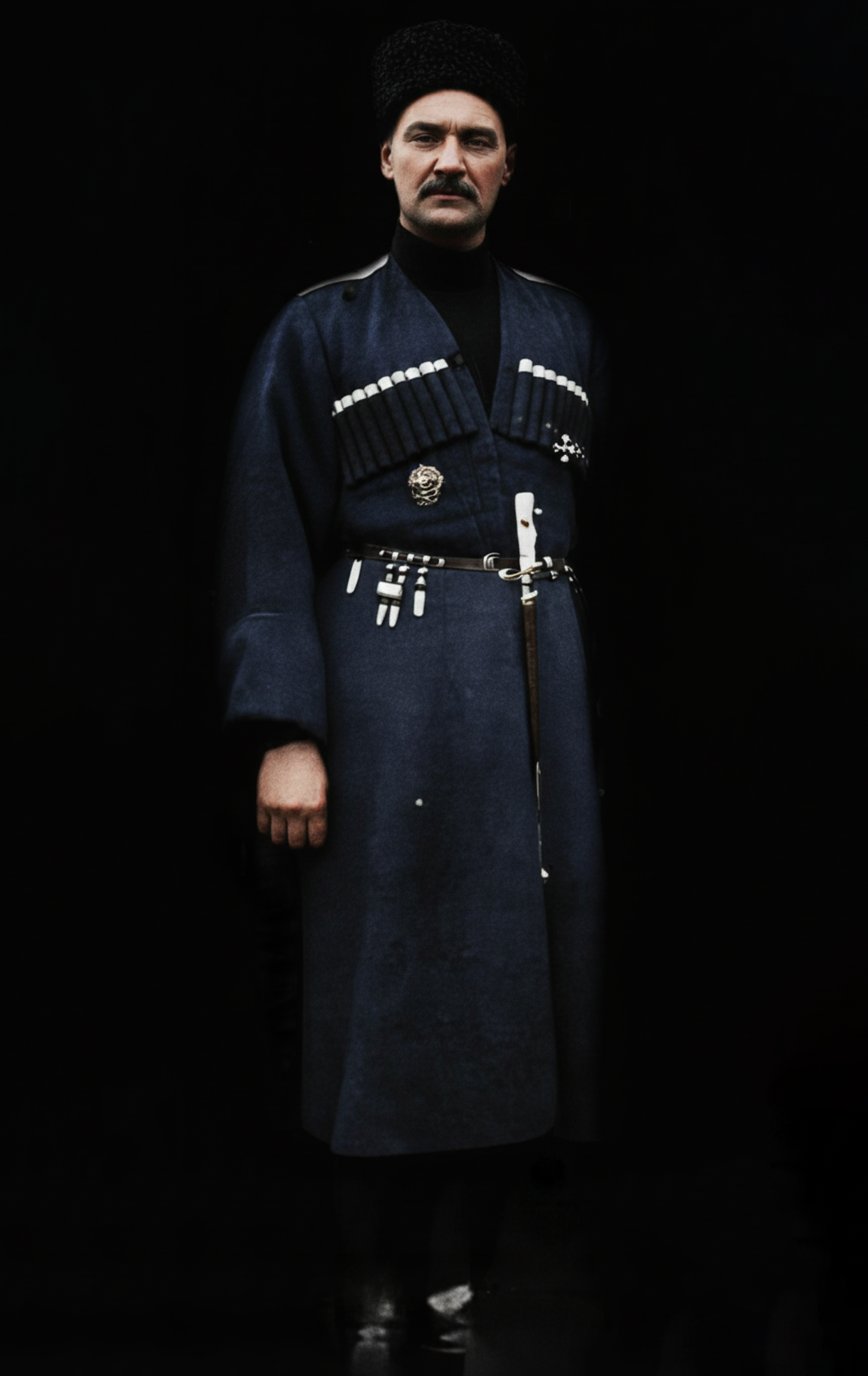
Following protracted deliberations, a consensus was reached, and the dossier was submitted to the French government. However, Prime Minister Aristide Briand failed to align French policy with British interests regarding anti-Soviet intervention. Consequently, the Union Council was unable to secure the necessary financial backing to operationalize its plans.
Despite these diplomatic setbacks, resistance fighters in the North Caucasus maintained their insurgency, buoyed by the prospect of the proposed army. This hope persisted until 1924, when France moved to establish diplomatic and commercial relations with the Soviet Union. Demoralized by the evaporation of foreign aid, resistance groups began to capitulate. The resistance leader Imam Najmuddin of Gotsatl (Gotsinski) held out until September 1925 but was ultimately captured by the NKVD.
Cem Kumuk
Istanbul, 12 December 2025
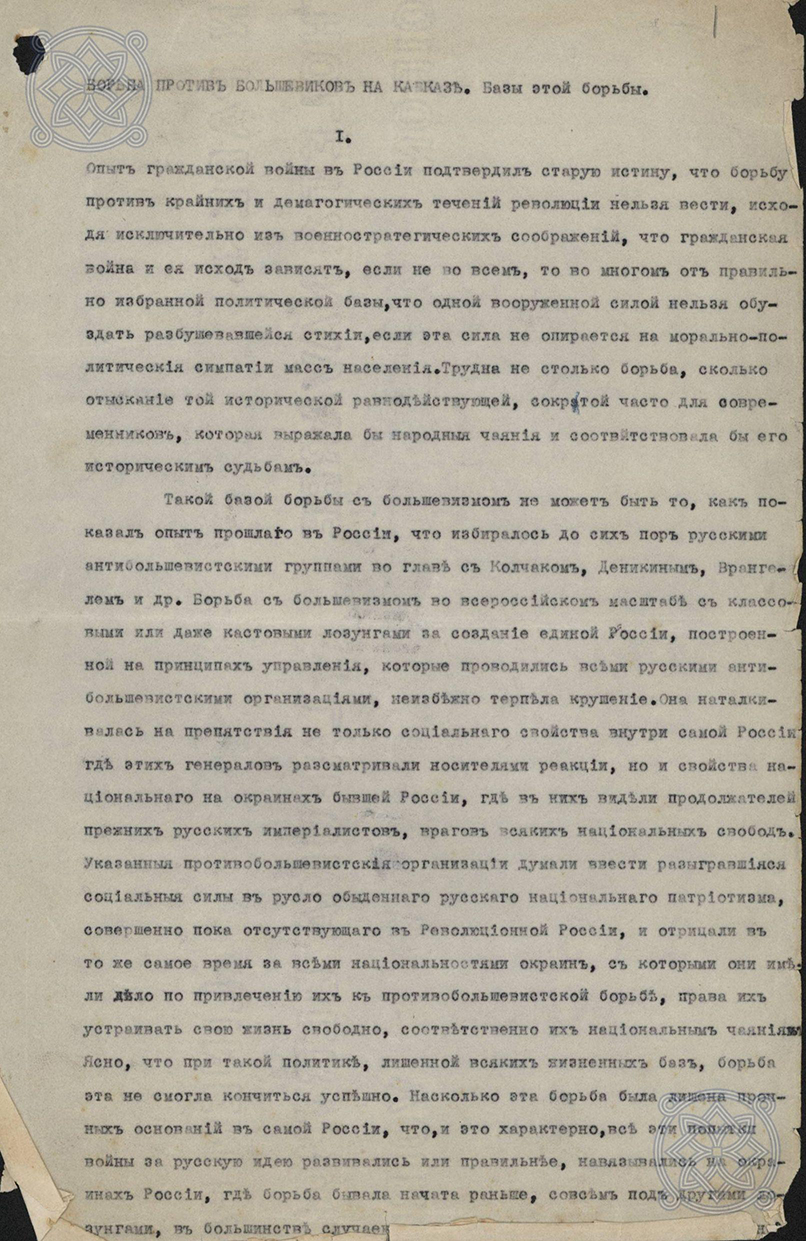
The Bases of this Struggle.
The experience of the civil war in Russia confirmed the old truth that the struggle against the extreme and demagogic currents of the revolution cannot be waged based solely on military-strategic considerations; that a civil war and its outcome depend, if not entirely, then largely on a correctly chosen political base; that military force alone cannot curb the raging elements if this force does not rely on the moral and political sympathies of the masses. The difficulty lies not so much in the struggle itself, but in finding that historical resultant force, often hidden from contemporaries, which would express the people's aspirations and correspond to their historical destinies.
As the experience of the past in Russia has shown, the base for the struggle against Bolshevism cannot be what has been chosen until now by Russian anti-Bolshevik groups led by Kolchak, Denikin, Wrangel, and others. The struggle against Bolshevism on an all-Russian scale, with class or even caste slogans for the creation of a "United Russia," built on principles of governance implemented by all Russian anti-Bolshevik organizations, inevitably suffered collapse. It encountered obstacles not only of a social nature within Russia itself, where these generals were viewed as carriers of reaction, but also of a national nature on the peripheries of the former Russia, where they were seen as continuators of the former Russian imperialists, enemies of any national freedoms.
The indicated anti-Bolshevik organizations thought to channel the unleashed social forces into the stream of ordinary Russian national patriotism, which is currently completely absent in Revolutionary Russia, and at the same time denied all the nationalities of the borderlands—with whom they dealt in attracting them to the anti-Bolshevik struggle—the right to arrange their lives freely, in accordance with their national aspirations.
It is clear that with such a policy, devoid of any vital bases, this struggle could not end successfully. The extent to which this struggle was devoid of solid foundations within Russia itself is characterized by the fact that all these attempts at war for the "Russian idea" developed, or rather, were imposed, on the peripheries of Russia, where the struggle had begun earlier under completely different slogans [Kuban], North Caucasus Rep[ublic] / or peripheral-territorial ones / Don, Siberia /. Unfortunately, to this day, any national movement that initially takes the form of an uprising against the Bolsheviks / Ukraine, North Caucasus / is naively viewed by many Russian circles as a Russian patriotic movement against the Bolsheviks for a united and great Russia.
In any case, the experience of the civil war in Russia showed that national fronts proved to be stable fronts against the Bolsheviks. Wherever Russian organizations à la Denikin mixed with this front, it inevitably spoiled, and fatally, the Bolsheviks would appear wherever the presence of these organizations called them. As a result, under the pretext of destroying nests of counter-revolution, the Bolsheviks seized territories free from them, devoid of any soil for the development of Soviet ideas, and healthy national movements ended up destroyed or exhausted.
To once again move the popular masses of the national borderlands, weary from long struggle, to new sacrifices, powerful and understandable stimuli are needed. It is unlikely that ideas of social restructuring can push them to such sacrifices. It is unlikely that these ideas can compete in the eyes of the masses with everything promised by Bolshevik demagoguery, which feeds the most unbridled instincts.
Such a stimulus can only be the national idea, where favorable conditions exist for its origin and development.
Such an idea exists and has taken deep roots, particularly in the Caucasus, in the Baltic states, and in Ukraine. After the revolution in Russia, a powerful will for national emancipation awakened among the peoples of these countries.
It is not the social tasks of restructuring life that occupy these peoples as priority tasks, but primarily the concerns of national rebirth, and only subsequently can questions of the first order interest these peoples as internal questions, depending exclusively on them, and not on external violent legislators: Bolsheviks, monarchists, or others.
The struggle against Bolshevism thus acquires seemingly limited dimensions: it does not set itself the goal of fighting Russian Bolshevism at any cost for the creation of a united and great Russia, but rather the tasks of liberating its own territories from alien Bolsheviks and creating national states.
The results of such a struggle would prove more effective, even for those [Russians] who would wish for the weakening or overthrow of the Bolshevik regime within Russia itself.
A struggle under national and strictly democratic slogans is dictated by the experience of the past Russian revolution. In the struggle against the Bolsheviks, all non-Russian nationalities have a united interest, as long as "Russian" Bolshevism comes to them as a hostile foreign force, implementing under demagogic cover a policy of enslaving nationalities, bringing them neither culture, nor order, nor the truth of equality.
The struggle against it will undoubtedly unite different peoples of the former Russia, either all of them or in groups, such as the Baltic peoples, the peoples of the Caucasus. [Handwritten note: devouring their goods and especially feeding the Red Army].
The Caucasus, embracing the peoples of the Kuban, the North Caucasian Republic, Azerbaijan, Georgia, and Armenia, will present one of the most powerful unions in the struggle for the expulsion of the Bolsheviks from its borders and for its independent national existence.
Representing a unified whole by geographical position and by the spirit of the peoples inhabiting it, the Caucasus could appear as a unified anti-Bolshevik military front through the creation of at least a military convention between the inter-Caucasian state entities.
[Handwritten: Despite this,] Unfortunately, the legacy of past centuries has left memories of a certain discord between some of the nationalities inhabiting the Caucasus [Handwritten: Cossacks] and distrust toward Turkey. Furthermore, the conquest policy of the Bolsheviks led to their seizure of the territory and peoples of the Caucasus, and the international situation of both the Bolsheviks and the Turks led them to an alliance.
At present, the anti-Bolshevik forces of the Caucasian states have found themselves outside their territories and are in a difficult situation while resolving to proceed with the organization of a movement aimed at liberating their peoples and countries, due to the lack of territory on which the conceived organization could be deployed in the preparatory period preceding the entry of their forces into the Caucasus.
Based on geographical and strategic considerations, it would be extremely advantageous to conduct the organizational work of the preparatory period on the territory of Turkey. As mentioned, this is hindered mainly by the current political situation, in which Turkey would not want to and could not allow the existence of an anti-Bolshevik organization on its territory.
However, the idea of creating our organization in the part of Turkey bordering the Caucasus should not be abandoned. This is suggested by a number of considerations regarding the possibility of a radical change in the political situation, regarding the possibility of anti-Bolshevik actions in the Caucasus, and a favorable attitude of the Turks toward the organization of anti-Bolshevik Caucasian forces in their country.
The alliance of the Turks with Soviet Russia appears to us unnatural, subject to destruction once the Turkish nationalists achieve their goals not with the help of Soviet Russia, but with the help of France, Italy, and, perhaps, England.
At that moment, Turkey can easily turn from an ally of Soviet Russia into its enemy.
Finally, under pressure from "capitalist" states, from whom Soviet Russia seeks support to exit the state of devastation and famine into which the peoples of Russia have been led by the policy of the communists, the Soviet power may go far along the path of concessions required by capital. It would not be unexpected if the Soviet power is forced to recognize the political independence not only of Finland, Latvia, Estonia, Lithuania, Poland, and the annexation of Bessarabia to Romania, but also to recognize [Handwritten: not only by decrees but also practically] the independence of the Caucasian states: Kuban, North Caucasian Republic, Georgia, Armenia, and Azerbaijan.
This independence, desired by the peoples of the Caucasus, may prove advantageous for England, France, and Turkey for the most various and clear, understandable considerations.
Confident that the matter of raising an uprising in the Caucasus against the Bolsheviks located there does not present particular difficulties, and even confident that this uprising will be fully successful, i.e., that Bolshevik power in the Caucasus will be overthrown and their troops expelled from the territory of the Caucasus, we are confident at the same time that such an uprising should not be allowed by the political leaders of the popular masses in the current situation.
There is no doubt that the Soviet power will find enough strength and energy to unleash a powerful army on the Caucasus and liquidate the uprising. One can easily imagine what sacrifices this will cost the rebelling population, for the Caucasian States, acting even jointly and in solidarity, but left to themselves, will never be able to fight against Russia, whatever it may be, and even more so against a Russia governed by a unified and strong power.
The situation changes when this power is overthrown under the pressure of internal forces or when this power is brought to the necessity of recognizing certain limits /the independence of the Caucasus/, which it will not dare to cross.
In both cases, a situation is maturing in the Caucasus in which the organization created on the territory of Turkey can and must invade the Caucasus for the [Handwritten: expulsion of the alien] Bolsheviks, the curbing of anarchy, and the creation of that legal order of life to which the peoples of the Caucasus have a legal, divine right.
Without organization, there is disorganization.
Without creating and managing military centers, no organized, planned work is possible.
What should its preparatory work consist of?
What goal should our organization pursue?
The Goal - The overthrow of Bolshevik power and the support by military force of the national power that comes to replace them.
An uprising is not conceived as the panacea for achieving this goal.
An uprising is not excluded, but [only] in certain conditions of the political situation guaranteeing the success not only of the expulsion of the Red Army from the borders of the Caucasus, but also the possibility of defending the Region from a new invasion by them into the territory of the Caucasus.
THE TASK OF THE MILITARY ORGANIZATION OF THE CAUCASUS FEDERATION IN THE PREPARATORY PERIOD MUST SERVE:
1/ The creation of military leadership centers.
2/ The adoption of all possible military measures to undermine the stability of the Bolsheviks' military power through propaganda, chetnik (partisan) activity, the development of desertion from the ranks of the Red Army up to luring command personnel to our side, and inclusively through the creation of a network of insurgent cells on the territories of all republics of the Caucasus Federation, supplying these cells with money, weapons, and equipment; guiding the manifestation of the greatest possible activity by chetas (bands) and insurgent cells in damaging communication routes, destroying enemy depots at the moment when our center deems this useful; through terror against the most prominent communists and generally disciplining the movement preparing against the Bolsheviks.
3/ The timely creation of a preparatory base corresponding to the preparatory period of actions for the seizure of power in the Caucasus and the expulsion of the Bolsheviks from it.
The concept of this preparatory base must include the following elements, bearing in mind the field of military activity of our organization in the Caucasus.
MILITARY-LEADERSHIP CENTERS: Preparatory Period.
Paris. STAFF OF THE CAUCASUS FEDERATION. [Note: Typed figures are heavily reduced by handwritten corrections]
1 Chief of Staff of the Federation: 2,500 -> 600 fr. per mo.
1 Adjutant for Operations: 1,500 -> 300 fr. per mo.
1 Inspector of Artillery: 1,500 -> 300 fr. per mo.
1 Quartermaster: 1,500 -> 300 fr. per mo.
1 Inspector of Engineering Troops: 1,500 -> 300 fr. per mo.
1 Medical Inspector: 1,500 -> -- fr. per mo.
2 Typists: 1,000 -> -- fr. per mo.
1 Officer for Assignments: 800 -> -- fr. per mo.
1 Translator, French Officer: 1,500 -> 300 fr. per mo.
2 Orderlies-Guards: 1,000 -> -- fr. per mo.
Total ..... 14,300 -> [approx 2,000 - 3,000 range based on cuts]
The Chief of Staff, until the appointment of the Commander-in-Chief of the Caucasian Armies, reports to the Chairman of the Supreme Federal Council.
SUMS OF THE FEDERATION STAFF:
1/ Inventory / typewriters, maps, duplicators, furnishings / .... 30,000 fr.
2/ Secret sums/intelligence, counter-intelligence / [100,000] -> 60,000 fr.
3/ Staff maintenance for 1/2 year ...................... 85,800 -> 76,800 fr.
4/ Office expenses for 1/2 year/paper, supplies, printing forms, brochures, appeals, orders, etc. / ....... 40,000 -> 25,000 fr.
5/ Rent of premises for 1/2 year ............................ 5,000 fr.
Total. --- [260,000] -> 227,800 fr.
REPRESENTATION UNDER THE TURKISH GOVERNMENT /Constantinople-Angora/ for communication between the Federation Staff and the Staffs of the forces of all Republics.
[Handwritten header: Liaison with Turkish Command]
[Handwritten insert: Liaison Officer to the Commander]
1 Resident: [Revised] .....fr. per mo.
1 General Staff Officer: [Deleted]
1 Typist: 600 -> 300
1 Orderly: 600 -> 400
1 Translator (Turk): 500
Office expenses: 1,000
Secret sums: 10,000 -> 300
Rent of premises: 1,000
Total: 16,550 -> 2,700
For SIX months, this will amount to 98,100 fr. -> 16,200
The Resident is subordinate to the Chairman of the Supreme Federal Council through the Chief of Staff.
Staff of each Republic:
1 Georgia: in Erzerum
1 Armenia: in Karakilisa
1 Azerbaijan: in Bayazet
1 Mountaineers in Samsun
[Handwritten insert: Staffs]
1 Chief of Cadre Detachment: 2,000 -> 1,500 fr. per mo.
1 General Staff Officer: 1,250 -> 1,000
1 Artillery Inspector: 1,250 -> 1,000
1 Engineer Inspector: 1,250 -> 1,000
1 Military-Medical Inspector: 1,250 -> 1,000
1 Quartermaster: 2,000 -> 700
1 Typist: 500 -> 400
1 Translator (Turkish): 500 -> 300
Rent of premises: 1,000 -> 1,500
Office expenses: 2,500 -> 3,000
Secret sums: 10,000 -> --
TOTAL: 24,500 -> 12,000 fr. per mo.
For 4 Republics for a period of SIX months: 564,000 -> 290,400
Add 4 duplicating machines with printers: 56,000
GRAND TOTAL: 620,000 fr. -> 346,400
a/ CADRES, supplied, armed, trained, secured, and disciplined, who at the necessary moment will obediently, quickly, with instructions received in advance, enter the territory of the Caucasus and around whom the future army of the Federation will be created.
b/ MILITARY DEPOTS, of weapons, ammunition, military-technical means, equipment, clothing, medicines, dressing material, mobile and local military hospitals, and food supplies. The reserves of these depots must be calculated for an army of 100,000 men minimum, for 6 months.
c/ CONVOYS [Transport]. Field kitchens, infirmary carts, or packs for a corps of troops of 25,000 men.
d/ DEPOTS OF THE FEDERATION GOVERNMENT for the distribution of supplies, products, and goods to the population of the regions to which the power of the Federation Governments will extend: textiles, iron products, medicines, clothing, footwear, tools and household utensils, agricultural tools /plows, harrows, scythes, and sickles/, food supplies /bread, sugar, salt/.
THE NECESSITY OF CREATING THE GOVERNMENT DEPOTS INDICATED ABOVE IS MARKED BY THE MILITARY ORGANIZATION as a powerful means of assisting the success of the military operations of the Federation troops against the Bolsheviks, and as a guarantee of the inviolability and coherence of the military organization for humanitarian and political motives.
I want to say that the Government, undoubtedly for the indicated motives, will have to extend a helping hand to the hungry, sick, and undressed population of the Caucasus, and the military organization, understanding the inevitability of such a phenomenon, guaranteeing the success of its military actions, must in advance propose to the future government that the hand of help be dipped into its own pocket, and not into the pocket of the military organization.
e/ MONETARY ADVANCES for the first expenses at the beginning of the movement in the organization on the territory of the Caucasus.
I proceed to compile a rough estimate of expenses caused by the implementation of the outlined plan.
THE MAIN POINTS OF THE PREPARATORY BASE WILL BE - SAMSUN, ERZERUM, /KARS/, KARAKILISA, BAYAZET, CONSTANTINOPLE, AND PARIS, with corresponding to the assignment or task of each point:
1/ SAMSUN — for the Mountaineer (North Caucasian) army.
2/ ERZURUM / KARS — for the Georgian army.
3/ KARAKILISSA — for Armenian army.
4/ BAYAZET — for the Azerbaijani army.
5/ CONSTANTINOPLE — main base
6/ PARIS — base administration
The base points were chosen as important nodes on the most vital routes leading from Turkish territory to the regions of future operations of the Caucasian Federation's military organization, with the exception of Samsun for the Mountaineers, penetration into whose territory by land is more complex; however, it is partially easier to establish communication by sea. Furthermore, Samsun lies in the region where Mountaineer emigrants are settled in Turkey. [Handwritten note: find (someone/something) there for the time being]
MOST IMPORTANT DIRECTIONS leading from TURKEY TO THE CAUCASUS:
1/ Ishkhana - Copper Plant - Borchka - Batum.
2/ Sagir - Oltu - Ardahan - Akhalkalaki - Akhaltsikhe - Borjomi - Suram.
3/ Hasan-Kala - Zivin - Kara Urgan-Kars - Alexandropol - Tbilisi.
4/ Karakilissa - Diyadin - Igdir - Erivan (Yerevan) - Dilijan - Qazakh - Agstafa.
5/ Bayazet - Maku - Nakhichevan - Goris - Shusha.
SEA ROUTES:
6/ Samsun - Trabzon - Batum - Poti - Sukhum. /and small ports between them with the possibility of penetrating to the Mountaineers via the Marukh and Klukhor passes/ Handwritten note: railway tunnels]
To schematize this question of drafting a budget, I proceed from the following schematic data:
1/ The Caucasian Federation consists of 4 Republics: Georgia, Armenia, Azerbaijan, and the North Caucasian.
2/ POPULATION: Georgia - 2 1/2 mil., Armenia - 2 mil., Azerbaijan - 2 1/2, and the North Caucasian Republic - 2 1/2 mil people.
3/ The Federation will field a minimum 100,000-strong army with 25,000 men in each Republic.
4/ The Georgian, Armenian, and Azerbaijani armies will consist mainly of infantry with artillery, calculated at 4 guns per thousand fighters, i.e., 100 field and mountain guns for each army /25 batteries/. Each of these armies includes 1 cavalry division of 2,400 horses with one /the 25th/ horse-mountain battery.
The Mountaineer (Gorskaya) army will consist of half cavalry. Artillery in the same ratio[Handwritten note: and] Machine guns: 4 per company or 16 per 1,000 infantry fighters and 8 per cavalry regiment.
5/ The population of Armenia is recognized as the MOST AFFECTED AND RUINED, followed by Azerbaijan, the N.-C. Republic, and finally Georgia. This data point must lie at the foundation of drafting the budget for government base depots.
[Handwritten note on margin: and in the mountains?]
6/ EACH ARMY MUST HAVE at the base telegraph and telephone equipment calculated for 150 versts* of technical communication lines, i.e., for one telegraph company, for the needs of the army command, and 6 versts for every thousand men, i.e., 150 versts + 150 ver. = 300 versts, with 300 telephone and 20 telegraph sets. (Note: 1 verst is approx. 1.07 km)
7/ For EACH ARMY there must BE prepared an aviation detachment consisting of 5-6 machines each, with corresponding equipment, and a 5th detachment consisting of 10 machines for the headquarters of the future commander-in-chief, totaling 30-35 machines.
8/ For each army, 8 MOBILE HOSPITALS with 200 beds each, 4 local hospitals with 250 beds each, and 8 " " with the same number of beds at the disposal of the Commander-in-Chief's headquarters, totaling...
32 MOBILE HOSPITALS and 24 LOCAL HOSPITALS with 12,000 beds.
The somewhat high figure for hospitals is caused by the character of a civil war in ruined regions, i.e., in a setting where hospitals will have to provide immense aid to the local population as well.
9/ For each army, 3 stations of field wireless telegraph [radio] with a radius of up to 150-200 versts. For the Commander-in-Chief's headquarters, 3 high-power stations with a radius from 300 to 500 versts, totaling 15 STATIONS.
10/ FOR EACH SOLDIER IS ALLOCATED:
— 2 pounds (funts) of bread per day
— 1/2 pounds of meat per day
— Hot meal (privarok) per day
— 1/2 zolotnik of tea per day
— 3 zolotniks of sugar per day
— Set of SUMMER clothing
— Set of WINTER clothing
— RIFLE with bayonet
— SHASHKA (saber) for cavalry
— 1 BINOCULARS per 10 men
— 1 COMPASS
— 1 TOWEL
— Knapsack, bag, or saddlebag
— Set of COMBAT gear.
— 3 sets of UNDERWEAR
— 1 pair of warm GLOVES
— 2 pairs of BOOTS
— 1 BASHLYK (hood)
— 1,000 cartridges /250 pcs. on person/ and 750 pcs. carried in transport.
— 2 hand GRENADES /1 on person/
— 1 pc. INTRENCHING TOOL / shovel, pickaxe, axe/
— 1 copy of a MAP PER 10 men.
— 1 Pot
— 1 MUG, SPOON, KNIFE.
11/ The achievement of goals indicated in point 2, /page 6/ must be entrusted to the staffs of the 4 armies of the Federation. These staff must have at their disposal for these purposes for six months 1,000,000 francs each, 1,000 rifles each, 2,000 hand GRENADES each, 100 copies of 40-verst MAPS of the Caucasus each, 1,000,000 rifle CARTRIDGES each, 1,000 REVOLVERS each, with 50,000 cartridges for them. This will constitute a monetary sum, counting the cost of weapons and maps - 4,000,000 francs. CREATION OF A BASE / point 3, page 6/ will incur the following expenses:
Each army, from refugees, deserters, retreated detachments, and local elements, will create its own cadre in the size of up to 5,000 men and consisting of: [Corrections in red pencil]:
— 200 (was 125) officers,
— 500 (was 375) NCOs and up to
— 2000 (was 4500) soldiers.
From them, in each cadre will be formed:
— 1 infantry regiment (3 battalions)
— 1 battery with a mounted platoon,
— 1 cavalry squadron and
— 1 engineering company.
[Crossed out: All these units will be considered to be in Turkish service.]
[Handwritten text on the right]: perhaps for the Georgian army the cadre should be increased since the officers are ready (?) to revive (?) the whole army... (text hard to read, mentions "arrived in full 3rd reg. comp. Taman(?)...")
The calculation of the cost of maintaining these cadres comes down to calculating the cost of rations for men, horses, and their housing in barracks:
— 1/4 funt of meat per person per day: 1 fr. 25 c.
— 1 kg of bread per person per day: 1 fr. 25 c.
— 1 kg Hot meal: 0.25 fr.
— Sugar: 0.10 fr.
— Tea: 0.10 fr.
— Housing, lighting, heating: 0.3 fr.
— Total: 3.00 fr.
— Horse per day: 5.00 fr.
SALARY:
— Regiment Commander: [Corrected to 1200] 1,500 fr.
— Battalion Commander: 1,000 fr.
— Company Commander, /squadron, battery, adjutant: 800 fr.
— Junior Officer: 600 fr.
— Sergeant Major (Vakhmistr): [Corrected to 350] 400 fr.
— Senior NCO: [Corrected to 200] 250 fr.
— Junior NCO: [Corrected to 150] 200 fr.
— Private: [Corrected to 50] 100 fr. / 7 liras.
When receiving rations from the pot, the cost is deducted from the salary, from [crossed out: lower officers], [crossed out: lower ranks].
EACH ARMY IN CADRE HAS:
— 1 regiment commander: 1,200 fr. per month
— 3 (corr. from 5) battalion comm.: 3,000 fr. per month(corrected)
— 15 (corr. from 19) company, sq., & battery comm.: 12,000 fr. per month(corr.)
— 174 (corr. from 94) junior officers: 104,400 fr. per month(corr.)
— 7 adjutants: 5,600 fr. per month
— 15 sergeant majors: 5,250 fr. per month(corr.)
— 80 senior NCOs: 20,000 fr. per month(corr.)
— 300 (corr. from 160) " junior: 45,000 fr. per month(corr.)
— 2000 (corr. from 4500) privates: 100,000 fr. per month(corr.)
— 400 (corr. from 500) horses: 60,000 fr. per month (corr.)
— Total: 356,450 fr. per month (corr. 667.700)
— Provisions.... 226,350 x 6= 1.358.100 fr. per month (handwritten calc) (corr. 500.000)
— For 6 months...... 7,006,200 fr. per month
— For 4 armies....... 14,203,200 fr. per month(corr.28,024,800 francs)
Expenses not connected with the direct expenditure of money from the Federation's cash on hand, for the acquisition of items of equipment, armament, clothing, and procurement of all materials for the base depots, as obtained from somewhere on credit on the Federation's state account, are not calculated.
I limit myself to a rough listing of them with an indication of approximate quantity:
— Rifles: [Corrected: 70,000 / Carbines 35,000] (Original: 150,000)
— Cartridges:150,000,000 [Note: 60,000,000]
— Cannons: 400 [Note: mtn. 150, howitz. 50]
— Shells: 500,000 [Note: 500 each] [Note: 200,000 total]
— Hand grenades: 500,000
— Summer clothing: 150,000 sets
— Winter clothing: 100,000 sets
— Underwear: 500,000 sets
— Tents: 100,000 sheets ?
— Shovels large: 10,000 pcs.
— Shovels small: 100,000 pcs.
— Axes large: 5,000 pcs.
— Axes small: 10,000 pcs.
— Pickaxes large: 5,000 pcs.
— Pickaxes small: 10,000 pcs.
— Binoculars: 10,000 [Note: for off. and NCOs]
— Compasses: 100,000 [Note: 5 thous. - for NCOs]
— Combat gear: 150,000 sets.
— Shashkas (sabers): 20,000 pcs. [Note: 120]
— Revolvers: 25,000 pcs. [Note: ? Carbines /]
— Cartridges for them: 125,000 pcs. [Note: 100,000]
— Mobile hospitals: 32 [Note: equipment, and med equip 32]
— Local hospitals: 24
— Field radio-station: 15
— Aeroplanes: 35
— Light automobiles: 50
— Trucks: 150
— Armored cars /tanks: 20
— Field kitchens: 100
— Cavalry saddles: 2,000 [Note: 12,000]
— Artillery harnesses: 2,000 [Note: 5,500]
— Machine guns: 3,000 [Note: 700]
— Belts and ammo for them: 10,000,000 [Note: 7,000,000]
— 8-heavy batteries: 32 guns
— Shells for them: 50,000
— Field telephones: 1,500
— Telegraph sets: 100
— Teleph. cable 1,500 versts
— Coils for wire: 3,000 versts
All these items must be distributed among the base points in Trabzon, Karakilissa, and Bayazet equally, and in Erzurum in double the quantity. Regarding point d/, i.e., the Federation Government depots, the Military Commission does not consider itself competent to indicate what and how much needs to be procured there; it only considers it possible to indicate and insist on the necessity of creating such depots, as they ensure in the best way the success of military operations against the Bolsheviks.
Regarding point e/ on the 9th page, it is necessary to indicate the size of the monetary advance, which must be in the mobilization plan of each army in the form of an allocation that becomes valid upon receipt of the Government's order to commence military operations by the Federation's armies.
This figure must be approached from the calculation of possible expenses en route, assuming that the army /cadres/ will begin to grow rapidly and that its maintenance will cost three times less compared to the cost of maintaining cadres in the preparatory period.
High salary rates within the Caucasus for mobilized army ranks are out of the question. From the moment the army crosses the Caucasus border, all army ranks must switch to salaries that ensure payment for food and a sum for petty personal expenses, handing over the task of supporting families remaining abroad to their base, and families of persons conscripted in the Caucasus territory during mobilization to the local public authority.
Counting the advance for two months and assuming that the cadres will grow within two months from 18,000 to 36,000 men and that their maintenance will become three times cheaper, we can assume that the sum of advances for all 4 armies will be expressed by the formula:
(28,024,800 x 2 x 2) / (6 x 3) = 6,297,733 fr. [Crossed out] [Handwritten note]: 3,000,000, i.e. ROUGHLY 1,560,000 francs for each army.
Summing up all proposed expenses, we obtain an approximate figure of MONETARY EXPENSES for the preparatory six-month period of work of the military Caucasian Federation:
1/ Federation Staff: [Corrected: 227,800] 250,800 fr.
2/ Representation in Turkey: [Corrected: 16,200] 98,100 fr.
3/ Maintenance of 4 army staffs: [Corrected: 346,400] 520,000 fr.
4/ Maintenance of cadres of 4 armies: [Corrected: 14,203,200] 28,024,200 fr.
5/ Allocations for 4 armies: [Crossed out: 4,000,000 fr.]
Total: [Crossed out: 33,003,100 fr.]
Furthermore, allocation advances must be written for [Crossed out: 6,000,000] 3,000,000 fr.
TOTAL IN ROUND FIGURES - 40,000,000 francs [Corrected: Roughly 18,000,000 (17,793,600)]
[At later stages the total figure was agreed as 25.000.000 Francs after several debates]
MILITARY ORGANIZATION OF THE CAUCASIAN FEDERATION PREPARATORY PERIOD.
Guiding center: PARIS.
Subordinate main points:
|
TURKEY (Communication) |
GEORGIA |
ARMENIA |
MOUNTAINEERS |
AZERBAIJAN |
KUBAN |
|
Constantinople (or)Angora |
Erzurum |
Bayazet |
Samsun |
Bayazet |
Paris |
|
|
Kars |
Karakilissa |
|
|
|