
 Türkçe
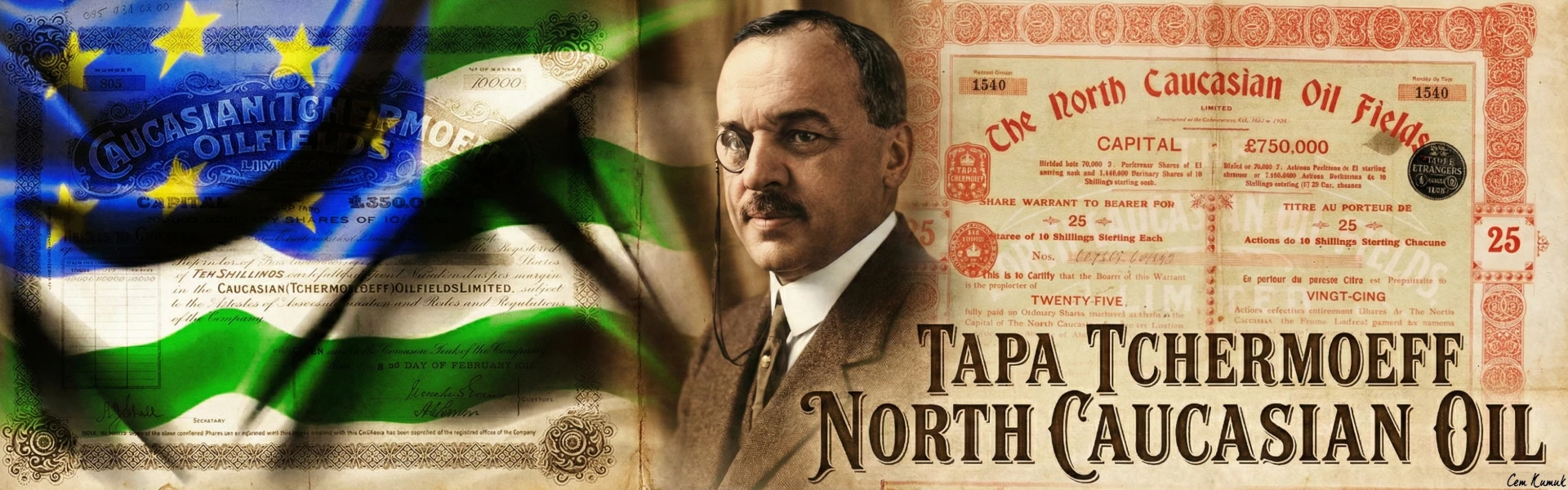
During the final week of January this year, I published an article on our website detailing the financial contributions briefly provided by the oil-rich Tchermoeff family and Tapa (Abdulmedjid) Tchermoeff to the North Caucasian struggle for liberty and statehood. I shared documents revealing the deterioration of Tapa Tchermoeff's personal life and political trajectory during his exile in Paris, alongside testimonies from his comrades regarding his shifting attitudes.
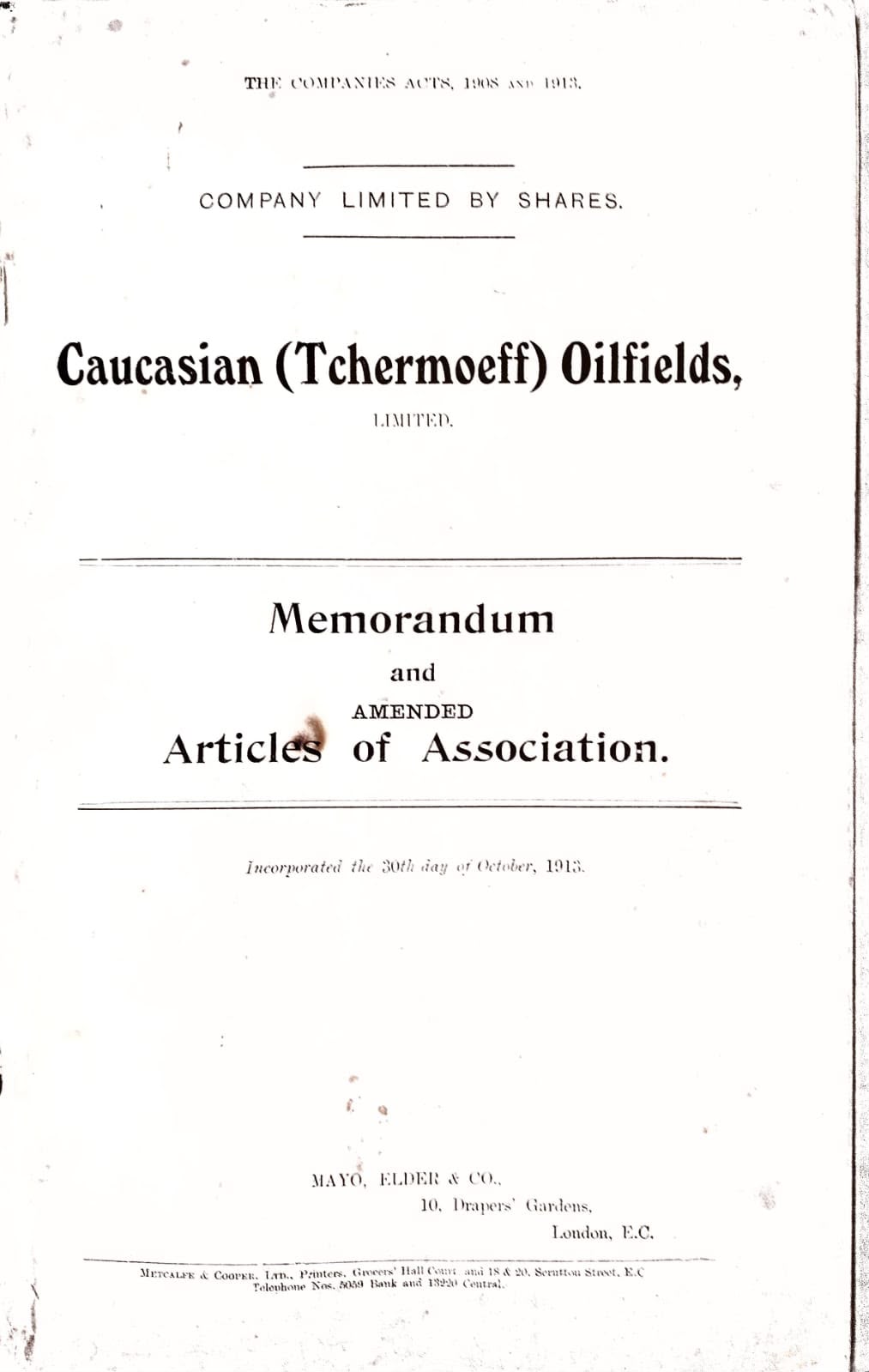
Traps to Control OilWithin these documents, you will find detailed information concerning the wealth and assets of the Tchermoeff family—who had become a legend in the North Caucasus—as well as specifics regarding the Grozny oil fields and their subsequent sale. Furthermore, the archive contains legal records detailing Tapa Tchermoeff's abuse of power of attorney granted by family members, and the consequent lawsuit filed against him by Mohamed Tchermoeff.
According to the allegations of his family members, Tapa Tchermoeff utilized his power of attorney to alter the corporate charter of the family’s oil company without consultation or consent. The revised bylaws consolidated the company entirely under his unilateral control. In his capacity as Chairman of the Board, Tapa Tchermoeff possessed the authority to confiscate the shares of dissenting heirs (Article 29), obstruct share transfers and inheritance procedures (Articles 35, 41), allocate himself remuneration and fringe benefits free from any oversight (Articles 106, 136–139), and conceal financial records and expenditure disclosures (Article 178). These statutory provisions constituted legal evidence substantiating Mohamed Tchermoeff's claims that Tapa Tchermoeff had deliberately restructured the enterprise to misappropriate the family inheritance.
A striking document dated January 1921 reveals a previously unknown Financial Agreement. Drafted in London on January 28, 1921, and notarized in the city's financial district, the contract's signatories included Tapa Tchermoeff—acting both on his own behalf and for his elder brother, Abdulmuslim—alongside a hitherto unheard-of French corporation he established in his own name, and a British company formed specifically to execute this agreement.
The aforementioned contract exposes vast financial sums, amounting to hundreds of thousands of pounds sterling at the contemporary exchange rate, and contains exhaustive details regarding oil rights in the Grozny and Novye-Aldy regions. These were the exact territories stipulated in the 1874 cadastral registry and the 1913 articles of incorporation of the British enterprise. The document serves as critical evidence linking the 1920 sale to Royal Dutch Shell with Mohamed’s allegations during their years in exile. It demonstrates that Tapa Tchermoeff orchestrated highly capitalized international commercial ventures across France and Great Britain, the valuation of which exponentially exceeded the annual 10,000 rubles he was obligated to remit to the heirs. This contract seamlessly complements the rest of the document collection, standing as a vital primary source for researchers.
Furthermore, the collection includes two receipts dated May 18, 1920, documenting substantial payments issued to Tapa Tchermoeff from the Trust Franco-Belge des Pétroles in Antwerp. These confirm that he received considerable funds during the establishment of the Trust, sums derived directly from the March 1920 sale of oil shares to Sir Henri Deterding, head of Royal Dutch Shell.
Family Feud Over a FortuneAnother pivotal document in the collection elucidates the legal catastrophe that befell Tapa Tchermoeff when his powers of attorney were formally revoked in 1930. According to a bailiff's decree dated October 3, 1930, Emilkhan and Zeynep Tchermoeff, acting as heirs to Abdulmuslim Tchermoeff, annulled the proxies they had previously granted to Tapa. A letter Emilkhan, Abdulmuslim’s son, wrote to the public prosecutor indicates that in 1934, Tapa Tchermoeff was sentenced to imprisonment for breach of trust and ordered to pay restitution of a substantial sum. Using this document as a kick-off point, researchers could trace the proceedings of this case within the archives of the French Ministry of Justice to acquire more profound insights into the matter.
Beyond these, the collection includes various records of extravagant consumption, illustrating Tapa Tchermoeff and his family's penchant for an opulent lifestyle. Notable among these are receipts and invoices linked to the Hotel Magellan, exclusive equestrian clubs frequented by the French elite, the 3-Michelin-starred Restaurant Larue, the Boucheron luxury jewelry house, and a custom-designed Rolls-Royce automobile.
Following the publication of the previous article, I received vehement backlash from certain factions intent on reducing our history to mere heroic rhetoric. Flinging reckless criticisms predicated on the logic of "It was his own money, he could spend it as he wished," these circles attempt to dismiss the issue as mere envy of the wealthy. However, as I have emphasized previously, the objective is not to pursue a tabloid sensation criticizing an individual's personal fortune or lifestyle. The core issue is the failure of a self-proclaimed leader of the national liberation movement to honor his commitments—specifically, an individual who signed the resolutions of the Andi Congress, pledging to utilize his personal wealth for the betterment of his people and state. Otherwise, private and familial matters fall well outside the purview of Historical Memory the North Caucasus project.
Tapa Tchermoeff’s ambitious character and the Republic of the Union of United Mountaineers of the North CaucasusCertainly, Tapa Tchermoeff’s sponsorship of the 1917 congresses aimed at reviving the national spirit, alongside his financial contributions to the North Caucasian Republic's delegations in Trabzon, Istanbul, Batumi, and Paris between 1918 and 1919, are sufficient grounds for our gratitude. Indeed, despite his complete lack of knowledge and experience in statecraft and diplomacy, his contemporaries entrusted him with the inaugural Premiership of the North Caucasian Republic. However, he executed the duties of this office with the disposition of a commercial proprietor, precipitating profound crises during a highly precarious period for the nascent state. Guided by a transactional ethos—essentially, "I provided the capital, therefore I dictate the terms"—he enacted unilateral decisions without consulting his cabinet colleagues, which engendered severe complications, most notably within the diplomatic sphere. Consequently, owing to the enduring sense of gratitude harbored toward Tapa Tchermoeff, when Mustafa Butbay’s Kafkasya Hatıraları (Memoirs of the Caucasus), which chronicles the years 1917–1920, was published in 1990, certain passages within the text even provoked in us a degree of adverse skepticism toward Butbay himself:
"Abdulmedjid [Tchermoeff] is Chechen. Having served as an aide-de-camp to Emperor Nicholas, he is a frivolous prince who owns oil wells in Grozny, has assimilated into Russian culture, and is prone to pleasure and amusement. He is, however, supportive of Caucasian independence, provided it does not disrupt his comfort and tranquility. He harbors the notion of reliving the grandeur and magnificence of the imperial era through his presidency. [...] The North Caucasian delegates were not remiss in conducting politics in the halls of the Pera Palace and the boulevards of Paris, expending one lira per hour per person, and they did not hesitate to squander the borrowed 40 million rubles in places of pleasure and entertainment. Only with the ten thousand liras obtained from the Minister of National Defense, Enver Pasha, did Aziz Meker, Haydar Bammat, and Agayev travel to Switzerland; utilizing these funds, they resided in Switzerland for six months, printing maps and books, and publishing newspapers. The European press and political elites were thereby appraised of the existence and initiatives of the North Caucasian Government. Of the funds that passed into the hands of the intelligentsia, only this sum was duly expended for a beneficial cause. Even out of the 37,000 francs held by the delegates returning to Paris, 20,000 francs were squandered by the President, Tchermoeff."
Statements found in letters from devoted advocates of the contemporary liberty movement, unearthed from Haydar Bammat’s personal archive, align corroboratively with Butbay’s accounts. While Tapa Tchermoeff and his inner circle lived an ultra-luxurious existence in Paris utilizing the treasury registered as the "Wealth of the People" at the Andi Congress, the modest requests of political refugees suffering in destitution in Istanbul were outright rejected.
Emerging from obscurity after many decades, these documents delineate yet another profound historical fallacy. Given that the materials provided by our French source substantiate the realities documented in previous archives, it has become imperative to situate Tapa Tchermoeff in his rightful place before the judgment of history.
I can already anticipate the murmurs of the heroic rhetorical chorus. Let them murmur. What matters most is that our children learn their history accurately, rather than chasing after false heroes and those who usurp the labor and roles of others.

Istanbul, 21 September 2026