
 Türkçe
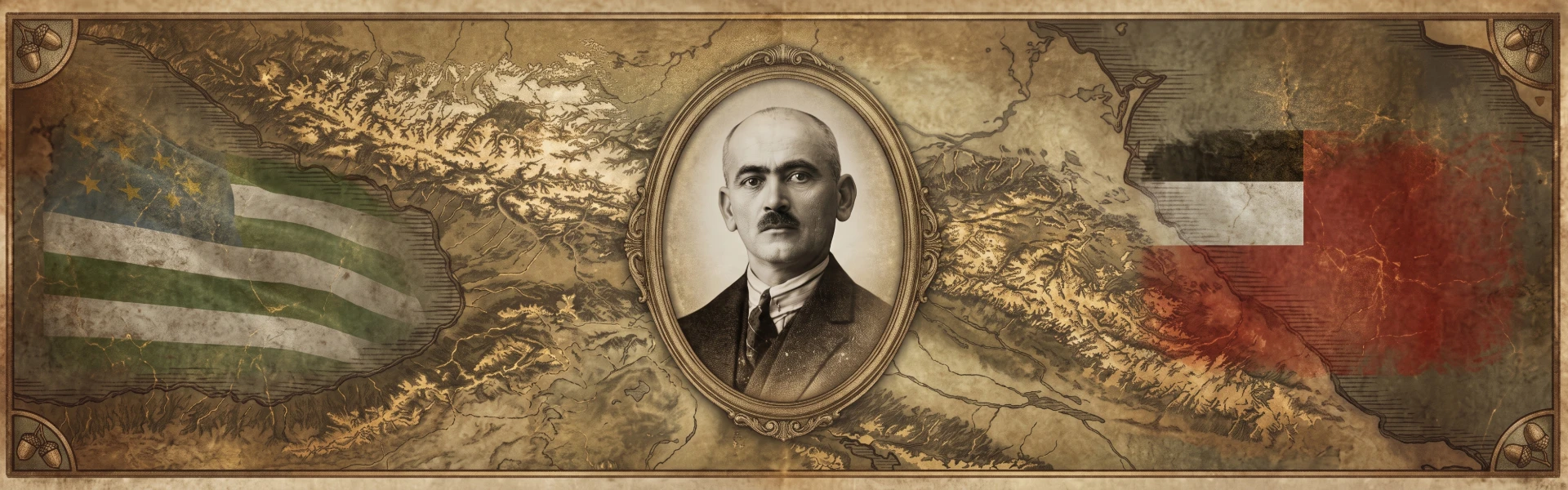
In commemoration of the 33rd anniversary of Abkhazia’s independence, I invite the indoctrinated youth of contemporary Georgia to seek the guidance of history by drawing upon the memoirs of an authentic Georgian nationalist.
Shalva Amirejibi, an earnest Georgian nationalist who dedicated his life to the liberty and sovereignty of the Georgian homeland, articulated the following in an essay titled “From the Unfinished Past,” penned to commemorate the 11th anniversary of the declaration of independence of the Republic of the Northern Caucasus:
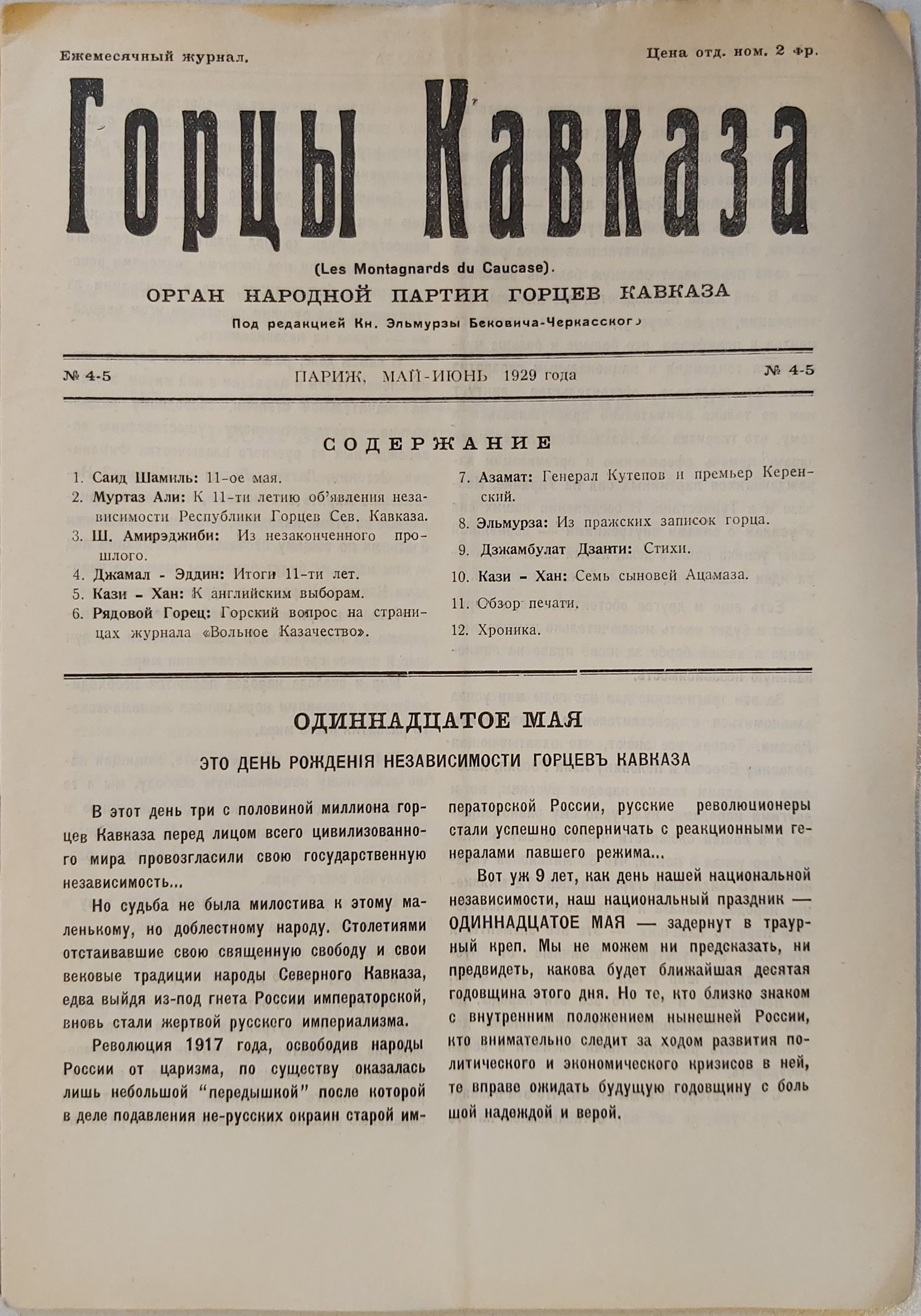
In 1917, my Georgian friends and I had occasion to travel to the North Caucasus twice: once in May, and again in August. In the month of May, four of us undertook the journey: D. Vachnadze, P. Ingorokva, Sp. Kedia, and the author of these lines. Naturally, we possessed no official mandates from Georgia; we were dispatched by our National Democratic Party for the purpose of establishing relations with the political circles of the Mountaineers, and thereby with a populace yearning for independence.
Fraternal disposition toward representatives of the entire Georgian nationThe Mountaineers immediately demonstrated their fraternal disposition toward us when they received us as representatives of the entire Georgian nation, thereby significantly elevating us in our own estimation. For my friends and me, this was the inaugural opportunity for close acquaintance with the Mountaineers, a chance to heed the beating of their hearts, which were then, as they are now, so deeply akin to our own.
Our first journey was to Vladikavkaz. It was spring. D. Vachnadze’s small "Ford," adorned with the red flag of the "great, bloodless" February Revolution, sped us along the picturesque Georgian Military Road. The shaded banks of the Aragvi, the impetuous and roaring Terek, the eternally white Kazbek, and subsequently the formidable Darial Gorge, produced a mesmerizing and multifaceted impression. By the time we emerged from Darial into that gradually widening valley where the Terek becomes tame, and its banks are clad in the verdant vestments of spring, Vladikavkaz was already near. It opened its gates to us in the evening twilight.
In Vladikavkaz, we were hosted by Abdul-Medjid-Bek Chermoev. Within the opulent chambers of his residence, we first became acquainted with the Mountaineers’ statesmen—Kotsev, Shakhanov, Prince Kaplanov, and others—engaging in discourse, mutually sharing the sentiments of our peoples, and prognosticating the consequences of the Great War. During those same days in Vladikavkaz, a congress of delegates of the Mountaineers was convening in the city theater, and our hosts were obliged to divide their time between the congress, where they were the principal figures, and us. We abstained from making an appearance at the congress. During that era, all congresses and public assemblies of non-Russian peoples transpired beneath the vigilant surveillance of the February Revolution, and freedom for us Caucasians was merely relative. Furthermore, specific individuals had been officially delegated to this congress, and presenting ourselves there did not fall within the purview of our objectives. It is not devoid of interest to mention an occurrence at this assembly. When Georgians appeared there, a tempest of enthusiasm swept through the entire theater; the presiding officer suspended the session, and the mullah recited a prayer for Georgia, which the congress heard standing.
This was the first and nationwide manifestation of the fraternal sentiments of the Caucasian peoples. However, one must also remember that this occurred at the very "dawn" of the February Revolution, when it still entertained the notion of a "united and indivisible" Russia, and when the entirety of the Caucasus was constricted within the ring of bayonets of the million-strong Russian army of the Caucasian front. Such a confluence of the emotions of the Caucasian peoples as occurred at this congress could have precipitated premature complications.
This elucidates why the second congress of the mountain peoples was scheduled far from this "eye"—in Andi, on the border of Chechnya and Dagestan, in that historic expanse of Mountaineers’ territory where the great Shamil succeeded in establishing his prolonged stronghold for his wars against Russia.
Fortune favored me, and I managed to attend this congress as well. D. Vachnadze was absent, but present were S. Kedia, P. Ingorokva, General I. Dzhaparidze, and the now-deceased Prince D. Mikeladze. The railway journey via Baladjary - Derbent - Gudermes was exhausting. The inspection of documents, verification of mandates, and various credentials was evidently a hallmark of any revolution, be it "October" or "February." Even now, I cannot fathom how everything was found to be in order on our end, for none of us was a member of any soldiers', workers', or peasants' organizations, but rather, on the contrary, all were individuals from the "arch-bourgeois" party in Georgia.
Yet, from Gudermes onward, we traveled as guests of the Mountaineers and as representatives of the Georgian people. We were welcomed, escorted, and surrounded by a convoy. The journey to Andi lasted several days, and we delighted in both the blindingly magnificent nature and the wondrous weather. We traversed the renowned Vedeno, journeyed through the whole of Chechnya, and the closer we drew to Andi, the more equestrian and pedestrian individuals we encountered, traveling—where? To Andi! But who were they—this multitude of people; could they all be delegates? Imagine! Following the delegates, the populace itself was drawn along. When we finally approached Andi, twenty thousand people met us there. This was no longer a congress of delegates. In Georgia, this phenomenon is termed "a man for every hat!"
For us Georgians, this was not only magnificent but instructive!It was an authentic encampment, where tents were innumerable, and horses, freed from their saddles, grazed in entire herds on the alpine meadows of Kerket. This entire resplendent throng of humanity clamored, sang songs, moved about, visited one another, inspected steeds, tested weaponry, and above all this fluttered the multicolored banners of the Mountaineers. For us Georgians, this was not only magnificent but instructive. We ourselves hailed from a revolutionary country. Georgia, too, was seething and agitated. But how could our Georgian banners, bearing the visages of Marx and Engels, compare with the sacred antiquity of the Mountaineers’ standards that had seen battle in the wars of Shamil? It was unequivocally clear to us that here stood a people possessing a centuries-old contemplation of liberty, bearing eternal, immutable relics of struggle.
Yet, one cannot speak of the Mountaineers without recalling the beauty of their mountainous nature. This breathtaking spectacle unfolded above Ezenam. Ezenam is a captivating alpine lake on the border of Chechnya and Dagestan, near the Kerket Pass toward Andi. By day, its pristine waters reflect the profound depth of the celestial azure, and by night, the stars and the moon gaze upward from within. Who shed this tear at such an altitude? What gigantic eye, what sorrowful eyelash?!
And it was here, amidst this majestic nature, in this reinvigorating mountain air, during this review of the popular will and national forces, that the idea of Mountaineers’ independence was solidified, although no actual congress took place—for, one must agree, amid such a confluence of people, organizing one would have been rendered meaningless. We descended to Vedeno, where the delegates of the mountain peoples could more effectively deliberate and delineate the milestones of their homeland's future destiny. We remained in Vedeno for nearly a week and returned to Georgia, emboldened by what we had witnessed and imbued with the hope that the cherished aspirations, of which the Mountaineers' hearts and ours dreamt, would soon come to fruition.
To the Mountaineers belongs the unfading glory that, among the Caucasian peoples, they were the first to declare independence. The Republics of Georgia, Azerbaijan, and Armenia followed slightly later. I still recall the jubilation that the tidings arriving from the Mountains elicited in Tiflis. In Georgia, it was understood that the curtain had been raised, and following the first act, the remainder must inevitably play out.
Our fortune lies in the fact that the curtain has not yet been lowered, and life shall continue to perform this drama until freedom, freedom, and freedom triumphs!That was eleven years ago. I am not saddened by the fact that these "acts" proved far more numerous than we had anticipated at the time, nor that the inception of the glorious days of our freedom was succeeded by a protracted sequence of bitter scenes and sanguinary episodes, a temporary eclipse upon the historical stage of the Caucasus. Our fortune lies in the fact that the curtain has not yet been lowered, and life shall continue to perform this drama until freedom, freedom, and freedom triumphs!
The Mountaineers’ state described by Shalva Amirejibi was the very entity of which the Abkhazian People's Council became a constituent part of its own free will. This Mountaineers’ state, as described by Amirejibi, was the same territory that Menshevik Georgian forces attempted to occupy in June 1918. Amirejibi endeavored to defend his homeland not solely against Bolshevik Russians, but also against the devastation wrought by Menshevik Georgians. Among the cohort chronicled in his memoirs, alongside other genuine Georgian nationalists such as Spiridon Kedia and David Vachnadze, there also emerged racist figures like Pavle Ingorokva—individuals from within that very same faction who would later categorically deny the existence of the Abkhazian people.
Today, the representatives of an ideological synthesis combining Bolshevik Russian and Menshevik Georgian paradigms—who currently control the Tbilisi administration—condemn the Abkhazian question to an intractable impasse through the artificial ethnic doctrines they promulgate. Consequently, with each passing day, they compel Abkhazia to drift ever deeper into a Russian quagmire.
Under such circumstances, it is impossible not to commemorate Georgians like Shalva Amirejibi with profound nostalgia.
Once, we too had true Georgian friends...

Istanbul, 30 September 2026