
 Türkçe
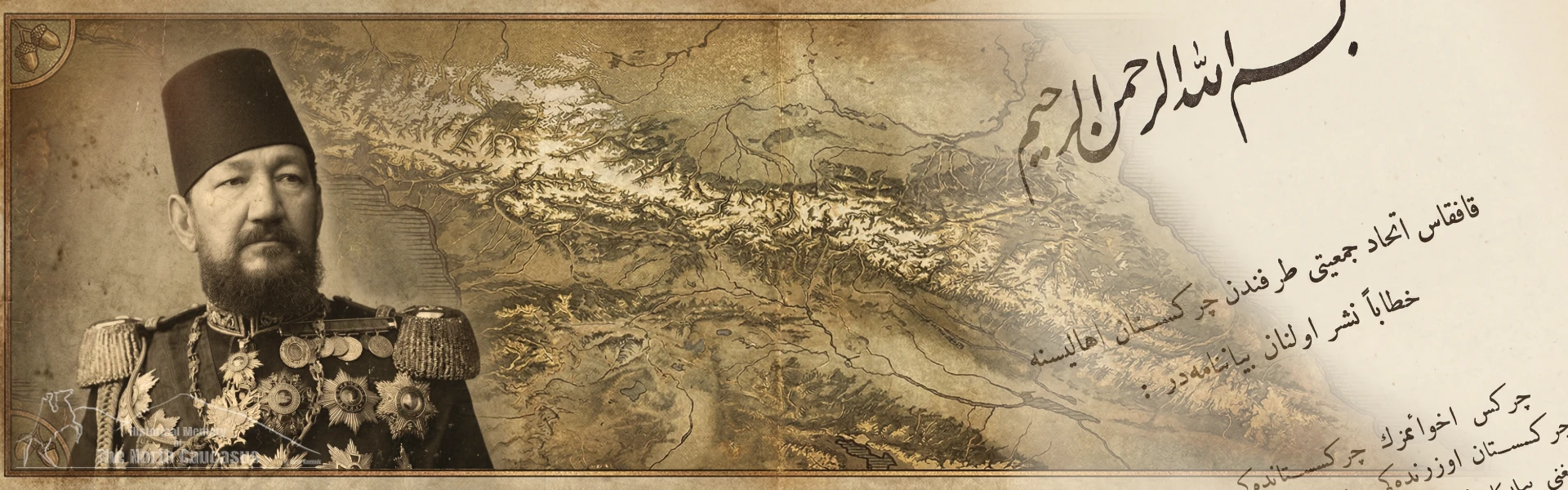
From the outbreak of World War I until early 1917, members of the Caucasian Committee—who had undertaken diplomatic initiatives in the capitals of the Central Powers, such as Vienna and Berlin, advocating for the liberty and independence of the Caucasian peoples living under the yoke of the Russian Empire—were compelled to recalibrate their political strategy in accordance with Caucasian realities following the February Revolution in Russia and the subsequent abdication of the Tsar. Non-Russian subjects of the empire were expected to exercise their right to self-determination based on the resolutions anticipated from the planned convening of the All-Russian Constituent Assembly. At the All-Russian Muslim Congress, convened in Moscow on May 1, 1917, the representatives of these peoples advocated for a model of a union of states featuring extensive autonomy within a democratic and federal Russia, rather than pursuing objectives such as absolute independence or full sovereignty. The Central Committee and the Provisional Government of the Peoples of the Northern Caucasus were proceeding along a similar political trajectory.
The previous political paradigm—which had been predicated upon the establishment of a fully independent republican model under the auspices of the Ottoman Empire and the formation of a confederation of Caucasian republics that would also encompass the peoples of Transcaucasia—underwent a profound transformation due to the burgeoning socialist ideals in Russia and Transcaucasia. Consequently, it began to evolve toward a vision wherein non-Russian peoples aspired to forge a "United States" out of a "Free Russia."
Fortuitously, the All-Russian Constituent Assembly never convened, and no concrete measures were enacted regarding the self-determination of non-Russian subjects of the empire; by early 1918, the Northern Caucasus had resolved to determine its own fate. Today, I present to historians and researchers, from the dusty shelves of the archives, a manifesto that is the direct product of this very movement—a movement captivated by the illusions of the February Revolution and the dream of a democratic and free Russia, which ultimately forced the Caucasian Union Society in Istanbul to revise its political stance temporarily.

Istanbul, 24 July 2026
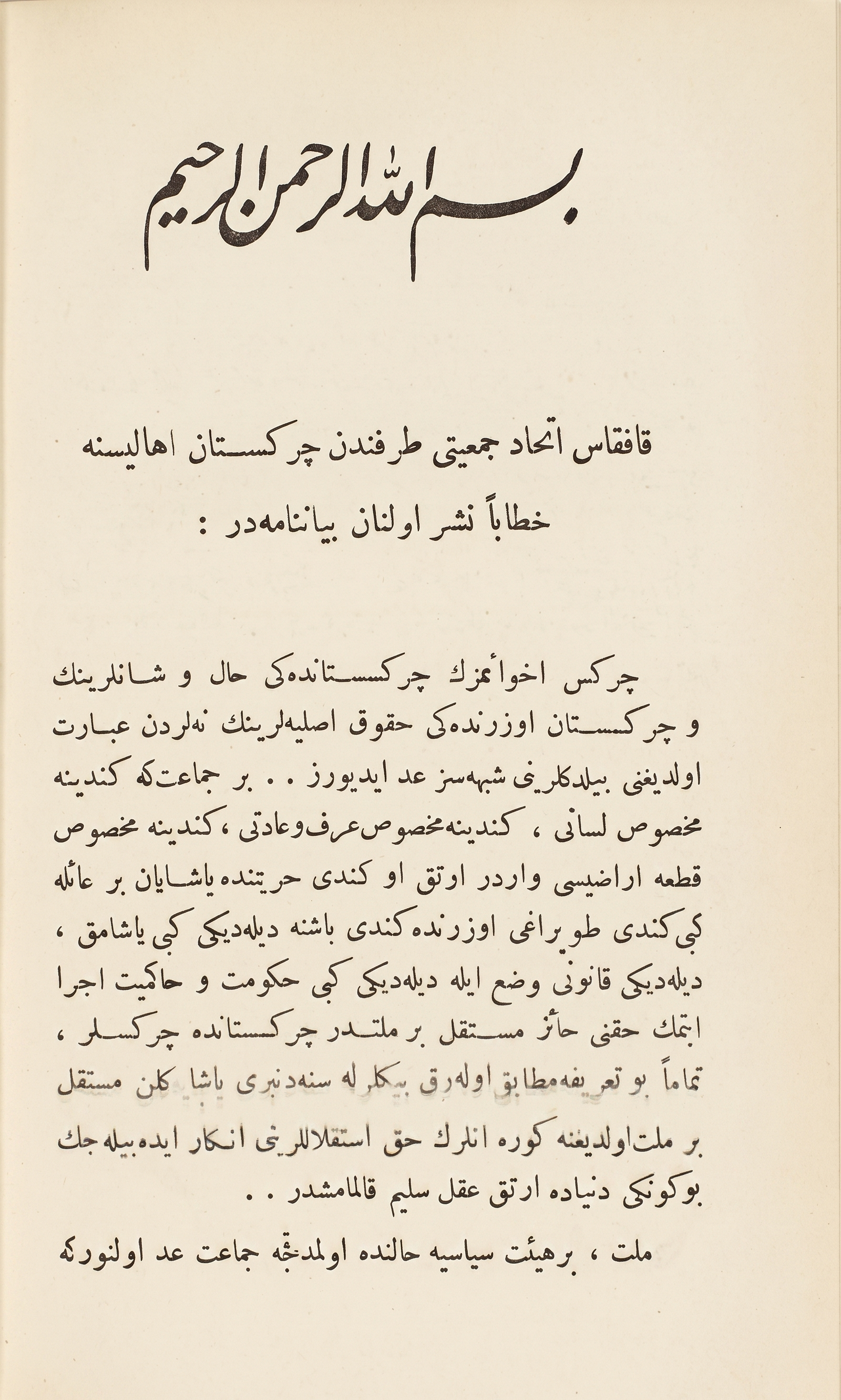
Declaration Issued by the Committee for the Caucasian Union Addressed to the Peoples of CircassiaIn the Name of Allah, the Most Gracious, the Most Merciful.
Our Circassian brethren! We presume, without a doubt, your profound awareness of your current condition and dignity in Circassia, as well as the fundamental rights you possess over the Circassian homeland. A community distinguished by its own unique language, customs, traditions, and a distinct territorial domain constitutes an independent nation. Much like a family residing in its own sphere of liberty, such a nation possesses the inherent right to live freely on its own soil, to legislate as it deems fit, and to establish its own government and sovereignty. Given that the Circassians have existed in Circassia for millennia as an independent nation perfectly embodying this definition, there no longer remains any rational basis in the contemporary world to deny their right to independence. A nation is regarded merely as a communal gathering until it assumes the form of a political entity...
A nation, presumed to hold the highest value among human societies, must above all crystallize into a political structure to assert its existence. To assume a political structure means that the community establishes a self-governing administration, convenes a representative assembly to legislate the laws applicable within its territory, and institutes courts and an executive body to enforce these laws. Furthermore, it necessitates the presence of executive apparatuses such as an army, a navy, a judiciary, a gendarmerie, and a police force, in addition to markers and symbols of sovereignty like its own currency and flag.
The Circassians, however, currently exist on the soil of Circassia merely as subjects of the Russian administration. Their ability to live there, to consume as they please, and to move about freely constitutes nothing more than the rudimentary liberties that any individual might exercise anywhere and at any time as a consequence of basic personal freedom. The juridical personality of the Circassian identity is entirely devoid of the attributes of nationhood, liberty, and independence. The Circassians lack a national legislative assembly endowed with the authority to enact requisite laws in Circassia; equally absent is a comprehensive governing force to execute decrees, defend the borders and tribes of the country, along with the executive instruments and their subordinate branches.
To state it clearly and accurately: The Circassian nation does not yet possess anything of its own sovereignty and national government. A century and a half ago, the Tsarist government invaded the Circassian homeland—where the Circassian nation had lived freely and independently for millennia—with its military forces, forcibly usurping and suppressing Circassian independence and sovereignty.
Following that calamitous invasion, the Caucasians, and the Circassians in particular, have been reduced to mere multitudes of captives, subjugated and deprived of their fundamental rights to independence. What the Caucasian peoples have for years resolved to reclaim and emancipate from the grasp of the Tsarist government are precisely these essential rights to governance and sovereignty. While the Caucasians were tirelessly striving toward this sacred objective, the Russian Revolution transpired, and the Tsarist government collapsed. The Tsar and his regime stood as impediments to liberty and independence. With this obstacle removed, the restoration of the prohibited independence becomes imperative. The right to freedom and independence, which Tsarism systematically withheld from the Caucasian peoples as well as from nations like the Poles and Ukrainians, has now been restored.
The vast territories under the administration known as Russia do not belong solely to the Russians. They are lands forcibly expropriated from numerous other nations and peoples. The nations within Russia that have now attained their freedom and are conscious of their right to sovereignty over their homelands will now convene; they shall draft their essential legislation (constitutions) determining how their nations and territories are to be governed, whether their governments shall take the form of republics or monarchies, alongside other crucial matters. The free Russian nation, to enable these peoples to operate in accordance with the constitutions they will now establish for themselves, shall facilitate the transition of these nations and peoples to freedom and independence without revolution or violent conflict.
Among the nations and peoples destined for independence is the homeland of us Circassians; a vast territory of two hundred thousand square kilometers encompassing four provinces and one independent sanjak [ * ]. It is our distinct homeland, usurped from no other nation, in which we have dwelled for no less than five thousand years.
[ * ] These encompass the provinces of Kuban, Terek, the Black Sea (Chernomorsk), and Stavropol, along with the Sanjak of Sukhum.
Principles of the Caucasian ConfederationThe Caucasus Committee desires that the Circassians, Georgians, and every other ethnic group possessing such an ancestral homeland and ancient territory in the Caucasus, attain independence over their respective domains. The Committee has shown no trepidation in exerting all possible efforts in this regard; indeed, it has adopted the principle of a Caucasian Confederation comprised of four states under the designations of Daghestan, Circassia, Georgia, and South-Eastern Caucasus. Regarding this framework, through the representative delegation dispatched to Europe last year, diplomatic initiatives were undertaken with the Central Powers (the Quadruple Alliance), resulting in the endorsement of the principle of these peoples forming a confederation by Germany and its allies. The primary outlines of the Committee's program, as advocated through its delegation at that time, were as follows:
- The recognition by foreign states of the independence of the territories within the Caucasus (Daghestan, Circassia, Georgia, and South-Eastern Caucasus).
- The reciprocal recognition by these states of the formation of these four independent administrations into a confederation.
- The demarcation of the northern Caucasian border along Lake Manych and the Don River.
- The designation of the Independent Caucasian Confederation with a status of permanent neutrality.
- The exemption of the Caucasus from being apportioned or burdened with any share of Russia's general public debt (Dette Publique).
It is evident, therefore, that both Germany and Britain mutually advocate for the rights of small, subjugated nations and peoples to liberty and independence. Given that we, the peoples of the Caucasus, are among those minor, subjugated populations whose cause they purportedly champion, what remains to be concluded other than declaring, "Our ultimate demand for independence has been fulfilled"?
Nevertheless, while the probability of achieving Caucasian independence through the specific diplomatic paradigms proposed during those initial initiatives has significantly diminished today, the hope for realizing this objective through internal dynamics has been reinvigorated following the collapse of the Tsarist government—the primary impediment to national freedom. It must be noted, however, that the scope and nature of this independence have evolved according to recent developments:
Before the revolution, the adversary of independence and liberty was the Tsar and his government. At that time, independence necessitated the violence and tragedies of revolution, rendering our secession from Russia an absolute imperative. Now, however, the revolution has eradicated the Tsar and his regime, the enemies of independence, thereby eliminating the necessity for revolutionary violence, its attendant tragedies, and consequently, formal secession. It is for this reason that we now proclaim, fearlessly and without apprehension, at the top of our voices to the entire world:
We shall all become an independent and republican state! However, none of us shall secede from the federal and democratic "United Republics" that a free Russia seeks to establish. Let the small and large peoples, whom Tsarism chained together through coercion and massacre, now form a republic... Let these small and large republics subsequently confederate, mirroring a united America!
It remains possible, however, that the populace in Russia may fail to expand national liberties to such an extent. In that eventuality, the programmatic objective of the Circassians is to secure an exceedingly broad autonomy for the Circassian people within Circassia. An autonomy of such a degree that the pre-independence status of Bulgaria serves as the primary archetype for our Circassian autonomy. I reiterate: If outright independence becomes structurally impossible, we shall adopt the pre-independence paradigm of Bulgaria as our model. This is the highest, most rational principle we have accepted as the one most congruent with our national aspirations!
Five Principles to be Pursued on the Path to IndependenceThere are myriad actions to be taken and multiple trajectories to be pursued to secure this most sacred demand for independence. Should we fail to properly execute the tasks within our capacity while navigating this path, we shall forfeit the opportunity. Therefore, it is the solemn obligation of the nation to expedite the prudent implementation and fulfillment of the following provisions:
— First: All Circassians in Circassia must fervently support the Circassian Committee—established in Circassia as the local branch of the Caucasus Union Committee, which was founded to strive for a confederation alongside the independence of the Caucasian peoples. It must be unequivocally understood that the Circassian Committee is not a revolutionary vanguard intended to engage in armed insurrection against the Russian administration. It has dedicated its efforts solely to securing communal benefits through the utilization of laws they intend to establish autonomously. As long as this endeavor remains strictly within the realm of political ideals, there are no legal grounds to incriminate its proponents; hence, there is no possibility of criminal liability being imposed upon the Circassians for these political initiatives.
— Second: Because the central Committee collaborates with pro-liberty and pro-republican political parties in Russia, as well as with Finnish and Ukrainian committees, it is imperative that the Circassian Committee also ally with them and strive to secure electoral majorities. It is both the right and the duty of the Circassians to ensure they have parliamentary representatives in the constituent assembly, and subsequently in the National Assembly, and to demand that this representation be proportional to the overall Circassian population.
— Third: There are concessions, such as the formation of a Muslim army or the distribution of land, that the Russian administration will promise to pacify and divert the populace. In the face of the paramount issue of independence, such matters are merely subsidiary details. Even if the Russian administration concedes to such specificities, it would not manifest an iota of Circassian sovereignty. Once the Circassians attain the liberty to govern their homeland as they see fit, they will possess the legislative capacity to autonomously enact the laws required to establish their military, distribute their lands, or organize their educational institutions. The fundamental priority is to first establish our own government in Circassia. We shall build the army thereafter; we shall deliberate upon and distribute the land thereafter. Whatever is necessary, the Government of Circassia, established by the nation, will subsequently execute it.
— Fourth: The endeavor for independence is of such profound importance and honor that, while other nations deem it necessary to shed immense blood to elevate their governments, one must deeply reflect upon the existential necessity of the Circassian nation establishing its own. In this world, every undertaking is entrusted to those qualified. What profound administrative wisdom resides in the Hadith: "When authority is entrusted to those who are unfit, then await the Hour (the Day of Judgment)." In theological matters, we must defer to the religious scholars (ulema); however, in contemporary political affairs, we must privilege the perspectives of enlightened statesmen possessed of political expertise. Let the scholars, the tribal leaders, and the entire populace follow the enlightened vanguard in this vital enterprise, and let them not stand in opposition. Otherwise, progress will stagnate, and eternal condemnation will burden the necks of those who obstructed it.
— Fifth: It is a binding obligation upon all Circassians to support the activities of those who have resolved to achieve this supreme goal of independence, which constitutes the honor of the nation. Tendencies and actions to the contrary represent the most abhorrent of tyrannies and crimes. Even if an individual is unable to actively support this duty, they may stand aside, refraining from any covert or overt rhetoric and action that might impede the Committee's efforts. However, should they not only shirk this duty but also commit the crime of erecting obstacles against the Committee’s national endeavors, their actions shall be construed as an assassination attempt against the very life of the entire nation. Consequently, even executing the perpetrator of such a heinous crime would not constitute a sufficient penalty for their transgression.