
 Türkçe
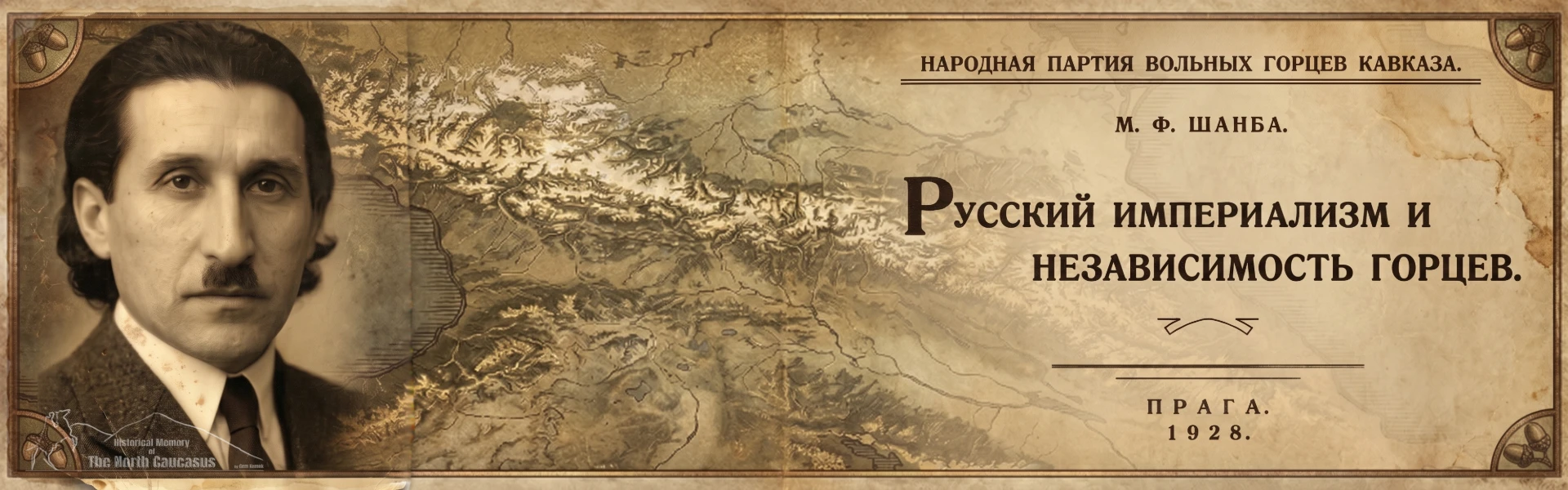
Mehmed Fetgerey Shoenu emerged as a prominent figure within the Turkish echelon of the anti-Soviet North Caucasian political emigration movement, which flourished during the first half of the twentieth century. This distinguished intellectual of Abkhazian descent secured a profound place in the collective conscience of both the North Caucasian diaspora in Turkey and the broader Turkish public. This recognition stemmed from the memorandum he submitted to the Grand National Assembly of Turkey (TBMM) in 1923, vehemently protesting the tragic mass deportation of the Gönen and Manyas Circassians to the Anatolian interior.
The 1926–1927 period was characterized by intense factional struggles, as various groups vied to monopolize the representative authority of the North Caucasian political emigration. During this era, Czechoslovakia under the administration of Tomáš Masaryk and Poland under Józef Piłsudski initiated sponsorship programs for anti-Soviet movements, often ostensibly functioning as university scholarships or under other institutional guises. Notably, the government of the Second Polish Republic, through the Promethean movement cultivated under its aegis, had consolidated control over the socialist (Menshevik) factions of Georgians, Azerbaijanis, and various Eastern European and Baltic nationals who had been rendered political refugees following the Bolshevik occupation.
Given the absence of a substantial Menshevik movement within the North Caucasus, Poland opted to support former members of General Denikin’s Russian Volunteer Army rather than the nationalist-democrat politicians, whom Warsaw found less amenable to manipulation. Consequently, rather than backing independent entities such as the Union of Caucasian Mountaineers or the Revolutionary-Democratic Mountaineers’ Party in Prague—which had successfully resisted Polish subjugation—they directed their patronage toward the Popular Party of Free Mountaineers of the Caucasus, an organization they had instigated under the leadership of Said Shamil.
Influenced by certain opinion leaders within the Turkish émigré community and the impassioned propagandist rhetoric of Said Shamil, Mehmed Fetgerey Shoenu aligned his political allegiance not with the nationalist-democrat factions, but rather with the Popular Party of Free Mountaineers of the Caucasus, which essentially functioned as the Caucasian branch of the Polish-directed Promethean movement. Composed predominantly of remnants from the Russian Volunteer Army and lacking a coherent political doctrine, this party attempted to co-opt the political platform of the federalist-nationalist cadre. This latter group—comprising intellectuals such as Haydar Bammat, Alikhan Kantemir, Vassan Girey Jabagi, Pshemaho Kotse (Kosok), and Aytek Namitok—was structurally inhibited from conducting robust publication and propaganda campaigns at the time due to severe financial constraints.
The most compelling evidence of this ideological usurpation manifested in subsequent years: when the genuine proponents of the confederation ideal began to amplify their voices, the party executed an abrupt ideological pivot from federalism to a stringent centralist policy. Shoenu did not live long enough to witness these developments, having tragically perished at a young age in 1931 as the victim of an orchestrated conspiracy.
In essence, Shoenu was advocating sound principles within a structurally flawed medium. As one of the few genuinely sincere patriots within the party's ranks, he delivered a fervent speech at the party's Prague headquarters on May 11, 1927, commemorating the ninth anniversary of the declaration of independence of the Republic of the Union of the Mountaineers of the North Caucasus. This address was subsequently translated into Russian and published by the party leadership. Because the original Turkish manuscript of this speech is no longer extant, I am compelled to share it with you by reverse-translating the published Russian rendition back into modern Turkish.

Istanbul, 20 July 2026
On the occasion of the ninth anniversary of the declaration of independence of the Republic of the Mountaineers of the North Caucasus on May 11, 1927, a solemn session of the Popular Party of Free Mountaineers of the Caucasus was convened.
At this session, M. F. Shanba delivered a speech in the Turkic language, which, by a resolution of the assembly, is published in translation as a separate pamphlet.
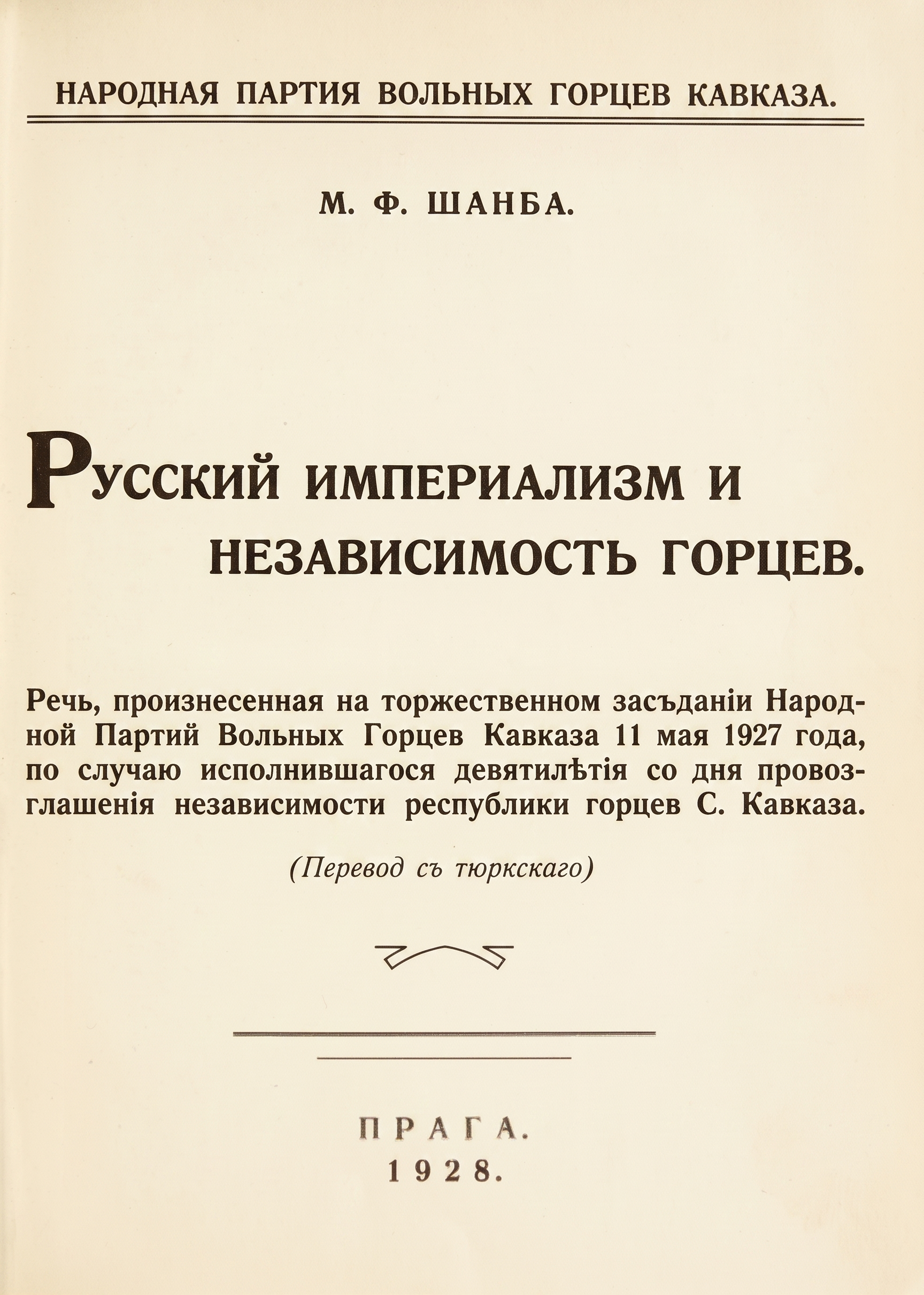
SPEECH BY M. F. SHANBA [Shoenu]Dear Compatriots!
May 11 is the day when the Mountaineers of the Caucasus formally proclaimed their state independence. It is the day when the fraternal tribes of the North Caucasus unfurled the banner of freedom, uniting into a federative republic.
I believe that nine years ago, on this day, in a country inherently freedom-loving yet oppressed, in a country thoroughly saturated with the scent of blood and gunpowder, the hearts of all mountain peoples from the Caspian to the Black Sea beat in unison with joy to celebrate their freedom—the day of the proclamation of their state independence.
The star of freedom had finally dawned! It appeared as a glimmer of light in the dark night over the peaks of the Caucasus, which had been cast in shadows for 70 years under the Russian yoke... And it was a yoke with which the Mountaineers never reconciled, for throughout the 70 years following the great Caucasian wars, the struggle against Russian domination never ceased, adopting various forms at various times.
This is a page in a historical drama that chronicles the endless clashes of coercion against justice, of brute force against dignity; it recounts the unprecedented conflagrations that, for 150 years, scorched and devastated village strongholds (auls) and hitherto flourishing valleys.
The hostile encirclement gripping the mountains closed ever tighter. Thus, in the middle of the last century, the free and independent North Caucasus became the captive Caucasus. The predatory imperialism of the northern neighbor had triumphed. To satisfy these imperialist appetites, a sea of Mountaineer blood was spilled. The Mountaineers were stripped of their freedom and their lands!
For the Russian conquerors, this was a triumph. They celebrated in a country ruined and laid waste by fire and sword, where hundreds of thousands of people had been exiled from their native gorges. For the Mountaineers, however, the loss of freedom and independence heralded an era of destitution, oppression, and enslavement.
The Enduring Spirit of IndependenceDespite this tempest of calamities, the Mountaineers did not lose faith in the future.
The memories of the bygone struggle, which spanned a century and a half, are enshrined in the memory of the Mountaineers. The love for freedom and independence is glorified in folk songs. The endless exertions of Russian armies, Russian gold, and Russian intrigues conquered the Mountaineers, but did not subjugate them. The Mountaineers never ceased to envision the restoration of their freedom and independence. It suffices to point out how negligible the results of the Russian government's Russification efforts were over 70 years of rule in the North Caucasus. The number of Russified Mountaineers does not amount to even one per year. Does this not prove how potent the faith was in the possibility of a holy vengeance, the vengeance of history! And history has already delivered this retribution. It remains for us to draw the logical conclusions from it.
"To live is to know how to die!" our glorious fathers used to say. "He who is incapable of dying with honor is incapable of living with honor." And this capacity, which was inherent in our recent ancestors, we must preserve. Let us believe that the love for freedom, for the liberty of the mountains, will not dry up within us and will ultimately lead to the triumph of law and justice—to our freedom and independence!
The Brief Dawn of the Mountaineers' RepublicNine years ago, on May 11, 1918, after 70 years of enslavement, the never-extinguished hope and faith of the Mountaineers were realized, and the banner of freedom and independence began to wave proudly over our land. Our motherland was fortunate not merely because of this. She was fortunate because, for the first time in the history of the peoples of the North Caucasus, a complete unification of the fraternal tribes, who had nested since antiquity in the territory between the two seas, was achieved.
It is well known that the geographical position of the beautiful and rich Caucasus, surrounded by Russia, Turkey, and Persia, resembles a deep spring, a rich well, or a full-flowing stream; its waters are used to irrigate the fields of whoever manages to reach out their hands to it first...
Among the peoples of the Caucasus, there was no unity to forge the strength necessary for defense against external enemies. In the 16th and 17th centuries, a multitude of khanates existed in the southeast of the region; in the southwest, there were several principalities. In the north, on the lands of the Mountaineers proper, the situation for millennia was such that every gorge housed a separate, independent little republic.
This, inherently, served as the primary and principal cause of the ruination of the Caucasus. This fragmentation into tiny republics, this spirit of independence permeated both the character of the people and the mindset of individuals. It was a very rare phenomenon for several Mountaineers to reach a consensus.
Characterizing the Germans, Bismarck once said that if three Germans come together, they will produce four opinions. This is highly applicable to the Mountaineers of old. It was precisely this fragmentation and lack of organization that caused our downfall. History tells us of the exploits of several individuals of whom, truly, we can be proud. But these were solitary individuals. They proved to the world how the Mountaineers value and are capable of dying for their freedom and political independence.
The day of May 11 clearly proved that after 70 years of bondage, the peoples of the North Caucasus had developed and fully consolidated the awareness of the vital necessity of their mutual unification. The act of May 11, 1918, opened a new page in the history of the mountain peoples of the North Caucasus. It is an event in which the consciousness of the necessity of uniting all mountain tribes was translated into reality. This is a consciousness born among the Mountaineers from a correctly understood meaning of the word "Motherland." Through enduring and surviving suffering and trials, the Mountaineer finally came to a profound realization that his motherland has strictly delineated boundaries, within which lives a unified spirit, way of life, and mores completely distinct from the life, language, and concepts of the Russian man.
On September 20, 1917, the Second General Congress of the Peoples of the North Caucasus was convened in Vladikavkaz, at which the constitution of the Mountainous Federative Republic was drafted. From the adopted provisions, it is evident that the form of government was akin to the state structure of the Swiss Confederation, with the formation of cantons.
The Mountaineers gained the opportunity for unification and independent existence thanks to the revolution of 1917, when the foundation of the Tsarist regime, undermined by the authorities themselves, rotted and collapsed.
The Bolshevik and Imperialist BetrayalsBut what is to be done when the plot of an old fairy tale tells us that wherever a drop of a slain dragon's blood falls, a new offspring of that terrible monster is born? Thus emerged, on one hand, Generals Denikin, Wrangel, and Kolchak, and on the other, the Bolsheviks, taking up arms against the new state formations. They carried new chains and dug new graves for the Caucasian republics that had not yet had time to consolidate their strength.
The golden sun of freedom, gleaming over the mountains, was threatened with an inevitable eclipse by these hostile forces. The Allied Mountaineers' Republic, still tottering like an infant who had barely learned to stand on weak legs, was doomed to perish because Europe, failing to comprehend the events, came to the aid of the newly formed Russian power in the south. And our young republic was torn to pieces. The groans of new martyrs who fell for the freedom of the motherland, merging with the groans of old heroes, have since that day found an echo in the innermost recesses of our conscience.
When, nine years ago on May 11, independence was proclaimed, and the Allied Mountaineers' Republic was formed, offering all nationalities from the Caspian to the Black Sea a taste of the sweetness of freedom and autonomy, the Bolshevik menace was advancing from the North. The Bolsheviks' goal and task were to destroy and annihilate all social institutions, and everything held sacred by humanity. In their imperialist onslaught, they did not lag behind the figures of the Tsarist period.
The Caucasus constituted a great lure for them due to its natural wealth, fertile lands, and advantageous strategic position. They attached great importance to their advance into the Caucasus. With their flattering speeches and generous promises, they soon won over the majority of the Terek Cossacks, who dreamed of settling scores with the Mountaineers with the Bolsheviks' help. Thanks to scattered funds, the agents of Bolshevism multiplied and grew like mushrooms after rain. The Caucasian horizon was once again enveloped in storm clouds. Once again, just as 70 years prior, the people had to prepare new sacrifices on the altar of defending the motherland. The sleeves of the cherkeskas [traditional coats] were rolled up, and this time they marched to defend not only their freedom but also the Allied Republic.
A brutal war commenced with the Bolsheviks—the incoming Red Army soldiers who had settled in the North Caucasus. For many long months, until late November 1918, the republican troops of the allied government and the Mountaineer partisan detachments shed their blood for the freedom and independence of the young Mountaineers' Republic, until they had cleared Dagestan and Chechnya of Soviet units.
Hardly had the republican authority cleared its entire territory of occupiers and gained a firm footing when General Denikin waged war upon it to destroy the Union of Mountaineers before taking on the Bolsheviks. This myopic bearer of the idea of "Russia, One and Indivisible" attributed no more significance to the Bolsheviks than to a passing rain shower, whereas he viewed the Union of Mountain Peoples as more dangerous than Bolshevism to his imperialist policies. The war between the Mountaineers' Republic and the Volunteer Army was stubborn and protracted. Under the pressure of superior forces, the republican government fell in late May 1919, but the spirit of the Mountaineers and their drive to defend their independence remained unbroken. Here and there, a widespread partisan struggle raged against General Denikin; the partisans, led first by Uzun-Khadji and then by Ali-Khajhi of Akusha, expelled Denikin's units from Dagestan and Chechnya.
All this was an unexpected stroke of luck for the Bolsheviks, and they did not hesitate to exploit the situation. By telegraph, they promised to recognize the independence of the Mountaineers' Republic; but later, following the collapse of the Volunteer Army, having advanced deep into the country, they did not stop at executing Mountaineer nationalists alongside Tsarist supporters. Their policy toward the Mountaineers was no better than Denikin's.
Once again, war erupted against the Soviet power, and in the mountains of Dagestan a front was formed anew; once again the blood of the motherland's defenders flowed. With broken sabers inherited from their grandfathers and with an unshakable faith bequeathed by their ancestors, they rushed to the mountain peaks. Like falcons and eagles, they swooped down upon the enemies, adding new laurels to their former heroic deeds in their search for pathways to the triumph of truth. The drawn sabers of this handful of heroes defended the nation's honor, the nation's idea, for a long time yet to come...
The long-awaited, cherished dream of freedom was crushed. The national triumph of May 11, 1918, rose like the sun and then set, giving way to darkness.
The Bolsheviks, taught by the bitter experience of Tsarism, sought to approach the matter through different avenues. They said: "Establish your independence, culture, and freedom; all this is sacred to you, and we will help you in this." But this was all hypocrisy and deceit, so that by hiding behind these proclaimed slogans, it would be easier for them to swallow the Mountaineers whole. Where are all those grandiose promises? Where is the freedom, where are the national adats [customary laws] and traditions? What became of the promises to help consolidate independence and culture? It was all a deception to pave the way for enslavement, exploitation, and, if possible, annihilation. All these were newly forged chains of the old Russian policy, wielded by more brutal and skillful hands.
An ancient Indian legend speaks of a butterfly known as the "vismara." Upon whatever flower it lands, it immediately adopts its color and hue. Similarly, the Soviet regime, in the very early stages of its activity, proved itself a vismara. It played every melody on its flute to adapt to the circumstances. The notes of its melody intoxicated everyone, like the voice of a siren. But, alas! The unfortunate, oppressed peoples, like travelers in the desert overcome with thirst, went to them for water, and without quenching their thirst, burned in the fire!
The metamorphosis of Bolshevism, which occurred over a short span of time, is highly instructive and worthy of attention. It can be subdivided into three periods:
- In 1917, they recognized the full and unconditional right of all peoples to independent state existence, "self-determination up to and including secession." But as it turned out, in this instance they were driven by a desire (relying on national minorities) to wrest power from those who had taken the place of the Tsarist government—the bourgeoisie, nationalists, and various democratic elements.
- In 1918, they conducted propaganda in favor of transforming all non-Russian nascent states—the republics—into Soviet ones and incorporating them on a federative basis into a union with Moscow.
- The third period in the national policy of the Bolsheviks should be assigned to 1919. The Bolsheviks felt solid ground beneath their feet and openly embarked on the path of imperialist conquests.
The three consecutive periods in Bolshevik policy we have outlined have led to the simple exploitation of the peoples, just as it was under the Tsars. Now they merely await a convenient moment to strip them of their last consciousness of distinctiveness and drown them, like a drop, in the Russian sea. Mountaineers! Do not yield to beautiful speeches and do not place your trust in outward forms! Do you not know that a wolf cannot birth a lamb? Since 1917, they have continuously plied you with promises; smiling sweetly, they compel you to execute their designs with your own hands. Have you not yet recognized your false friends? Are they not the children and grandchildren of the executioners who, for a century and a half, destroyed the hearths of your ancestors and kept your grandfathers and fathers in slavery for 70 years!?
Remember well the words of a naib [deputy/commander], addressed to the son of the hero Shamil upon his return from captivity: "One cannot find a friend among enemies; a Russian cannot be a comrade!" Every Mountaineer must know and never forget this.
The Path Forward: Organization and UnityEvery nation lives by some ideal. When this ideal weakens, the nation perishes.
What was the age-old ideal of the Mountaineer? Freedom and autonomy, is it not? To achieve this ideal, strength and struggle are required. The future of nations can be inscribed by their constant aspirations. Strength is forged through unity; one can avoid ruin only by opposing force with force and possessing a readiness to shed one's blood.
Can one perceive unity, freedom, and autonomy in the organization currently proposed by the Bolsheviks to the Mountaineers? Do we not see the very same tactics of the former Tsarist government in the present subdivision of the Mountaineers into Dagestani, Chechen, Ingush, Kabardian, Ossetian, and other "autonomous" regions? All these designations are accurate, but it does not follow from this that Dagestanis, Chechens, Kabardians, and Ingush are not blood brothers capable of merging into a single, unified, allied state! One blood courses through us and we are all animated by one spirit, and this is the foundation of brotherhood. The current policy of subdividing the nationalities is aimed exclusively at sowing discord among us and subsequently exploiting this discord. The artificial fanning of hostility, the implementation of measures obstructing the unification of the mountain peoples—these are the old, long-familiar tactics of the former Tsarist government. There is no doubt that it is far more convenient and easier to swallow our peoples separately.
Only one thing is certain: a lion cannot live chained, an eagle cannot fly locked in a cage. Similarly, the peoples of the Caucasus cannot live artificially disunited.
The ninth anniversary of May 11 has compelled us to cast a brief glance over past events. This anniversary of a fleeting freedom caught us in the position of a child who simultaneously laughs and weeps. Our eyes, full of tears of joy, now shed the tears of Mountaineers at the sight of the misfortunes to which our peoples are condemned, and we would like here to outline the principles of an organization commensurate with the spirit of our times, for without the presence of organization, no aspirations can be translated into reality. Not a single nation can realize its national aspirations without being organized. It is essential, however, that the organization is permeated with the spirit of true popular aspirations and fully reflects the nation's ideals within itself. We are happy to note that, by the ninth anniversary of the proclamation of our republic's independence, this void has already been filled by the organization of the Popular Party of Free Mountaineers of the Caucasus. This party sets as its goal the liberation of the peoples of the North Caucasus from foreign domination and their unification into a single independent republic.
The discord artificially stoked by our enemies must be forgotten. The Mountaineers must become the masters of their own national wealth, destinies, and social organizations.
Program of the Popular Party of Free Mountaineers of the CaucasusThe fundamental provisions of the program of the Popular Party of Free Mountaineers of the Caucasus are as follows:
- Formation of an Independent Republic: The establishment of an independent Federative Republic of the Mountaineers of the North Caucasus within its geographical and ethnographic borders, in which the Mountaineers could live and develop freely. Mountaineers who emigrated abroad and who wish to return to their homeland will enjoy all rights on an equal footing. This political entity will become part of a general confederation of Caucasian republics.
- Cantonal System: The federation of mountain peoples is built upon the principles of a cantonal system.
- Civil Liberties: The fortification of the principles of freedom of speech, press, assembly, association, and the inviolability of the home.
- Democratic Elections: The introduction of universal, equal, secret, and direct suffrage for all citizens of both sexes who have reached the age of 21, for legislative and other representative institutions.
- Public Education: Universal, compulsory education for children of school age at the expense of the state.
- Nationalization of Resources: The nationalization of the subsoil (mineral wealth).
- Land Reform: The transfer of land to the working people.
- Labor Rights: Legislative regulation of labor in all its forms.
- Economic Development: Broad participation of private initiative and capital, guaranteed by law, in the processing of natural resources and in the development of the country's industry and commerce.
It must be remembered that ignoring these vital pillars of our politics was the primary reason we have thus far been unable to realize our unification. An organized party is the political spirit of a nation. A body without a spirit is a corpse and cannot manifest any activity.
For harmony of actions, for their centralization and concentration around the designated objective, organization in the form of a party is indispensable. The founding of the "Popular Party of Free Mountaineers" will serve as a cornerstone in the history of our struggle for independence.
Disagreements on the path toward our common aspirations, which have heretofore been the cause of our calamities, must henceforth be erased and forgotten before the aforementioned points of our fundamental tenets. We trust that the strife which was the cause of the failure of our actions will not be repeated in the presence of party discipline and cohesion. It is the duty of every Mountaineer to facilitate the strengthening, development, and consolidation of everyone around the Party of Free Mountaineers.
Mountaineers! The realization of the idea of independence is still far off! The struggle ahead is long and arduous. Organize, organize, and organize! Pour into your national party! Discard any promises and attempts that aim to create a schism in your ranks. We must live by a single will and swell the ranks of the unified organizing Party of Free Mountaineers. This is what our motherland, presently in captivity, demands of you!
M.F. Shanba [Shoenu]