
 Türkçe
Early symptoms of deportation
During the century spanning the second half of the 19th century and the first half of the 20th century, the most tragic among the critical milestones in North Caucasian history is undoubtedly the Great Exile and Genocide of 1864, in which over two million North Caucasians were uprooted from their homeland, and more than half were killed following the conclusion of the Caucasian-Russian Wars. The addition of hundreds of thousands of new victims to these exiles following the Russo-Ottoman War of 1877–1878, and the secondary banishment of over two hundred thousand North Caucasians previously settled in the Balkans, constitutes another profound tragedy of the 19th century. The 20th century likewise failed to bring peace and tranquility to the North Caucasus; thousands of North Caucasians lost their lives and fell victim to renewed exiles, first on the fronts of World War I, and subsequently during the Russian Civil War and the independence struggle of the Mountaineers’ Republic of the Northern Caucasus. The exiles and massacres experienced during the Second World War constituted yet another deeply painful chapter in and of themselves.
Amidst such immense suffering, another tragedy that is frequently overlooked unfolded in the lands of diaspora in Anatolia. Following the 1908 Unionist (CUP) coup in the Ottoman territories where they had sought refuge to survive the genocide, the Circassians of the Southern Marmara region—known for their loyalty to the Ottoman dynasty—were gripped by the fear of yet another exile and genocide. This apprehension was not unfounded. As early as 1917, a Unionist official had proposed the idea of deporting all Circassians and Georgians from the provinces of Karesi (Balıkesir) and Hüdavendigar (Bursa) in order to mitigate the threat of banditry in the region and to free up land for other migrants and refugees. While the documentary evidence for this remained accessible in the archives for an extended period, it was inexplicably removed from public access sometime later.
The document alleged that the Circassians, who had been collectively settled in the farms and villages of the Karacabey district for 25 to 30 years, were engaging in extortion and banditry, and thus demanded their dispersal and resettlement in disparate locations. It was further proposed that it would be appropriate to settle individuals of various nationalities in the areas vacated by the deported Circassians, provided they were not settled en masse.[1]
This idea could not be actualized at the time; however, the Anatolian Civil War presented a second opportunity to its proponents. Much like in the Russian Civil War, both factions of the political rivalry in Anatolia exerted considerable effort to instrumentalize the North Caucasian diaspora, utilizing their martial prowess and capabilities for their own respective agendas. Indeed, akin to the White and Red Armies in Russia, the pro-caliphate and nationalist forces in Anatolia succeeded in drawing the North Caucasian Mountaineers into their conflict as active belligerents. Exploiting the traditions and customs of the Mountaineers, they also attempted to use the North Caucasians within their own ranks as instruments to persuade or exert pressure upon those on the opposing side. For instance, in a telegram dated October 25, 1919, Kiazym Bey (Özalp), the commander of the Nationalist faction's forces in Karesi, requested Yusuf Izzet (Met) Pasha to intervene so that the Circassian notables in the Bandirma region might exert influence over Anzavur:
"It has been gathered from intelligence that retired Gendarmerie Major Anzavur Ahmet Bey, the former District Governor of Izmit who arrived in Gönen from Dersaadet [Istanbul], is organizing against the National Movement in Manyas, and by meeting with Kadir of Hacıyakupköy, a pardoned bandit, has also formed a gang of one hundred men; and a few days ago, again for this purpose, Captain Kemal Bey, Aide-de-Camp to the Fifth Army Corps Commander Hamdi Pasha, and another companion arrived in Bandirma and from there crossed into Gönen to join Anzavur Ahmet Bey. It was previously requested by the Division Deputy Command that Captain Kemal Bey and his companion be apprehended and returned to Istanbul. Given that it is understood that Circassian notables residing in Bandirma—namely Circassian Tahir of Manyas, Tevfik Pasha's nephew Nuh, and Ibrahim Bey of Kizilkilise—are capable of exerting influence upon Anzavur Bey, it is deemed appropriate for your Excellency to impart the necessary counsel to these gentlemen so they may dissuade Ahmet Bey from his intentions; nevertheless, the execution of the necessary action remains subject to your Excellency's discretion." [2]
The delegation of this task to Yusuf Izzet Pasha was no coincidence. In the eyes of the Unionists, Yusuf Izzet Pasha was an incorrigible Circassian nationalist, and they were attempting to ascertain his allegiances within this polarization. The encrypted message sent by Zerakho Bekir Sami Günsav to Ankara on November 2, 1919, was highly revealing:
"Yusuf Izzet Pasha is a fervent Circassian nationalist. I do not believe he will oppose the Kuva-yi Milliye [National Forces]. Although I hope he will receive dispatches from you favorably, I cannot be certain. However, I believe Yusuf Izzet Pasha mustn't be lost [to our cause]. If you prefer, send highly confidential matters to me and Kiazym (Özalp) Bey for the time being. In due course, any sort of dispatch can be communicated to Yusuf Izzet Pasha." [3]
Lausanne debate...In the meantime, in Lausanne, the Treaty of Sèvres had been laid on the table, and negotiations were ongoing. During the session held on January 9, 1923, the status of Circassians who had become refugees was brought to the agenda within the scope of a general amnesty. The Allies, insisting that the general amnesty apply to everyone without discrimination, were met with resistance from the Turkish delegation, which sought to restrict the amnesty solely to non-Muslim subjects. Confronted with this situation, Lord Curzon implied that such a stance would be unwise on the part of Turkey, stating:
"Such an attitude creates the impression that the Turkish Government desires to apply retaliatory measures against those of its own nationals who, during the war, rendered certain services to the Allies. This means that members of certain minority communities who have fled Turkey will either fear returning to their country or will be compelled to live under the threat of reprisal. Such is the case, for example, of the Circassians, who live scattered in Northern Anatolia, west of Bursa, and including that city. The Circassians, during the war, by virtue of their places of residence, found themselves in close contact with the Allies; today they are dispersed everywhere outside Turkey; nevertheless, they constitute a highly useful and significant element of the Turkish population; their return to the country under conditions in which they can live without encountering situations that would lead to constant grievances will undoubtedly be in the best interests of the Turks as well."
Furthermore, the Allies had insisted that all ethnic minorities—in other words, Muslim minorities (such as Kurds, Circassians, and Arabs) in addition to non-Muslim minorities—should benefit from the protection measures in the draft. The Turkish delegation stated that these minorities required no protection and were completely satisfied to be under Turkish administration. Lord Curzon, in response, stated that he hoped this was indeed the case. Following these "persuasive" remarks, the Allies agreed to restrict the protection measures solely to non-Muslim minorities. [4]
Deportations under false pretextsNaturally, events did not unfold in accordance with the commitments made. Under the pretext of phenomena such as Anchok Ahmet Anzavur, Pşevu Ethem Bey, and the Near East Circassians' Society for the Securing of Rights, covert decisions were taken behind closed doors to deport the Marmara Circassians to the Anatolian steppes and to distribute their fertile lands as patronage to subjects trusted by the new regime. A total of 14 villages in the vicinity of Gönen and Manyas, consisting entirely of North Caucasian migrants of Adyghe, Abaza, and Ubykh descent—with 755 households and 3,775 individuals—were collectively deported to the steppes of Central Anatolia within one month spanning May and June. This mass deportation, carried out on the basis of the Law on the Prevention of Banditry (Men-i Şekavet Kanunu) enacted during the premiership of Rauf (Orbay) Bey, was an exile of a nature that would, in subsequent years, serve as an inspiration to figures like Hitler and Stalin. The sole basis of deportation was ethnic identity. Turks who intermarried with Circassians residing in the aforementioned villages were not spared from this exile either. Furthermore, there were victims who, despite having served in the ranks of the Kuva-yi Milliye, were included in the deportation simply because they were residents of these villages, and who died from illnesses caused by adverse travel conditions before reaching their final destination.
A letter written on August 11, 1923, by Colonel Zerakho Bekir Sami Günsav—a prominent commander of the Kuva-yi Milliye belonging to the North Caucasian diaspora—to the Minister of National Defense Köprülü Kiazym Pasha, seeking the restoration of honor for some of the deportees, demonstrates that the widows and orphans of numerous Circassians martyred in the Anatolian War of Independence were not exempt from this exile. The full text of this significant historical letter reads as follows:
"Honorable Sir,
Among the savior comrades who first stepped forward during the dark initial days when our homeland was tumbling into the abyss, I always remember with a sense of gratitude the assistance and support I received from your Excellency, both during my illness and my period of seclusion.
The telegram I previously dispatched to your Excellency in Balikesir from Bursa stands as eloquent testimony that I am not a Circassian ethno-nationalist and that the cause of the homeland resides above all else in my estimation. Having recalled these aspects, I shall proceed to the principal matter. Initially, when I began organizing in Salihli, I requested 50 horsemen from Manyas, my official birthplace, with the aim of raising the morale of the local populace. When I came to Bursa, I brought very few of them with me.
Subsequently, these men were reinforced by several hundred individuals from Manyas. There are those among these men who fell as martyrs in various locations and positions. I have learned with profound regret that the orphans and widows of these early martyrs were not distinguished during the Manyas deportation and were instead dispatched along with the convoys of migrants. The matter of segregating and returning these unfortunate families, whose numbers I assume are not exceedingly large, to their localities constitutes a debt of honor, conscience, and patriotism for your Excellency, for Ali Fuat Pasha, and for myself, by virtue of our having been the commanders during those dark days.
Those among the aforementioned Circassians who remain alive, having loyally persisted in the execution of their patriotic duties from the inception of the National Movement to its conclusion, know the families of their martyred comrades. I have compiled a list. I demand the return of those families, consisting entirely of women and children, who have close or distant affiliations and kinship with me, and whose men fell as martyrs on various fronts during the Great War.
I expressly request from your Excellency the return to their localities and the relief of the orphans and widows of those altruistic individuals who fell as martyrs in the cause of Independence and the homeland during the early dark days, solely and strictly under my command.
Awaiting your response, I kiss your eyes with respect and sincerity, Sir.
Colonel Bekir Sami" [5]
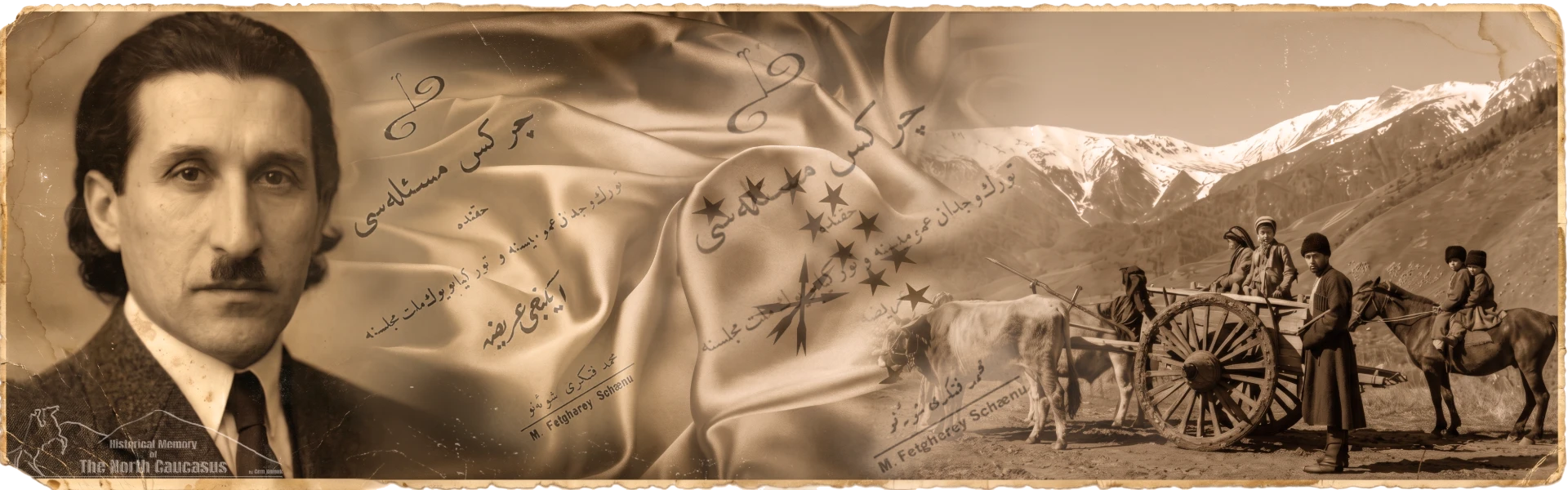
Fatal petitions...Another individual who demonstrated the courage to stand against this exile was Shoenu Mehmet Fetgerey (Asheni) Bey, who was also one of the founders of the Beşiktaş Sports Club. Risking his entire career as a jurist and journalist, he chronicled this crime against humanity down to its finest details and submitted it to the Grand National Assembly of Turkey (TBMM) as a letter of condemnation. In these two letters, penned in the format of petitions, Shoenu presented historical, conscientious, and logical arguments against the unjust exile of Circassian villages in the Manyas and Gönen districts, refuting the accusations of "treason" directed at Circassians and opposing assimilationist policies. Asserting that the tragic events and rumors regarding Circassians being displaced from their homes, killed, having their properties confiscated, and their women dispersed caused immense damage to Turkish-Circassian relations, Shoenu vehemently opposed the stigmatization of Circassians as "traitors" and the allegations that they allied with the Ottoman Sultanate in hostility toward the Turkish ideal.
He articulated that the Düzce rebellion did not stem from pro-sultanate sentiments. Rather, he specified that the fundamental causes of the uprising were a profound fear of annihilation evoked by years of assimilation rumors, provocations by the opposition, attacks on Circassian villages by Albanian gangs perceived as protected by the central government, and intimidating propaganda alleging that the Kuva-yi Milliye intended to exterminate the Circassians.
He emphasized the fallacy of forced Turkification and deportation policies, arguing that integration should be achieved peacefully through schooling, culture, prosperity, and time, rather than through coercion; failing this, the nation's tranquility and economy would suffer. He further underscored that the historical ties between Circassians and Turks extended back to the era of the Crimean Khanate, and that Circassians had produced over 400 pashas, grand viziers, and statesmen for the Ottoman state.
He stated that Circassians demonstrated immense sacrifices on fronts such as Sakarya and Eskisehir during the Greco-Turkish War, and that they harbored absolutely no intention of establishing an independent state within Turkey, being solely loyal guests and subjects of the country. By quoting Halide Edip Adivar’s work "Ateşten Gömlek" (The Shirt of Flame), Shoenu provided evidence of Circassians fighting shoulder to shoulder with Turks, thereby affirming their brotherhood.
In his second petition, Shoenu complained of the silence maintained by the press and the parliament in response to his first submission and detailed how the populace of the 14 exiled villages had been abandoned to death by starvation, disease, and destitution amidst the approaching winter months.
Noting that the government had based its exile decree (dated May 2, 1923) on the justification of harboring Greece-backed political gangs (such as the Mehmet Ali, Kel Aziz, and Kanli Mustafa gangs), Shoenu demonstrated through detailed research that out of these gang members—who totaled no more than 170—at most 15 were Circassian, while the remainder were composed of Turks, Yörüks, and Turkmen. It was also emphasized that the Circassian people did not protect these gangs; on the contrary, they assisted the government in their capture and informed on their ringleaders. Despite this, he noted that the deportation decree was applied with bias; 14 villages affiliated with Gönen and Manyas, along with their estimated population of 3,775, were dispersed to distant regions such as Malatya, Kayseri, Sivas, and Ulukishla. Utilizing various statistical data, he revealed that 40,000 decares of cultivated land, 7,000 cows and water buffaloes, and thousands of sheep and horses belonging to these villages had been lost; furthermore, a population of 5,825 across 30 non-exiled villages, fearing that their turn was next, had sold off their assets for a pittance and were being driven into starvation. He noted that although a decree exempting families of martyrs and relatives of soldiers from exile had been issued in August 1923, it proved ineffective in practice, allowing only 20 households to return. Underscoring that the war had now concluded and the threat of gangs had dissipated, Shoenu demanded that the innocent exiled villagers be urgently permitted to return to their homes in accordance with newly enacted laws. [6],[7],[8],[9]
Thanks to this courageous initiative by Shoenu, the deportation process was eventually halted. An attempt was made to partially rectify the injustice by allowing the displaced populations to return to their villages. However, the publication of these documents cost Shoenu dearly; his publications were first confiscated and banned from sale, and he was subsequently barred from the profession of journalism.
The decree published in the Official Gazette on Saturday, November 20, 1926, bearing the signatures of President Gazi Mustafa Kemal, Prime Minister Ismet Bey [Inönü], and the members of the Council of Ministers, read as follows: [10]
"Upon the proposal submitted via the memorandum of the Ministry of Interior dated October 28, 1926, and numbered [...], the prohibition of the sale and the confiscation of the books about the 'Circassian Issue'—authored a few years ago by an individual named Cherkes Mehmed Bey and published in two parts under the titles 'First Petition to the General Turkish Conscience and the Grand National Assembly of Turkey' and 'Second Petition'—as well as two books entitled 'The Origins of the Circassians are of the Lineage of Deities' and 'Circassians,' because their contents are deemed pernicious, was approved and ratified during the meeting of the Council of Executive Ministers on November 3, 1926."
Shoenu, perceived as a threat to the State, paid the ultimate price for his courageous endeavor by losing his life in a highly suspicious fire that broke out at his office in 1931.

Istanbul, 12 August 2026
References: (You can access the original versions of the sources with links from our archive.)
[1] T.C. Cumhurbaşkanlığı Devlet Arşivleri, Regarding the expulsion and dispersal of migrants in Southern Marmara.,10 November 1917, BCA 272-0-0-11,11-32-25.
[2] Kazım Bey’s (Özalp) telegram to (Met) Yusuf İzzet Pasha dd. October 25th.,1919, Harb Tarihi Vesikaları, Year.3, No. 9, Ankara, September 1954. pp.76-77.
[3] Muhittin Ünal, Miralay Bekir Sami Günsav’ın Kurtuluş Savaşı Anıları., Istanbul, 2002. p.196.
[4] Seha L. Meray (Tr.) Lozan Barış Konferansı Tutanaklar – Belgeler Cilt 1, Kitap 1. Istanbul 2001. pp.301,303.
[5] Muhittin Ünal. 56. Fırka harb cerîdelerinden Miralay Bekir Sami Günsav'ın Millî Mücadele anıları. Cilt 2. Ankara 2016 pp.1250-1251.
[6] Mehmed Fetgerey Şoenu, Çerkes Meselesi Hakkında Türk Vicdan-ı Umumisine ve Türkiye Büyük Millet Meclisine Ariza – I (Print in Ottoman), Istanbul, 1923.
[7] Çerkes Meselesi Hakkında Türk Vicdan-ı Umumisine ve Türkiye Büyük Millet Meclisine Ariza – II (Print in Ottoman), Istanbul, 1923.
[8] Mehmed Fetgerey Shoenu, Lettres à la conscience collective turque et à la Grande Assemblée nationale de Turquie concernant le problème Circassien (Draft Manuscript in French), Istanbul, 1923.
[9] Mehmed Fetgerey Shoenu (Tr. T.C. Kutlu), Çerkes Sorunu Hakkında Türk Kamuoyu ve T.B.M.M.'ne Sunu, Ankara, 1980.
[10] Resmi Gazete (Official Gazette) dd. 20 Teşrinisani (November)1926, Saturday.