
 Türkçe
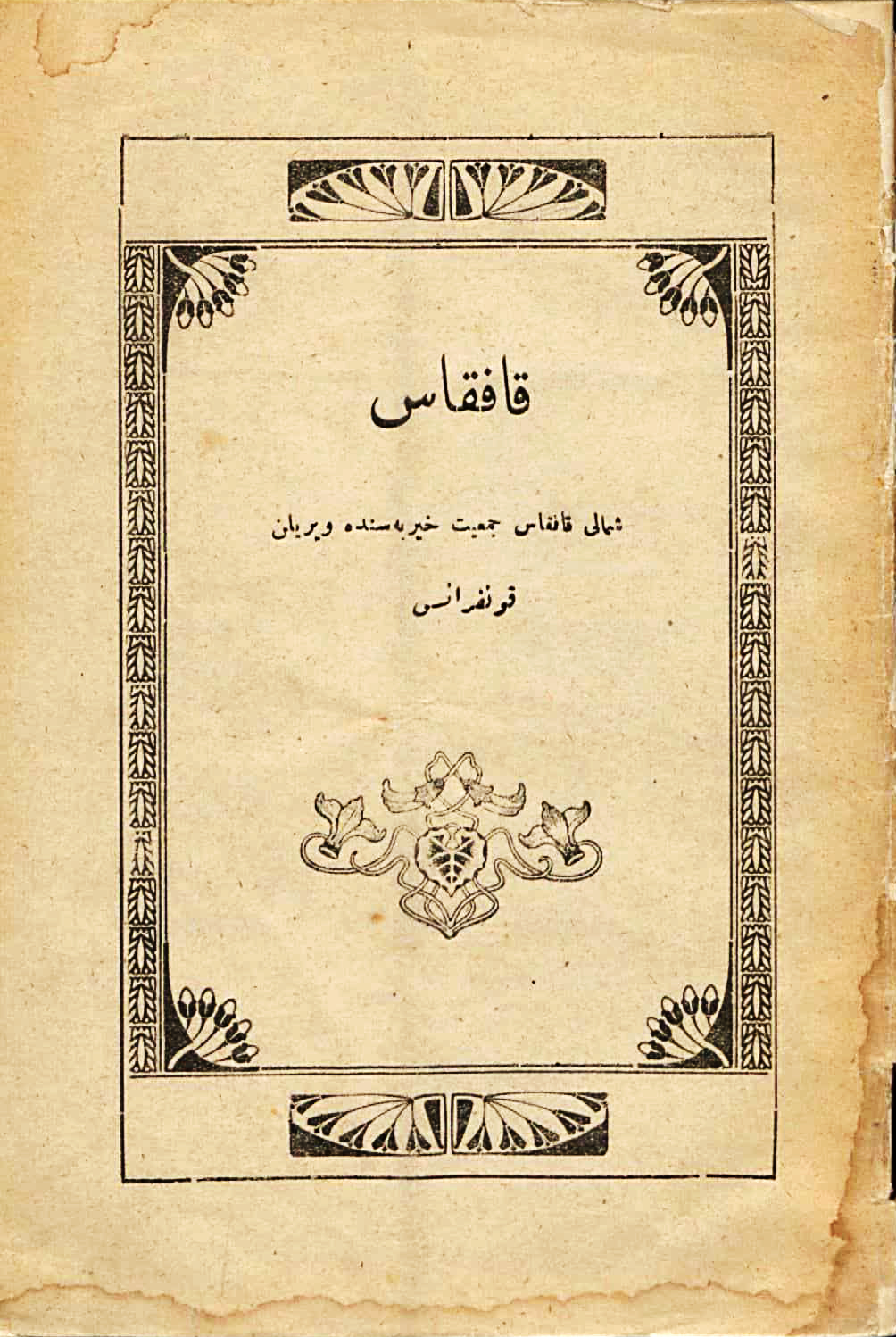
  Ottoman Transliteration
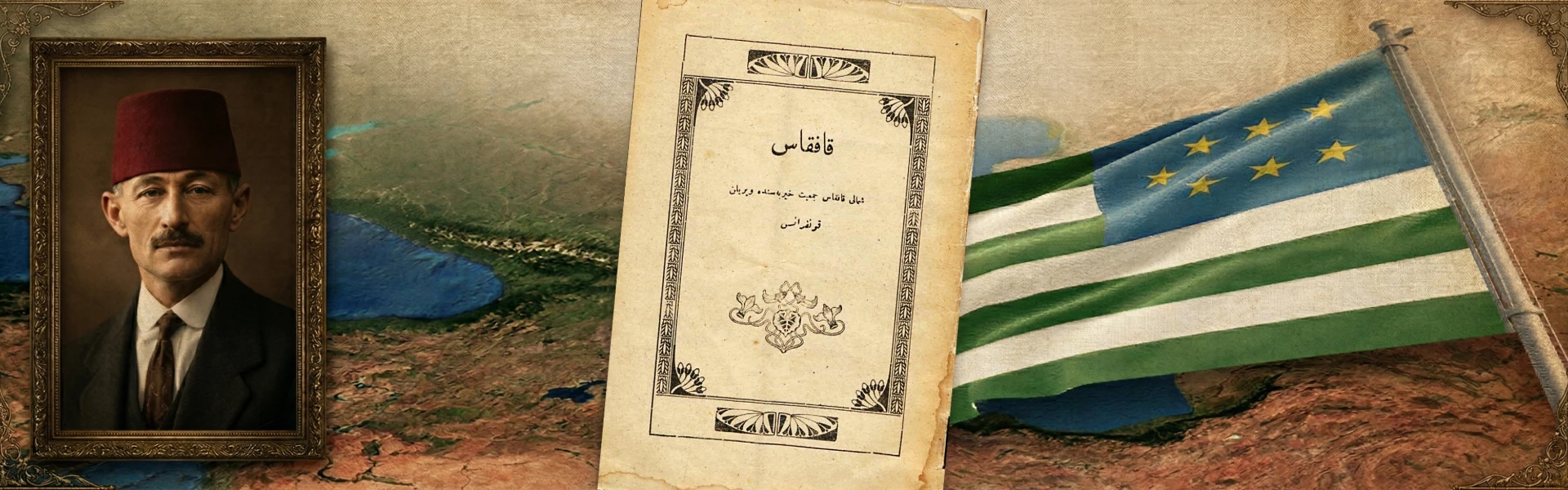
In 1918, the modest Caucasian patriot Aziz Meker delivered a conference entitled "CAUCASUS"—encompassing history, geography, and ethnography—at the North Caucasian Philanthropic Society (Şimali Kafkas Cemiyet-i Hayriyesi) in Istanbul. Until recently, the original publication of this address remained unknown to us. Upon translating the text, originally published by the Ahmet İhsan and Partners Publishers, I realized it was the very same manuscript serialized in 1953 within the Istanbul-based Kafkas Dergisi (Caucasus Journal), a periodical owned by İsmail Ziya Bersis and edited by Sheref Terim.
I consider the historical, political, and ethnographic sections of this lecture to be of paramount importance today. Specifically, they offer substantive counterarguments to the contrived disputes that certain factions artificially impose upon the contemporary agenda of North Caucasian society. It is as though Meker, speaking in 1918, anticipated our current epoch, bequeathing this discourse to us as an enduring legacy.
Previously, I had the honor of bringing to light several of the late Aziz Meker’s anonymously published writings. These included his interview with Lenin in Switzerland following the Conference of Nations Oppressed by Russia (published in Tasvir-i Efkâr), his treatise "A Caucasian Confederation for the Independence of the Caucasus," and the associated conference notes. Now, I am profoundly gratified to have the privilege of introducing this current work to the scholarly community for the first time, presented comprehensively with its original text, Ottoman transliteration, and both English and Turkish translations.

Istanbul, 29 June 2026
The CaucasusServing as a bridge between Europe and Asia and functioning as the conduit for the great historical routes leading from Eastern Europe to Central Asia and Anatolia, the Caucasus is a zone of transition and convergence between two massive continents. Conversely, the formidable, high mountain range that bisects this region from northwest to southeast—possessing only one or two passes of extreme difficulty—gives the impression of having been forged as a natural barrier against human migrations crossing between Europe and Asia.
The landmass presently designated as the Caucasus is bounded by the Yeya, Manych, and Kuma rivers to the north; the Sea of Azov and the Black Sea to the west; the Ottoman Empire and Iran to the south; and the Caspian Sea to the east.
The Caucasus mountain range, which originates at the Taman Peninsula and terminates at the Absheron Peninsula, bifurcates the Caucasian continent into two major divisions. The mountainous zone constitutes a topography reminiscent of the Pyrenees, harboring unparalleled and picturesque landscapes, and occupies 140,000 square kilometers of the total 420,000 square kilometers that make up the Caucasus.
The western coastline of the Northern Caucasus commences at the estuary of the Ingur River, which empties into the Black Sea, and concludes at the mouth of the Yeya River on the Sea of Azov. Administratively and politically, the Northern Caucasus consists of the provinces of Dagestan, Terek, Stavropol, and Kuban, alongside the districts (sanjaks) of the Black Sea, Sukhum, and Zaqatala; its total surface area is estimated at 248,900 square kilometers. The mountain range begins as modest hills on the Taman Peninsula, progressively gaining elevation as it extends southeastward. While the average altitude of the mountains along the Circassian coast is 1,000 meters, it reaches 1,800 meters in the Abaza territory. The range continues relentlessly southeastward, culminating in two massive peaks: the first is Mount Elbrus (5,630 meters) and the second is Mount Kazbek (5,045 meters). The former gives rise to the Kuban River, while the latter originates the Terek River. Beyond Kazbek, the elevation of the range diminishes, eventually reducing to minor hills on the Absheron Peninsula.
Hydrology and Glaciology
- Glaciers: The total surface area of Caucasian glaciers exceeds that of the Swiss Alps. These glaciers are particularly abundant in the central and western sectors of the range, the largest among them being the Karagom Glacier.
- Rivers: The Caucasian glaciers feed numerous rivers, the most significant of which is the Kuban. This river initially flows northward from the south, then turns northwest, and finally westward, discharging into the Strait of Kerch through multiple distributaries. It is joined by substantial tributaries such as the Zelenchuk (İncik), Urup, and Laba rivers, and is navigable for a distance of 160 kilometers. The Terek River flows rapidly northward from the foothills of Mount Kazbek, abruptly turning east to empty into the Caspian Sea via a broad delta. Between these two great rivers of the Northern Caucasus lies a vast plateau with an average elevation of 700 meters, from which the Kuma and Talavus rivers originate.
- Transcaucasian Rivers: In Transcaucasia (the South Caucasus), the principal river is the Kura (Kür), which is joined by the Aras River flowing from Turkey. Its terminus is the Caspian Sea. Transcaucasia also features two major rivers flowing into the Black Sea: the Rioni (Phasis) and the Ingur.
- Lakes: Despite its abundance of glaciers and rivers, the Caucasus—particularly the Northern Caucasus—has relatively few lakes. However, small alpine lakes can be found at high altitudes on the northern slopes of the range. Transcaucasia, by contrast, contains numerous lakes, the most expansive being Lake Sevan (Gökçe), situated at an altitude of 2,000 meters.
ClimateThe temperature in the Caucasus is highly variable, a consequence of the adjacent seas to its east and west, as well as extreme altitudinal differences. While some points lie below sea level, others soar to nearly 6,000 meters.
Whereas a continental climate predominates in the Northern Caucasus and the eastern reaches of Transcaucasia, the Black Sea basin enjoys the effects of a temperate and fertile maritime climate. The following table illustrates the mean annual temperatures and precipitation levels at key locations:
|
Location |
Elevation |
~Annual Temp (°C) |
Annual Precipitation (Meters) |
|
Kutaisi |
-141 meters |
14.85 |
2.398 |
|
Poti |
7 meters |
14.69 |
1.760 |
|
Novorossiysk |
9 meters |
13.44 |
1.580 |
|
Vladikavkaz |
678 meters |
9.03 |
0.920 |
|
Pyatigorsk |
516 meters |
9.07 |
0.548 |
|
Tiflis (Tbilisi) |
409 meters |
12.67 |
0.471 |
|
Ganja |
458 meters |
12.89 |
0.209 |
|
Gyumri |
1469 meters |
5.69 |
0.316 |
Flora and FaunaIn the Caucasus, flora thrives at altitudes unattainable in European mountainous regions, and the vegetation is far richer and more diverse than the alpine ecosystems of the Alps and Pyrenees. Broadly speaking, the Caucasian flora aligns more closely with that of western France than with the Mediterranean basin, although the environs of Sukhum, Poti, and Kutaisi harbor species endemic to both the Mediterranean and Western Europe. While European vineyards rarely surpass an elevation of 900 meters, Caucasian vineyards yield abundant harvests even at 1,600 meters. Cotton can be cultivated in favorable locales at elevations of up to 680 meters.
Cereals yield produce of exceptional quality and quantity up to an altitude of 2,300 meters on both sides of the mountain range. The Northern Caucasus produces 15 million tons of grain annually. Tea is cultivated in numerous areas. The most robust and fertile vegetative zones are the Abaza and Mingrelian territories. In recent years, substantial quantities of sunflowers have been planted across both Transcaucasia and the Northern Caucasus.
The forested zone along the mountain range stretches 700 kilometers in length with an average width of 23 kilometers. In the forests blanketing the slopes near the Black Sea, pine, linden, oak, ash, and hornbeam trees alternate or coexist, occasionally encroaching upon the domains of wild fruit trees.
The fauna of the Caucasus largely mirrors that of broader Europe. Exceptionally, tigers and lions are occasionally sighted in the eastern parts of Transcaucasia. Game is extraordinarily plentiful, particularly in the vast forests of the northern Caucasian peaks. The rivers and streams teem with various fish species, leading several Caucasian ethnic groups to engage extensively in hunting and fishing.
Agriculture and EconomyBefore the Russian invasions, agriculture was highly advanced in the Caucasus, particularly in the northwest. The fields of the Circassians resembled meticulously cultivated vegetable gardens. Foreign travelers who traversed this continent before the Russian conquest expressed profound admiration for Circassian agricultural ingenuity and labor. Although incessant warfare and massive exoduses caused a temporary stagnation in this advanced agricultural tradition, the peoples of the Northern Caucasus—especially the Circassians—have recently embraced modern European agricultural implements with great enthusiasm. So much so that plows, mowers, and reapers are found in two-thirds of the households in every village, alongside three or four large threshing machines per settlement. Equipped with these tools, they have outpaced the Cossack farmers, who possess the most arable lands and operate under the permanent patronage of the Russian government. A significant portion of the 15 million tons of grain harvested annually in the Kuban, Stavropol, and Terek provinces is exported via Novorossiysk and Tuapse to Istanbul and Western Europe.
Georgia's wines and silk products are internationally renowned. Fruit orchards are abundant in Georgia, Dagestan, and the Abaza territories. Recently, tobacco cultivation has expanded in Transcaucasia, specifically in the Abaza region. Unfortunately, Transcaucasia currently does not produce enough grain to sustain its own population.
Livestock—including horses, sheep, and cattle—are extremely plentiful in the Northern Caucasus, particularly in the continent's center and northwest. Historically, the horses for the light cavalry regiments of the Russian Empire were bred here, and the meat requirements of major Caucasian cities were met by this region.
Mineral Wealth and HydrographyThe geological formation of the mountain range exhibits a remarkable uniformity. The crystalline rocks that form the foundational pillars of the range and most of Transcaucasia's mountains are of three types: granite, porphyry, and volcanic rock. While the highest peaks are composed of granite, their bases consist of porphyry and volcanic rock.
The mineral wealth of the Caucasus is of paramount importance. In the north, for instance, toward the sources of the Kuban River, there are active copper mines; the Alagir valley and its environs contain abundant argentiferous lead and zinc. Coal is present in these same regions and elsewhere, while Transcaucasia—particularly Mingrelia—boasts rich iron and manganese deposits. Given the abundance of copper and iron, one must concede to those who characterize the Caucasus as the cradle of metallurgy. Lead and copper are found in the Karabakh mountains, salt mines in the Aras valley, and coal near Kutaisi.
Surpassing all these mineral assets is an extraordinary resource: petroleum (neft). This precious liquid was initially discovered at the two extremities of the range—the Taman and Absheron peninsulas. Baku currently stands as the epicenter of petroleum production. A single well near this city yielded 164 tons of oil daily for five consecutive years. Subsequently, petroleum was discovered in numerous locations in the Northern Caucasus, such as Grozny and Maykop, leading to the establishment of corporations extracting oil on a massive scale.
Furthermore, the Caucasus is exceptionally rich in mineral springs. The vicinity of Pyatigorsk alone harbors a vast array of them. According to recent statistics, 600 varieties of mineral water exist in the Caucasus. The temperatures of Northern Caucasian springs range from 10°C to 62°C. These include sulfurous, chalybeate, acidic, and alkaline waters, some of which contain iodine and bromine. Concentrated within a 30 to 45-kilometer radius in the Northern Caucasus, these waters are comparable to the renowned springs of Europe, such as Vichy, Vals, Luçon, Schwalbach, and Marienbad.
Transportation and InfrastructureBecause the Russians encountered immense difficulties during their conquest of the Caucasus, they constructed numerous military roads—devoid of commercial value—at various stages of the invasion. Even after the subjugation was complete, the imperative to maintain control over this fiercely contested continent remained the primary determinant in routing public highways. Consequently, most infrastructure serves strategic military purposes rather than economic necessities.
The Russians connected the Trans-Russian railway network to the Northern Caucasus via a main line running from Rostov to Vladikavkaz, extending it to Baku by tracing the Terek valley and the Caspian coastline. In Transcaucasia, a major trunk line links Baku to Poti and Batumi, which serve as the region's western import-export ports. In addition to these primary arteries, several branch lines traverse the highly fertile regions of the Northern Caucasus:
— Yekaterinodar – Novorossiysk
— Kavkazskaya – Stavropol – Yekaterinodar
— Armavir – Tuapse
— Prokhladnaya – Nalchik
— Pyatigorsk – Kislovodsk – Yessentuki
Transcaucasia also possesses several secondary rail lines:
— Kutaisi – Poti
— Tiflis – Gyumri (Alexandropol) – Kars – Sarikamish
— Gyumri – Julfa
The total length of the railway network constructed by the Russian government and private enterprises in the Caucasus is approximately 3,500 kilometers. In 1912, a company was formed to connect Pyatigorsk to Sukhum—linking the summer retreat of the Caucasus to its winter resort—but the outbreak of World War I halted construction. Having temporarily lost naval dominance in the Black Sea during the war, the Russians realized the inadequacy of the existing railways and planned to connect Tuapse to Poti via a coastal line. While the earthworks and bridges were completed, the project was inevitably abandoned with the outbreak of the Russian Revolution.
Before the advent of railways, the populations of the Northern and South Caucasus communicated via mountain passes. The most critical and lowest of these is the Darial Gorge in Ossetia. The famous macadam road connecting north and south—dubbed the Georgian Military Road by the Russians—traverses this pass. In the Western Caucasus lie the Teberda and Klukhor passes. While the former is accessible to wagons, the latter can only be navigated on horseback or foot, and only during a two- or three-month window in summer.
Ethnography and Caucasian SocietiesThe Caucasus remains one of the most remarkable regions globally, both regarding the historical significance of its inhabitants and its profound ethnographic diversity.
Many anthropologists postulate that the Caucasus is the cradle of the Caucasian race. Unchallenged until the early nineteenth century, this theory has recently met with dissent. The German scholar Klaproth, who achieved immense fame through his writings on the Caucasus, was the first to contest this. Other scholars view the Caucasian peoples as remnants—"survivors of the sword"—of great migrations passing through the region from Asia to Europe or vice versa.
Recently, researchers engaged in scientific studies of the Caucasian peoples have rejected the aforementioned conclusion, proposing a radically different thesis. They argue that, despite the multiplicity of dialects and linguistic nuances, the peoples of the Caucasus are the descendants of a great, prehistoric civilization that managed to preserve their existence only within the Caucasus. Fleeing persecution and invasion in the northern and southern plains, these populations purportedly sought refuge in the Caucasian mountains, which served as a sanctuary. One point upon which all ethnographers agree is that—barring a few exceptional tribes—the Caucasian peoples share a common origin. Differences in language and religion are merely superficial and do not subvert this fundamental truth.
Observing the political landscape of sixty years ago, the Northern Caucasus was bifurcated into two main regions: Circassia in the west and Dagestan in the east. The inhabitants of both regions exhibit profound similarities in customs, traditions, psychology, and social structure. The plausible hypothesis that their seemingly disparate languages stem from a single root has convinced the scientific community that these peoples are branches of the same ancestral tree. To understand the societal framework of one group is, essentially, to understand the others.
Child-rearing and EducationOne of the most striking aspects of Caucasian society is its pedagogy. The progressive theories applied in modern developed nations today were instilled in us millennia ago by the masterminds who laid our social foundations. In Circassian child-rearing, harsh methods are strictly avoided; to mold the child's mind and character, appeals are consistently made to their pride and their capacity for noble sentiments. As they mature, they are progressively taught their duties toward their peers and elders within the tribe, alongside their familial obligations. On one hand, a child's sense of honor is cultivated to enhance individual worth, providing the material and moral education necessary to foster initiative. On the other hand, children are endowed with commendable virtues such as love, respect, and obedience toward their parents and the elders of the tribe. Thus, upon reaching adolescence, a young Circassian is expected not only to be active and enterprising in personal matters but also to eagerly accept and meticulously execute orders from national elders regarding matters of public and patriotic interest. Consequently, an authentic Circassian upbringing molds an individual who is simultaneously individualistic and community-oriented.
Family and Gender RolesSocial life in the Caucasus echoes the social structures of antiquity in several respects. A single household might contain a patriarch, his children, his grandchildren, and even great-grandchildren. However, duties are strictly delineated, and the patriarch holds absolute authority. In a Circassian family, the man manages external affairs, while the woman is the absolute sovereign of the domestic sphere. The husband has no right to interfere in matters falling under her jurisdiction. He procures the necessary provisions and hands them over to the lady of the house, who oversees domestic management and early childhood education. Circassian women have played a profound role in raising generations of heroes, as it is the mother who provides the foundational education and instills the first civic duties.
When a mother handed her child the weapons of his martyred father, the boy remarked, "This sword is short." She replied, "With every step forward you take, my son, this sword will be one step longer than the enemy's." Mutual respect between husband and wife is paramount in Circassia. Domestic disputes, common even in the most "civilized" countries, are virtually non-existent. Veiling in Circassia is more a matter of moral modesty than strict physical concealment. Unmarried women enjoy complete freedom—perhaps even greater than their European counterparts—yet this has never led to moral decay; rather, it has elevated public morality. Respect for women is so profound that a Circassian woman could travel alone from one end of the country to the other without fear of molestation. Even today, despite the presence of foreign elements, women travel and trade independently. The high esteem accorded to women is deeply intertwined with our societal resilience. A British traveler observing Circassia remarked at a conference in Istanbul: "If a nation's level of civilization is measured by its respect and reverence for women, then surely the Circassians are the most civilized people in the world, for nowhere else will you see the respect accorded to women as it is in Circassia."
Social Structure and GovernanceThe peoples of the eastern Northern Caucasus are structurally democratic. Except for one or two tribes, a nobility class is virtually nonexistent there. In Dagestan, Sheikhs and their disciples (murids) hold sway. The populace is enlightened and governed by these Sheikhs, some of whom achieved sovereign influence, the late Sheikh Shamil being the purest and most brilliant example.
Conversely, the western reaches of the Northern Caucasus are grounded in an aristocratic framework. Yet, regardless of their aristocratic structure, the Circassians have remained steadfastly democratic in their social relations and conduct. As Europeans intimately familiar with them have noted: "The Circassians are aristocrats in spirit, but democrats in morals." The Circassian nobility never subjected the lower classes to the oppressive treatment seen in Western Europe centuries ago, or in Russia half a century ago. The Circassian character would not permit it. Just as the nobility did not contemplate violating established laws and customs, the populace would not tolerate the slightest disregard for national traditions by the lords, readily disciplining those who overstepped.
Circassian society was primarily stratified into four classes:
— Princes/Chiefs
— Nobles
— Freemen
— Serfs/Slaves
The patriarchs of the princely class were elected by popular vote, recognizing their talent, intellect, and service to the country. The right to lead a tribe or the Circassian nation was a mandate bestowed by the people. This meritocratic system was evidenced by the fact that if a ruling family failed in its duties or failed to defend tribal rights, the populace would strip them of their authority. Upon a prince's death, his sons retained the position only if they demonstrated merit; otherwise, the people would elect a successor from the nobility. Princes were obliged to execute public affairs in consultation with an assembly composed of nobles and the wise men of the freemen class.
The freemen engaged in commerce, artisanship, and agriculture, driving the economic engine of the country. Periodically, they, alongside the nobility, elected deputies to convene general assemblies (Khase) to draft the nation's laws and regulations. Thus, the legislative power rested with the deputies of these two classes, while the princes held executive power.
The Khase (assembly) convened to deliberate on critical issues concerning a specific tribe or all of Circassia. These sessions could last for months, and their resolutions were strictly enforced. Princes were obligated to execute the assembly's decisions; dictatorship, which corrupts morality and warps national character, thankfully never emerged in Circassia.
Ancient LineageThe Circassian nation has been known to the ancient Greeks and Romans since the 6th century BCE. Greek historians occasionally referred to them as the "Antes." Some scholars attempt to derive their endonym, "Adyghe," from this term, positing "Adyghe" as a corrupted form of "Ante"—a theory aligning with modern views on Caucasian antiquity. The celebrated author Alexandre Dumas, in his Adventures in the Caucasus, posited that the name "Adyghe" derives from "Adam," attributing supreme antiquity to the Circassian people. Our nation is probably the noble lineage of the great "Ad" people (Adyghe meaning "the generation of Ad").
Historically, the Circassians have continuously occupied the Caucasus. Yet, ancient empires such as the Hittites in Asia Minor (widely recognized by European scholars as comprising basal Caucasian elements), the Thracian Empire, and the Cimmerian Empire of the Northern Caucasus stand as testaments—echoed by Herodotus—that the Circassians were once the most formidable nation and earliest disseminators of civilization in ancient Asia and Europe.
The Russian Conquest and ResistanceSituated between the great population reservoirs of Europe and Asia, the Caucasus suffered invasions by Huns, Avars, Mongols, conquerors like Timur, and ultimately, the Russians.
While initial contact with the Russians occurred in the ninth century CE, systematic conflict began in the sixteenth century under Ivan the Terrible. However, the annihilation and conquest of the Caucasus truly began under Catherine the Great (1760). From that date until June 1864, the Northern Caucasus, particularly Circassia in the northwest, fought an unyielding war against the Russians. History has rarely recorded such a disproportionate and relentless struggle: a colossal empire that terrorized Europe and enslaved much of Asia pitted against a small republic of five or six million souls, isolated from the rest of humanity.
During a military parade in St. Petersburg in 1840, a European asked a Circassian observer why his people did not fear and submit to such military grandeur. The Circassian replied: "These are merely orderly flocks; they have no essence (spirit)." This encapsulates the psychology of the Circassian-Russian struggle.
However, morale could not indefinitely triumph over material superiority. In the northeast, the heroic Sheikh Shamil's resources were depleted; his final stronghold, Mount Gunib, fell in 1859, and he was captured. Thereafter, the full might of the Russian Empire concentrated on the northwest—Circassia. This resistance, involving men, women, and children, endured for six more years. The sacred homeland finally fell to the enemy in June 1864.
European diplomats, influenced by humanitarian appeals or geopolitical anxieties, made several attempts to secure independence or autonomy for the Northern Caucasus, most notably during the Treaty of Paris negotiations. However, these efforts proved futile, partly due to Napoleon III's reluctance to alienate Russia and the Ottoman diplomats' short-sighted apathy.
Knowing that the fiercely independent Circassians posed a perpetual threat, the oppressive Russian government forced them into a brutal choice: assimilation via dispersion within the Empire, or exile. The Circassians chose exile. Emigrating en masse to the capital of the Ottoman Caliphate, an estimated 700,000 left during the initial exodus. They saw this not as defeat, but as a tactical retreat, harboring an unyielding resolve to return and liberate their chained homeland. This dream fueled their participation in the 1877 Russo-Turkish War and later, World War I, where Circassian volunteers fought fiercely against Russian forces across various fronts, animated by the immortal ideal of a liberated Circassia.
In the homeland, the Russians employed systemic tactics to erase Circassian identity, forcibly resettling them near malarial swamps, installing hostile Cossack settlements on the best lands, and sowing discord by artificially dividing them into "Kabardians," "Shapsugs," and "Abazas," restricting the term "Circassian" merely to a small tribe near Maykop.
Cultural Revival and the Modern Political StruggleFollowing their embrace of Islam, the Circassians—and particularly the Dagestanis—demonstrated immense zeal for Arabic and Islamic theology. Today, the peoples of the Northern Caucasus are among the most deeply committed to the tenets of Islam. However, recognizing that traditional madrasas were insufficient for modern political survival, scholars initiated a national secular education movement. The first such school, blending European pedagogical models with local needs, was established in 1880 in Biberd Hable. Although Russian authorities restricted native-language instruction to suppress national awakening, these institutions successfully fostered both ethnic consciousness and proficiency in Russian, enabling Circassian youth to integrate into the broader economic and academic spheres.
Economically, despite systemic disenfranchisement, the Northern Caucasians outpaced their Cossack rivals by eschewing alcohol and rapidly adopting modern American and European agricultural machinery. Socially, the region boasts an equitable distribution of wealth; destitution and begging are virtually nonexistent due to a deeply ingrained Islamic and cultural welfare system. This intrinsic social equity rendered the region highly resistant to the class warfare ideologies introduced by the Russian Revolution.
The Revolutionary Era and the Quest for IndependenceWhen the Bolshevik Revolution proclaimed the right of nations to self-determination, the Northern Caucasus immediately seized the opportunity. Unlike Transcaucasia, which fractured along ethnic lines and succumbed easily to Soviet influence due to its stratified class dynamics, the Northern Caucasus maintained remarkable unity.
In May 1917, a massive General Assembly (Khase) convened in Vladikavkaz, attended by delegates from the Caspian to the Black Sea, resulting in the formation of the "Union of Mountaineers" (Mountaineers' Republic). This confederacy drafted a progressive constitution, establishing a bicameral legislature and a federal framework ensuring tribal autonomy. Following the October Revolution, the Central Committee declared the total independence of the United Republic of the Northern Caucasus on November 2, 1917.
Diplomatic delegations were dispatched to Istanbul and Batumi to secure recognition and military alliances, successfully signing a treaty of friendship with the Ottoman Empire in June 1918. Despite severe geopolitical headwinds—including the hostility of the Bolsheviks, the vacillating loyalties of the Cossacks, Transcaucasia's refusal to share military arsenals, and Germany's catastrophic diplomatic concessions to Russia regarding Georgia—the Northern Caucasian diaspora in Turkey continues to fiercely lobby for the survival and recognition of their homeland.
It is an undeniable geopolitical reality that the security of the Ottoman Empire and the viability of an independent Azerbaijan hinge entirely upon the existence of a robust, independent Northern Caucasian state acting as a bulwark against Russian expansionism. The pursuit of a grand Caucasian Confederation remains the most rational safeguard for the region's future. Our cause is just, and God is the helper of those who struggle for truth.
Aziz Meker
Akhmet Ihsan and Partners Publishing
Istanbul, 1918