
 Türkçe
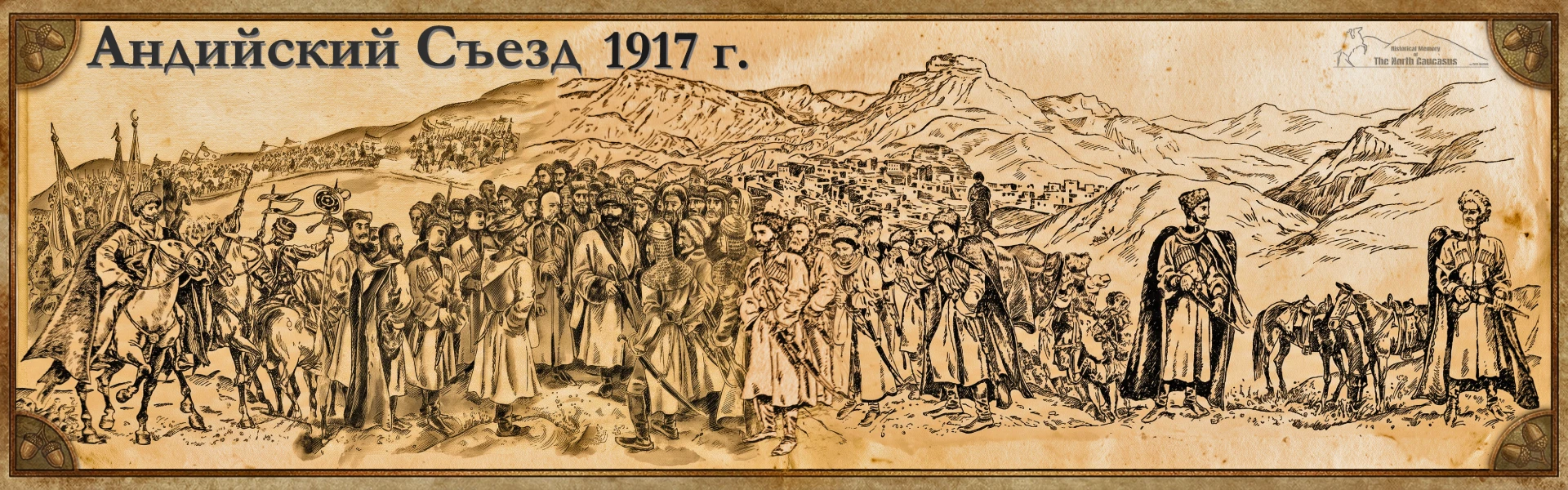
The performance exhibited by the Central Committee of the Union of Mountaineers during its initial test of democracy in Vladikavkaz was rather commendable for Mountaineer politicians unaccustomed to such a tradition. Although the First Congress opened the door to freedom and independence for the North Caucasus as a whole, it remained a largely incomplete endeavor due to the uncertainties in Russia, inadequate ideological maturity, and insufficient preparation time. Its most significant shortcoming was the exclusion of representatives of the devout masses in a region like the North Caucasus, where religious faith serves as a profoundly vital driving force. As the Central Committee strove to protect the Mountaineers from the adverse effects of the anarchy and chaos engulfing all of Russia, it simultaneously prepared for the Andi Congress, which would include the religious groups omitted from the Vladikavkaz assembly. It was becoming increasingly evident that the Russian Revolution would fall drastically short of fulfilling the aspirations of the peoples living under the Russian yoke. It was manifest that the time had arrived for the Mountaineers to exercise their right to self-determination. It was within this zeitgeist that the Andi Congress was to be convened.
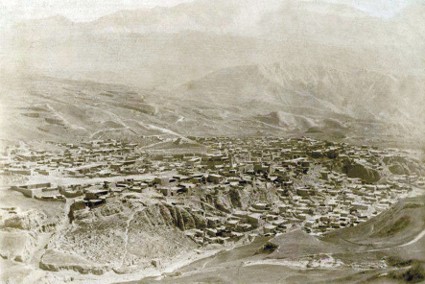
In an effort to rectify the shortcomings of the inaugural congress and ensure a secure environment devoid of external threats, the village of Andi on the Dagestan-Chechnya border was selected as the venue instead of Vladikavkaz. In his memoirs, Muhammad Kadi-Dibir elucidated this rationale with striking clarity: [Dibirov, p.29]
The Road to Andi: Seeking True Representation
“The reason for convening the congress in a remote village in the Dagestani mountains was so that the people of Dagestan, situated far from military deployments, could freely articulate their needs and debate their problems without the coercion of a power alien to their spirit and way of life.”
Furthermore, Andi's historical significance during the era of Imam Shamil's Gazavat (Holy War) endowed it with a distinct spiritual privilege during this critical juncture. The Congress was scheduled to convene on August 20. In studies concerning the Congress of Andi, authored by various individuals over time, divergent dates are cited due to discrepancies between the Julian and Gregorian calendars, as well as lapses in memory. The delegates and masses intending to participate in the Congress began converging on the vicinity of Andi from August 17 onwards, and preparations were finalized to convene the Congress as scheduled on August 20 according to the Julian calendar (September 2 in the Gregorian calendar).
The prominent Mountaineer Bolshevik Alibek Takho-Godi reflected on this venue selection in his memoirs as follows: [Takho-Godi, p.24]
“Evidently, in order to allow the Sharia bloc and Najmuddin Gotsinsky to spew all the venom they had accumulated throughout the revolutionary period in their own domain, it was deemed necessary to resurrect the historical memories of the Andi congress of Sheikh Shamil, who was at that time preparing for decisive actions against Tsarism.”
In reality, the Muslim religious leaders, unrepresented at the first congress, had absolutely no influence on this choice of location. The selection was dictated entirely by the preferences of bourgeois intelligentsia. The signatories to the decision designating Andi as the most suitable venue included Basiyat Shahan, Bashir Dalgat, Elbuzduko Britati, Sultan Kaplan Giray, Nuh-Bek Tarkovsky, Zubair Temirkhanov, Makhach Dakhadaev, Alibek Takho-Godi, Muslimov, and Kuvarshalov. Not a single one of these figures was a Muslim opinion leader. All were representatives of either liberal, socialist, or monarchist factions.
Clashing Narratives: Secular Apprehension vs. Popular EnthusiasmViewing the event entirely through the lens of Marxist dogma, Takho-Godi portrayed the Andi Congress as an absurd religious ritual and a spectacle tailored for the devout faction: [Takho-Godi, p.25; Dibirov, p.30]
“In such an atmosphere, it was abundantly clear that there was no longer a congress for the organizers themselves to even consider. Their sole imperative was to safely extract their guests—for whom they already felt profound embarrassment—from the premises as swiftly as possible. The Dagestani socialist delegates [Jalaluddin] Korkmasov and [Magomed-Mirza] Khizroev, who had gone to observe the spectacle, barely escaped with their lives, thanks only to their local friends (kunaks). [Muhammad Kadi] Dibirov, a participant in the Andi Congress, recounts that the congress disbanded in a 'rather peculiar' manner: A portion of the delegates fled in panic, others turned back while en route, and the remainder abandoned the congress, having completely lost hope that order could be established in Dagestan without the intervention of an external force. Even within this milieu, the intelligentsia of the Sharia bloc attempted to fabricate a constitutional pretext for Gotsinsky's 'imamate,' striving to persuade him to adopt the title of 'mufti' instead of 'imam' to forestall potential conflicts with revolutionary organizations in the cities and military garrisons stationed in Dagestan. Regardless, following the Andi Congress, many swore off ever attending 'congresses' of the Mountaineers again.”
As is patently evident, the Mountaineer Socialists and proponents of resurrecting the Russian Monarchy, much like the liberal intellectuals, harbored a profound fear of relinquishing power to the religious faction. It is essential to juxtapose Takho-Godi’s narrative, which was meticulously adapted to conform to Bolshevik Soviet doctrine, with the account of Shalva Amirejibi, a Georgian Christian guest at the congress: [Amirejibi, p.6-7]
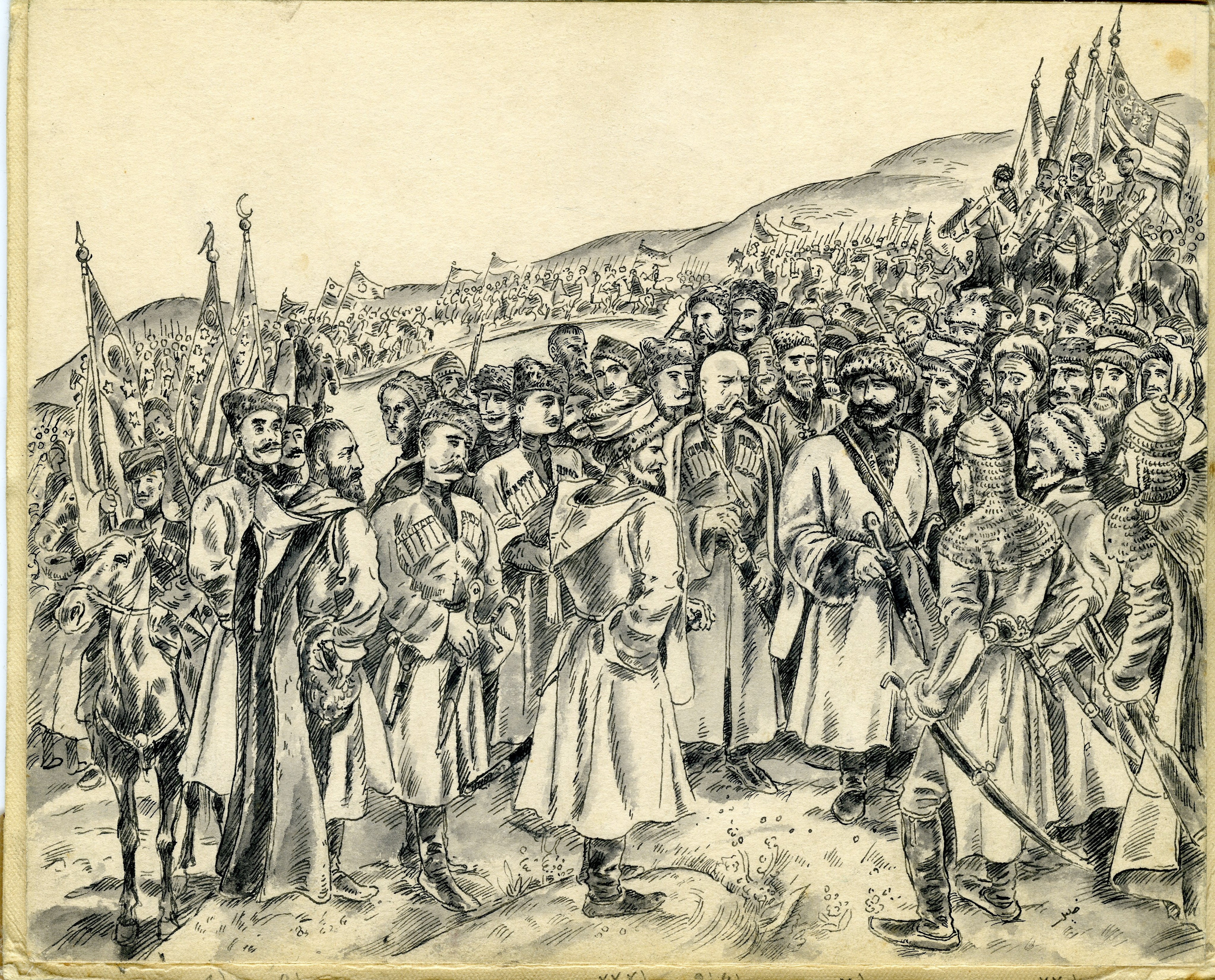
“[…] From Gudermes onward, we proceeded as guests of the Mountaineers and representatives of the Georgian people. We were greeted, seen off, and escorted by an enveloping convoy. Our journey to Andi spanned several days. We reveled in both the breathtakingly beautiful nature and the magnificent weather. We passed through the renowned Vedeno, traversed the entirety of Chechnya, and the closer we drew to Andi, the more people we encountered journeying on horseback or on foot. Where were they going? To Andi! But who were all these multitudes; could they all be delegates? Imagine! The populace itself had taken to the roads in the wake of the delegates. Finally, upon approaching Andi, we were welcomed by twenty thousand people. This was no longer a convention of delegates. In Georgia, we refer to this as 'a man from every hat!'
It was a veritable encampment where tents were innumerable, and unsaddled horses grazed in herds on the alpine meadows of Kurket. This entire majestic throng was murmuring, singing, strolling about, visiting one another, inspecting horses, testing weapons, and above it all fluttered the vibrant, multicolored banners of the Mountaineers. […]”
From the expressions of Shalva Amirejibi, captivated by the magnificent spectacle he witnessed, it is readily apparent that he and his companions felt not the slightest threat to their lives.
Beyond the Propaganda: The True Agenda of the CongressThe uncompromising posture of the secular cadres would ultimately prevent this initiative, which commanded the most substantial popular support during this critical epoch, from realizing its objective. Unfortunately, we are deprived of the necessary minutes, protocols, and reports regarding this assembly, which was convened within a much narrower framework than its planned agenda due to their obstructionism. Today, we attempt to decipher this pivotal initiative through the subjective memoirs of prominent contemporary figures. In reality, the planned agenda of the Andi Congress encompassed highly significant topics: [Kakagasanov, Kaymarazova, p.37]
1. Religious affairs,
2. Organization of popular forces to defend the revolution against anarchy and counter-revolution,
3. Combating banditry,
4. The provisioning crisis,
5. The formation of the council of peasant representatives and agrarian committees,
6. Preparing the populace for the Constituent Assembly elections,
7. Rapprochement with the Georgian people and dispelling misunderstandings between the Mountaineers and Georgians residing in the region,
8. Other contemporary issues.
However, the liberal and socialist cadres, terrified of losing the reins of power, sought to discredit the Congress by reducing its purpose solely to the election of Najmuddin (Gotsinsky) of Hotso (Gotsatl) as Imam. On the opening day of the Congress, the following information and clarifications published in the newspaper Gorskaya Zhizn (Mountaineer Life) regarding the event's purpose and objectives unequivocally demonstrated that it had no relation to the election of Najmuddin as Imam or the expectation of establishing a Sharia order by Sheikh Uzun Haji of Salta: [Donogo, p.19]
“Today, in the village of Andi in the Dagestan region, the 2nd Congress of the Mountaineers of the North Caucasus and Dagestan, convened by the Central Committee of the United Mountaineers Union, opens. The objective of the inaugural congress that established the union was to eradicate the toxic legacy of tsarism. This objective was achieved so completely in such a brief span that the urgent necessity for a creative, constructive plan for collaborative action among the Caucasus Mountaineers, united as a single, indissoluble family, became starkly apparent. The 2nd Mountaineer Congress has been summoned precisely to resolve this complex and constructive task. The paramount issue on the congress agenda is the Constituent Assembly, encompassing the preparation of the populace for elections and the nomination of candidates. The formation of peasant deputies' Soviets and agrarian committees must consolidate Mountaineer democracy upon the firmest of all foundations—the economic base—and provide impetus for resolving the agrarian question. Matters pertaining to provisioning and the people's militia are linked to combating the economic collapse and the ensuing anarchy that threatens to obliterate the gains of the revolution. Finally, issues concerning rapprochement with the Georgian people and the administration of Muslims' religious affairs, alongside matters defining the constitution and the competencies of the union's organs, must definitively chart the further development and deepening of the union.”
The Gathering at Andi: A Unified Call for IndependenceDetailed accounts of the Andi Congress can be found in the memoirs of Boris Kuznetsov, the aide-de-camp to Shamkhal Nuh-Bek Tarkovsky. In his reminiscences of the era, penned in New York in 1959, Kuznetsov provided striking details about the Congress, citing Pshemakho Kotsev: [Kuznetsov, p.15-18]
“On the night of September [August] 18, as 10 members of the Central Committee assembled at the Vedeno fortress to depart for Andi, alarming news arrived: A self-authorized congress organized by Najmuddin Gotsinsky at Lake Kezenoy-Am had proclaimed him imam. Moreover, according to information Gotsinsky had received, the socialists were preparing to declare Soviet power; consequently, the new imam had resolved to eliminate all the intelligentsia, particularly all members of the Central Committee.
For the congress meeting in Andi, we were allocated a large, multi-roomed house belonging to the elderly Major Giray (a major from the 1877 Russo-Turkish War — B.K.).
By 09:00 on the morning of September [August] 10, a group of seven or eight individuals representing nearly all the tribes had arrived. Clergy from the Dagestani, Chechen, Ingush, Ossetian, and Kabardian communities were present. They briefly awaited Nuh-Bek Shamkhal Tarkovsky, who arrived with a retinue of six or seven horsemen. The appearance of Najmuddin Efendi (the imam) occurred around 15:00 in the afternoon. This time, the negotiations with him culminated in absolute consensus. Everyone agreed to the Republic, namely the proclamation of the Republic of the Mountaineers of the North Caucasus. The decrees were drafted first in Avar, Arabic, and Kumyk, and subsequently in Russian.
On the morning of September [August] 20, at an assembly attended by the entire jamaat (community), this resolution, signed by all the clerics, was scheduled to be read.
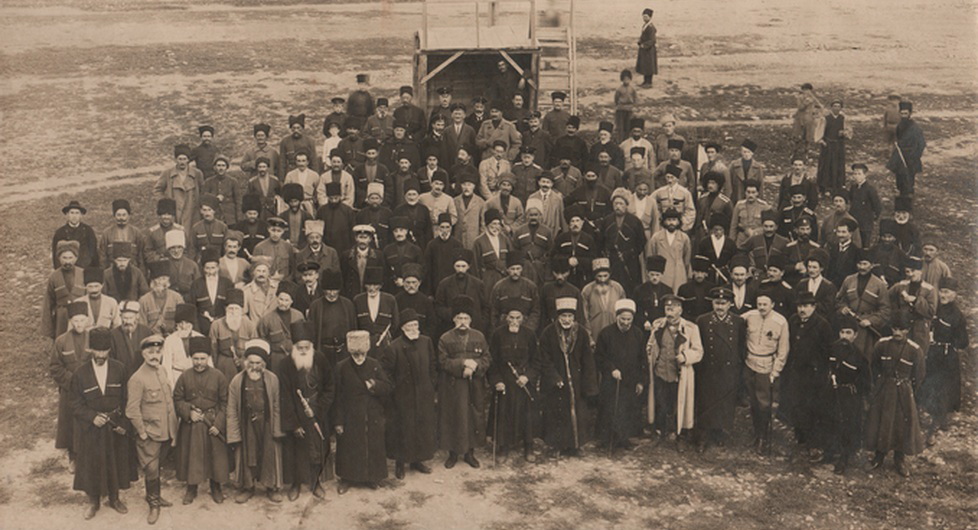
September [August] 20 is a grand day of festivity in the village of Andi. Thousands of people have congregated in the western part of the village, spread across a vast square and the hills. Representatives of all tribes and peoples from a vast geography stretching from the Black Sea region to Zaqatala are present. All of these are the citizens of the future Mountaineer Republic. However, guests from Azerbaijan, Georgia, and elsewhere are also in attendance. The exceptional administrative prowess exhibited by the young commissar Akhmed Nabi, coupled with the innate discipline of the populace, made it possible to maintain unparalleled order at the gathering.
The committee members were situated on the flat roof of a low building. In total, they numbered only five: Chairman Tapa Tchermoeff, Vice-Chairman Pshemakho Kotse[v], Prince Nuh-Bek Shamkhal Tarkovsky, Muhammad Kadi Dibir, and M[agomed-Mirza] Khizroev; they were joined by a few others, including Major Giray. Ten clerics, led by Najmuddin, sat side-by-side on the roof. Uzun Haji (a fanatical mullah and pro-Turkish — B.K.) was not present. Over a hundred pilgrims and elders sat on benches facing the committee on the roofs. Further up the hills, the ritual dances of the 'people of dhikr' (Zikrism) were being performed, and the sounds of their chants could be faintly heard.
The assembly commenced with a welcoming address delivered by the chairman in Chechen, which was translated into Arabic, Avar, and other languages. A separate cohort had been assigned to translate into all the local dialects; this group comprised Muhammad Kadi Dibir (Kumyk), Mehmed Abdulkadir (Chechen), Tahir Temirjan (Kabardian), Jafar Efendi (Karachay), Abdulkarim (Khojalmakhi), and two or three others. All these individuals were exceptionally well-educated, not solely in Islamic theology but across a broader spectrum. Among them were those educated in Egypt and Turkey, and all possessed a strong command of Russian.
At the conclusion of the meeting, Abdulkarim of Khojalmakhi stepped forward from the aforementioned group, holding a document, and read a summary of the petitions. He first read the text in Arabic, then translated it into Avar and the Khojalmakhi dialect, as well as Kumyk, Karachay, Chechen, Circassian, and Ossetian.
This was followed by a brief prayer recited by three senior clerics. Subsequently, young men on foot and horseback standing in the distance fired shots into the air, and a general 'ziko' (celebration) commenced.
Chairman Tapa Tchermoeff delivered a brief speech, expressing his gratitude to the clergy, the notables, and the entire populace for their sagacious decision, conveying his confidence in the Central Committee, which would dedicate all its strength and intellect to executing the will of the people.”
Pshemakho Kotsev, in an article published four years after Kuznetsov, this time by his own pen, recounted the event as follows: [Kotse (Kosok), p.47]
“On September 17 the members of the Central Committee of the Northern Caucasus arrived at the fortress of Vedeno, in Chechnya, on their way to the Andi Congress. At Vedeno it was learned that in addition to the delegates, 20,000 people had assembled in Andi and were bivouacking in the Kurket valley near Andi. This mass had gathered there under the influence of propaganda of the Moslem clergy, particularly of Nazhmuddin Gotsinsky and Uzun Khadzhi, in order to demand that the independence of the Northern Caucasus be immediately proclaimed.”
As Kotsev unequivocally articulated, the objective of the multitudes convened in Andi was neither to establish a Sharia Dictatorship nor to execute dissenters; that crowd had assembled “to demand the immediate proclamation of the independence of the North Caucasus”—a concept many liberals could not yet even articulate, and one that socialists and monarchists, who comprehended no existence outside Russian dominion, lacked the cognitive capacity to even fathom.
“Envoys from all over the Caucasus converged in Vedeno: Georgians, Abkhazians, Kabardians, Circassians, Chechens, Ingush, Karachays, Nogais, Azerbaijanis, Avars, and many others. Over the two days we spent here, severe complications arose with the supporters of Uzun Haji, whom I had known intimately since childhood. Uzun Haji sought to exclude from the national movement anyone who had ever harbored ties with Russia, deeming them suspicious and poisoned by alien ideologies. Following interminable speeches and debates, we nonetheless departed for Andi to witness everything with our own eyes. We primarily rode on brightly moonlit nights.
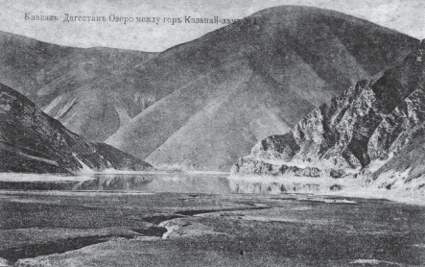
A colossal equestrian throng had swarmed there. Representatives of all the Caucasian Mountaineers—distinguished by markedly diverse physical appearances, having never before seen one another as they were separated by nearly impassable mountain ranges—waited together on the shores of the mountain lake for the arrival of the imam. All these individuals, whom the chaos of the times would later scatter to the four winds or even annihilate, were still brimming with life and hope. The venerable Chechen and Ingush sheikhs had begun contesting for leadership, but because the concept of the Fatherland proved more potent than all else, they swiftly reached an accord with the Christian princes of Georgia and Abkhazia. Such was how the sons of the mountains regarded their loftiest ideals. Early the following day, the thunder of drums and the shrill notes of the zurna heralded the arrival of the imam of Hotso and his comrade-in-arms, Uzun Haji. Encircled by his chanting murids (disciples) and escorted by hundreds of horsemen, he projected the aura of a formidable figure commanding profound reverence. He was proclaimed imam of Dagestan and the North Caucasus. Those vibrant, evocative days spent on the shores of the brilliantly green Lake Andi—the glint of weaponry, the fluttering of banners, the thundering hooves of horses, the vivid garments, the dark, somber figures of the Mountaineers whose wind-scorched, angular faces beneath the towering turbans of the nobility, colossal papakhas, and majestic burkas appeared as ancient as their craggy mountains—are the most unforgettable vistas of my life, permanently etched into my heart. This land, comprised of myriad mountains and valleys, was a single entity. This populace, composed of multitudinous tribes, was a single people. And a singular destiny bound them all.”
Shepherd, Not Dictator: Najmuddin Gotsinsky’s ManifestoAll these narratives categorically demonstrate that the Andi Congress—a critical threshold in the North Caucasus's struggle for freedom, independence, and statehood—was not, as conveyed by secular or atheist politicians, a theatrical facade where peoples were terrified to send their representatives, where Muslim religious leaders threatened lives, and which was orchestrated to declare a Sharia state. It is evident that the public's veneration of spiritual leaders intimidated their political adversaries, including the liberal intellectuals. The spectacle they encountered upon arriving in Andi daunted them, making them realize they would be compelled to play this political game on the very turf of the Muslim opinion leaders. While the election of Najmuddin Gotsinsky as “Imam” by the Muslim masses was fundamentally the selection of a religious leader, they attempted to distort this, framing the office of the imamate as a head of state—as it was in the persona of Imam Shamil—and the position to which Gotsinsky was being elevated as a Sharia Dictatorship.
The marginal persona of Sheikh Uzun Haji of Salta and his orchestration of Najmuddin Gotsinsky’s election as the imam of Caucasian Muslims in Andi could not, in isolation, be accepted as a valid pretext for the Liberal, Socialist, and Monarchist Mountaineer factions to abscond from the congress. The truth was their apprehension of losing the reins to Muslim opinion leaders if the Congress proceeded with its planned agenda in Andi. Najmuddin of Hotso’s sentiments regarding the rank and title attributed to him could be unequivocally deduced from the statement he provided to the Azerbaijani newspaper Müsavat in the ensuing days: [Dibirov, p.31-34]
“To the peoples of the Caucasus!
I, Najmuddin Gotsinsky, am one who relies not on the illusion of my own strength, but on the power of Allah. When I traveled to the mountain of Andi, countless people- Chechens and other peoples of the Caucasus gathered around me. They elected me imam and resolved to obey all my edicts. I told them: 'If that is the case, return to your homes, embrace that which is the duty of every Muslim; abstain from the transgressions forbidden by Allah: murder, theft, robbery, and pillaging. Obey your scholars, muster soldiers capable of defending freedom and the Sharia, grant religious liberty to all Christians and adherents of other faiths, and inflict no harm upon the Russian soldiers who bestowed this freedom upon us.' Upon my return to Andi, acting on the counsel of my like-minded companions, the majority of the populace gathered there determined that it would be more appropriate to designate me as Sheikh al-Islam or mufti. This was done so that Muslims and Russians unacquainted with these affairs would not assume that the election of an imam would rupture the peaceful relations between Russians and Muslims. Such is not the case: The fundamental objective is this: To further solidify the relations between our peoples and the Russian people, and to eliminate the possibility of any turmoil and conflict between them. There is yet another reason: Many Muslims studying in Russian schools, disregarding the Sharia, have transgressed the testaments of the Prophet Muhammad (PBUH), outlawed polygamy, and granted married women the right to divorce their husbands to exchange one husband for another. Therefore, a religious leader is required to safeguard the inviolability of the Sharia, to combat those who violate it, and to implement the laws of the Sharia in life. Driven by these reasons and a profound concern for the Sharia and order, the perspicacious representatives assembled from every province of the Caucasus, authorized by their respective provinces and peoples, implored me to assume religious leadership. They pledged obedience to me as a guardian of the Sharia, and their peoples elected me.
If we are to discuss how I should be addressed, the most fitting title I would wish to ascribe to myself is 'shepherd.' And were it not for these paramount reasons and the necessity for my mediation, I would never have accepted any entreaty to assume such a title. I have therefore granted my consent and am prepared to labor to the best of my ability for the Sharia and for the peoples who adhere to this Sharia; for this, I am ready to sacrifice my life, my property, and my family.
Therefore: O scholars of the Caucasus and other regions! O you, sheikhs, representatives of cities and villages, the wise, khans, young men, the valiant, the affluent, governors, believers in Allah and His Day of Judgment, those who hope to meet Allah, and those who revere the Holy Quran and the Kaaba (Mecca), I call upon you for aid in the name of Islam; assist me in this consequential endeavor with all your might: scholars with their erudition, sheikhs with their prayers and counsel, the wise with their intellect, the affluent with their wealth, the valiant with their courage and gallantry, physicians with medicine, engineers with technical science, and craftsmen with their trades. May all of you assist me.
Let those whom the people travel from city to city, from village to village, dispensing counsel and educating the masses.
Such circumstances may arise: Among the peoples, some do not recognize the Sharia and content themselves merely with bearing the name Muslim. They must know that if they reject even a single letter of the Sharia, even if they pray to Allah ceaselessly day and night, they deviate from the religion and are excised from the ranks of Muslims.
The Sharia possesses its own definitive laws and boundaries. By the grace of Allah, in defiance of these apostates, we shall execute the Sharia in its inviolable and unshakable totality, without conceding a single letter.
Henceforth, let the peoples who have undertaken to protect the Sharia and freedom establish the Sharia order and treasuries to fund this path. Let them register the names of those committed to defending the Sharia and freedom in alphabetical ledgers and appoint their administrators (managers) from among them.
O Muslims of the Caucasus! Do not inflict harm or injury upon adherents of other faiths, upon Georgians, Russians, and Jews. Respect neighborliness. If there are among them those who harbor enmity and refuse to desist, grant them a respite. Perhaps they will regain their senses; if they do not come to reason, then administer the punishment they deserve.
O people of the Caucasus! Shafi'is, Hanafis, and Shiites residing in the south and the north! You are all brethren to one another! Unite, do not fracture! If you fail to unite, your power will remain inconsequential; do not depart from unity! That which is in the north is not in the south, and that which is in the south is not in the north! One of you is rich in knowledge, another in intellect, another in valor and resilience against the arduous hardships of life; let each put forth their own strength. Let one compensate for the deficiencies of the other. Remain vigilant in these perilous times. Only Allah knows what the future has prepared. I fear that the slumbering will provoke a thoughtless, blind anarchy that shall awaken them with a devastating blow. The plight of the sleepers will then be bitter, and their slumber will avail them naught.
If there is no vigilance, it will be just as valor aids the valiant; akin to the prophet's teaching, if a rich man does not aid his destitute neighbor, his wealth will offer him no salvation.
The Commander of the Faithful (may Allah bless his name!) has declared: "The wise man contemplates a calamity before it transpires, so that this calamity does not catch him unawares and he does not fear it, for he has pre-emptively deliberated upon it."
My final word to you is this, O Muslims! I, as one who has emerged to resurrect the deceased tenets of Allah's Sharia, am not in pursuit of a khanate. I know no 'cloak' other than the cloak of servitude. I summon you to aid me in this endeavor. He who refrains from assisting me shall be my adversary in the Hereafter, on the Day of Judgment. If a man emerges among you who declares he will not obey the shepherd, I shall answer him thus: "If there is another suitable for this task and prepared to sacrifice his life, I shall be the first to obey him, and I will ceaselessly cleanse his feet." With this proclamation, I address not merely one people, but all Muslim peoples as far as my voice can reach, urging them to expend all their vigor to revive the Sharia of the Prophet. In short, this is the essence of a long narrative. May Almighty Allah grant us strength.”
As can be discerned from these candid and sincere declarations, Najmuddin of Hotso's sole aspiration, as a devout figure, was merely to secure the guarantee of living his daily life as a faithful Muslim under the aegis of a free and independent Mountaineer state.
The Vedeno Resolutions and the Legacy of the ResistanceAbandoning Andi, the political “elites” who convened in Vedeno on August 20 deliberated on several agenda items of the Andi Congress and ratified a series of resolutions: [Kotse (Kosok), p.47-48]
1. All lands and forests declared Tsarist property during the conquest of the Caucasus shall be restituted to the peoples who lost them.
2. Subterranean resources and waters constitute the national wealth of the Caucasus.
3. An agrarian and control commission shall be established to execute the aforementioned measures swiftly and appropriately.
Furthermore, a provisional constitution was ratified. According to the foundational provisions of this constitution:
A temporary constitution was also approved. It had the following basic provisions;
1. The peoples of the Northern Caucasus form a Political Union.
2. Within the borders of the Union, each people is autonomous.
3. To decide on problems of common interest to the Union, a legislative body is organized, consisting of two houses: the lower house symbolizes the conception of free peoples and has deputies elected on the basis of 1 for every 30,000 population. The upper house exemplifies the idea of the unity of the peoples: each people is represented by three delegates.
4. Both houses jointly elect the government. The Central Committee will constitute the first national government. It will apportion the necessary functions to each of its members.
5. In view of the deteriorating political situation, the Congress invests the Central Committee with exceptional power: the right to organize a National Army; to prohibit the export of basic consumer goods from the country; and finally, the right to proclaim the independence of the North Caucasian Republic at the most opportune moment.”
Regrettably, the liberal, socialist, and pro-Russian monarchist politicians—the majority of whom espoused secular or atheistic worldviews—had not yet sufficiently internalized the concept of a free and independent Mountaineer state at that time. Socialists, bourgeois intellectuals, and other liberal cadres were compelled to defend and prove the validity of their theses to persuade society. Conversely, the religious leaders operated under no such obligation to prove their theses, for their point of reference was the holy book. Consequently, their capacity to gauge the pulse of the public vastly exceeded that of the bourgeois intelligentsia. Despite this, the bourgeois intellectuals' perspective on the devout masses remained unaltered. The innocent demands of devout Muslims were perceived—or deliberately portrayed—as an attempt to establish a “Sharia dictatorship.” Ergo, as novice travelers on the path to statehood, the Mountaineers of the Caucasus failed to successfully navigate this second test of democracy.

Istanbul, October 13, 2026
References: (Click on the links to access books from our reading room)
— Muhammed Kadı Dibirov, Istoriya Dagestana v Gody Revolyutsii i Grazhdanskoy Voyny, Makhachkala, 1997.
— Alibek Takho-Godi, Revolyutsiya i Kontrrevolyutsiya v Dagestane. Makhachkala, 1927.
— Badrutdin Kashkaev, Ot Fevralya k Oktyabryu, Moscow, 1972, s.42.
— Shalva Amirejibi, Iz Nezavershennogo Proshlogo, Gortsy Kavkaza, No.4-5, 1929.
— Gadjikurban Kakagasanov, Leyla Kaymarazova, Soyuz Obedineniy Gortsev Severnovo Kavkaza i Dagestana (1917-1918), Makhachkala, 2013.
— Hadji Murad Donogo, Andiyskiy Syezd, 1917 g., Makhachkala, 2017.
— Boris Kuznetsov, 1918 God v Dagestane: Grazhdanskaya Voyna, New York, 1952.
— Pshemakho Kotse (Kosok), “Revolution and Sovietization in The North Caucasus”, Caucasian Review, No.3, Munich, 1956.
— Halil-Beg Mussayassul, Das Land der Letzten Ritter, Munich, 1936 (German Original).
— Halil-Beg Musayasul, Strana poslednikh rytsarey, Makhachkala,1999, (Russian translation).