
 Türkçe
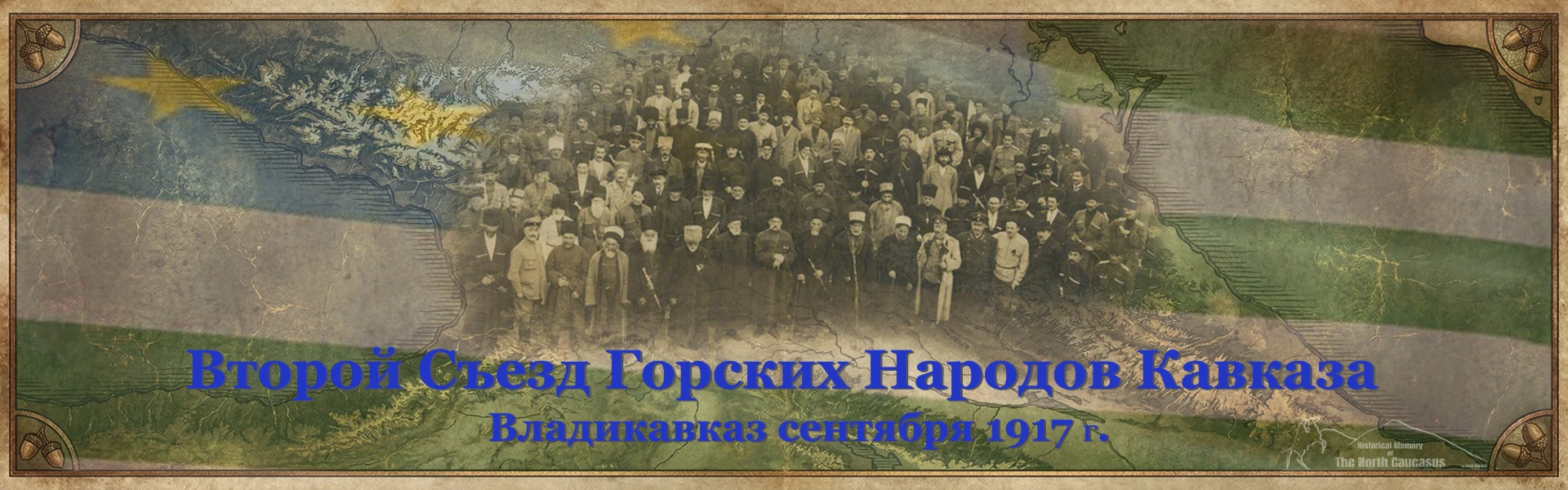
October marked one of the most significant pages in the history of the North Caucasus: September 21–23, 1917, the Second Vladikavkaz Congress of the Union of Mountaineers… The date of September 21 in the Julian calendar corresponds to October 4 in the Gregorian calendar used today. In this article, I will share the content and details of this important historical event in light of the documents accessible today.
After socialist, liberal, and status quoist monarchist groups sabotaged the Andi Congress, the Central Committee of the Union of Mountaineers wasted no time and immediately began preparing for another congress in Vladikavkaz. The newspaper Gorskaya Zhizn (Mountain Life), which served as the official organ of the Central Committee of the Union of Mountaineers, announced in its September 10, 1917, issue that the Congress would open on September 21 at the Grand Cinema Hall in Vladikavkaz. Unfortunately, only certain transcripts of the Second Congress of Mountaineers were published in Gorskaya Zhizn and Terskiy Vestnik, the organ of the Terek Regional Executive Committee. Seven transcripts of the congress sessions held on September 21, 22, and 23, 1917, were published across five consecutive issues of Gorskaya Zhizn (issues 15-19). Other materials about the Second Congress did not appear in subsequent issues of the newspaper. Terskiy Vestnik, on the other hand, only published commentary articles regarding the speech of Sultan Krym Girey and the report of Rashidkhan Kaplanov. The resolutions adopted at the Congress were published in their entirety in Istanbul in 1918 by the Committee for the Assistance of North Caucasian Political Emigrants in Turkey, in a work titled "Report on the Assemblies of the Peoples of the North Caucasus and Their Legislative Work."Congress Preparations and Documentary Sources
Today, issues of the newspaper Gorskaya Zhizn are preserved only in the inventories of state archives in Vladikavkaz and Moscow and are not accessible to researchers. These archives dismiss applications with responses such as "maintenance and repair work is being carried out in the archive" or "access to the material is currently closed," without any information on when they might reopen. Thanks to North Caucasian historians like Amerbi Khazretovich Karmov and Timur Magomedovich Muzaev, who had the opportunity to examine the issues of the newspaper during periods when access to the material was not restricted, we have access today to records that provide an adequate understanding of the transcripts of this Congress.Archival Access and Historical Research
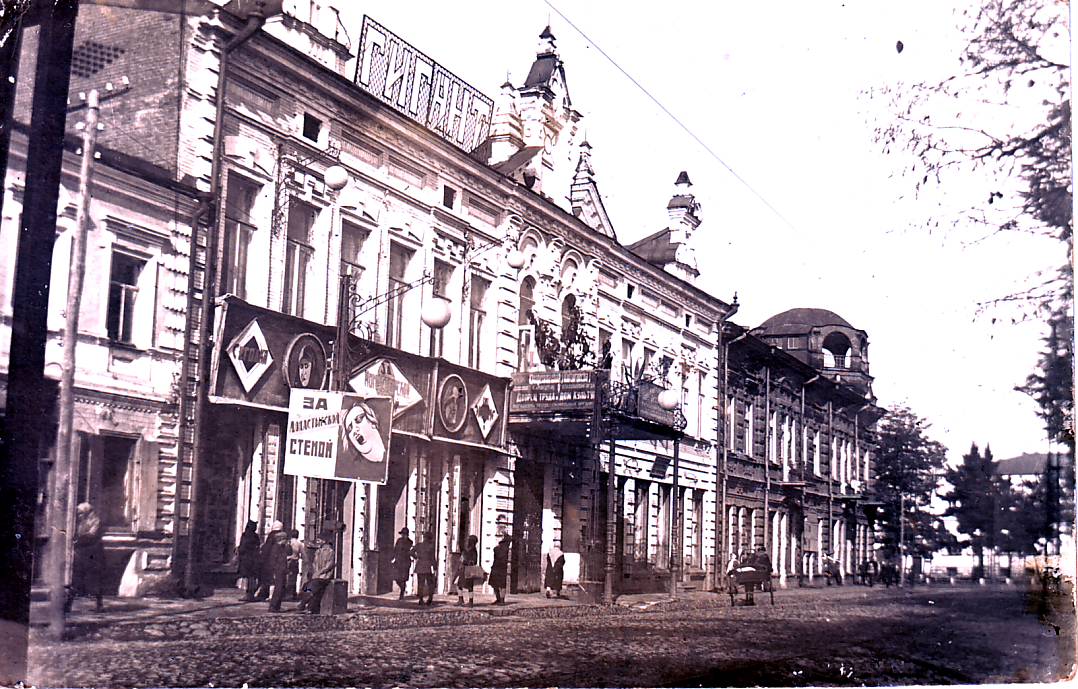
After the scandal in Andi, it was decided to hold the Congress of Plenipotentiary Representatives of the Mountaineers in Vladikavkaz for a second time, and this time, representatives of religious groups were also invited in an attempt to rectify the mistakes made in the previous two congresses. From the available materials, we glean the following information regarding the first day's proceedings of this Congress, which opened at 14:00 on September 21 at the Kinoteatr Gigant (Giant Cinema) in Vladikavkaz and stands as one of the most important milestones in North Caucasian history:September 21: Opening, Delegate Credentials, and Presidium Elections
T. Chermoev: At our congress, all North Caucasian Mountaineers are represented according to the norm established by the Constitution of our Union – one delegate per 15,000 population of both sexes. …[?] Furthermore, 9 mandates have been submitted to the credentials committee by delegates of our cavalry corps. The committee could not decide whether to grant them an advisory voice or a decisive vote. The committee recommends that this issue be resolved by Congress. — By a vote, the Congress unanimously grants the right of a decisive vote to all delegates of the native corps.
Britayev: In addition, mandates have been submitted to the credentials committee by representatives of various civil society organizations – the union of Muslim teachers, the food administration, etc. – requesting that they be granted the right to a decisive vote. Since the Union's Constitution clearly specifies who is entitled to a decisive vote, the committee did not take these into consideration. A proposal is submitted to grant a decisive vote to representatives of national organizations whose activities are directly related to the work of the congress.
Murzabekov: Regarding procedure …[?]. We have a Union Constitution that strictly stipulates the composition of our congresses, and according to it, only individuals elected per 15,000 people possess a decisive vote. We cannot violate the Constitution.
A delegate: If the first congress approved the Constitution, the second congress has the authority to amend it.
Kotsev (Central Committee Member): The Central Committee, while defending the inviolability of the Constitution, never wishes to infringe upon anyone's rights. It states that everyone invited to the congress can express their opinion on an equal footing with others. However, the right of decision belongs solely to the delegates. Our Constitution dictates this, and changing it at every congress like changing gloves is practically equivalent to having no Constitution at all.
T. Chermoev: If we grant a decisive vote to everyone attending the congress, our voting may not reflect the views of those who elected their own deputies to the congress. We made an exception only for the delegates of our cavalry corps, and we acted entirely correctly and democratically, deviating almost not at all from the representation norm adopted in the Constitution.
Urumagov: Granting the right of decision only to military delegates while depriving other organizations of this right is neither very consistent nor democratic. Chairman Chermoev puts the matter to a vote. By a majority vote, with 2 against, the Congress decides to grant an advisory voice to the delegates of the various organizations.
Britayev: A mandate of a delegate from the Great Ossetia community of the Mozdok section has been submitted to the credentials committee. The population of the community is 7,000–7,500 people, whereas the Constitution stipulates representation per 15,000 people. By a vote, the Congress allows this delegate to be granted an advisory right.
Britayev: In the committee, there are several Dagestani mandates containing certain surname inaccuracies. The Dagestan section confirms that these individuals were correctly elected. By a vote, the Congress approves the mandates of the Dagestanis.— Britayev reads the names of the delegates possessing a decisive vote.
T. Chermoev: On behalf of the Central Committee of the Union of United Mountaineers, I greet this congress and our esteemed guests. This congress is the second since the establishment of our Union. Four months of our work are behind us, and this work has demonstrated that our Union, which emerged almost instinctively, has now become a dictate of reason. From the subsequent work of our congress, you will see that the Union of United Mountaineers connects the peoples of the North Caucasus not only in thought but also on the most realistic ground. The work of the Central Committee, the executive organ of our Union, has taken place under very arduous conditions. There was scarcely a single quiet minute to work. From the report, you will see what the Central Committee managed to accomplish and what it could not. The working program of our congress is highly extensive. We will have to address the fundamental problems of the era and overcome immense difficulties stemming largely from the fact that we lack a press in our own native languages, and the populace is fed solely on rumors. Our program contains very acute, daunting issues, and we must remain exceedingly calm to resolve them. Everyone must set aside all personal considerations and be guided solely by public interests. The general situation dictates to us the absolute necessity of complete mutual trust. If someone speaks incorrectly in your opinion, believe only that they are mistaken. The Central Committee calls upon you to calmly and swiftly resolve the issues of Mountaineer unity, which are as collectively necessary to all of us as our need for air (Applause). The Central Committee proposes that you determine by ballot the candidates for the congress presidium, which will consist of a chairman, four vice-chairmen, and two secretaries. Guests may also vote; likewise, not only delegates but guests may also join the presidium.
Deni Sheikh: I propose that presidium candidates be nominated from every people, and that the candidates elect the presidium from among themselves.
E. Yashel: To save time, I propose that the presidium be elected by open voting rather than by ballot.
Khestanov: Is it not possible for the Central Committee to assume the presidency?
T. Chermoev: The Central Committee has no moral right to do so.
Sokhov: Are Central Committee members delegates to the congress?
Kaplanov: The Union Constitution states a single thing: Congress delegates are elected as one person per 15,000 people. It is clearly understood from this that Central Committee members are not considered delegates unless they are elected to the Congress.
Bammatov: I wish to warn the Congress against a slavish adherence to the letter of the Constitution. Central Committee members must unconditionally be accepted as delegates.
Chairman Kotsev: I put the question to a vote: Does the Congress wish to elect the presidium solely from among the delegates, or from among everyone present at the Congress? By a large majority, the Congress decides to elect the presidium from among everyone present.
Chairman Kotsev: Does the Congress want the presidium to consist of 7 people, or does it accept Deni Sheikh's proposal? The Congress decides by 63 votes to 36 to elect a 7-member presidium.
A delegate (from the floor): We were told that the total number of delegates was 62-68, yet a hundred people are voting.
Chairman Kotsev: Delegates continue to arrive; there must be more than a hundred now.
Chairman Kotsev: Does the Congress wish to hold the presidium elections by ballot or by open voting? The Congress decides by 52 votes to 46 that the elections be held by ballot. A 10-minute recess is called for the session. The session resumes at 5 o'clock.
Chairman Kotsev: I ask the congress members to submit their ballots. I also ask you to register for the sections (committees) with Central Committee member R. Kaplanov – to ensure more productive work, the congress should be divided into eight sections in accordance with the program. The sections are as follows: 1) Religious, 2) People's Militias, 3) Agrarian and Local (Land committees, soviets of peasant deputies), 4) Constituent Assembly elections, 5) Financial, 6) Food Supply, 7) Political, and 8) Educational.A recess is called. The session resumes at 6 PM.
Chairman Kotsev: I announce the results of the voting for the presidium members: By a majority of 170 votes, T. Chermoev has been elected as the chairman of the congress (Applause). For vice-chairmanships: P. Kotsev, T. Alkhazov, E. Britayev, R. Kaplanov (Applause). For secretariats: Z. Temirkhanov and V. Dzhabagiyev. (Applause).R. Kaplanov announces that the committees have commenced their work. The session closes at 6:10 PM; the next session is at 10 AM on September 22.
September 22 Session opens at 11 AM. T. Chermoev is presiding. After opening the session, T. Chermoev yields the floor to Colonel Sultan Krym Girey, commander of the Chechen regiment and chairman of the union committee of the native cavalry corps.September 22, Morning: The Cavalry Corps and the Kornilov Affair
Colonel Sultan Krym Girey: I am not a politician. I am merely a warrior. I cannot convey to you the emotions that returning to our family has created in us. For three long years, we were far from you on the merciless battlefields. But we believed in you wholeheartedly and worked quietly there. And now, having arrived here, I sincerely greet you on behalf of all the Mountaineer cavalry. We were far from you, but at the same time, we have always been close to you. On the battlefields where we did not engage in politics, we always considered it our duty to fulfill the orders of our commanders. Over three years, and especially recently in connection with Russia's difficult days, we experienced a great deal. In line with General Kornilov's well-known speech, it must be stated that the Central Committee of the Union of the North Caucasian Mountaineers played an immense role. We received numerous telegrams from the Central Committee urging us not to interfere in Kornilov's rebellion. It is not for me to evaluate how our corps was exploited in a military sense; moreover, our neighbors did this to us, and everyone knows it. We accepted the revolution in Petrograd from the very first moment, but unfortunately, here too, like others, we were subjected to attacks from various circles. Nevertheless, these attacks did not disturb us. We always kept in mind that we are merely warriors and that public and political affairs are the business of our elders and brothers. We are conscious of our own characteristics. There are no class distinctions; we have no party, and the class struggle is foreign to us. Therefore, attempts to drag us into the class struggle were futile. Because we do not see a special difference between the rich and the poor among us, there are no beggars in our companies, which possess enormous wealth. Thus, we preserved the discipline that others destroyed. I now turn to the famous Galician offensive. This offensive was to be a test for the Russian revolutionary army. You know that this offensive had undesirable, very tragic moments, and I will not dwell on them. Our Mountaineer troops also participated in this offensive. In combating this phenomenon, the command relied primarily on the cavalry and artillery units, where discipline was more or less maintained. Of course, we also had minds and brains. However, our commanders admonished us that our troops could never participate in the formation of political will and that maintaining order in the army required us to undertake only tasks of a military nature and stay away from all political conflicts. Our view on this matter was later presented to the former Commander-in-Chief Kornilov. In June, we clearly articulated our views and our reluctance to participate in any political struggle. We continually emphasized that we were solely warriors and would not transcend that. As you all know, we played the greatest role in the offensive. I will not dwell on this. I can say that our Division, which later transformed into a corps following unceasing fierce clashes, became extremely exhausted. Shortly thereafter, it was learned that our Corps would be transferred to Proskurov. After a long wait there, we were ordered to move down to the Northern Front. We felt no distress about this. We knew the difficult situation in the Riga region on this front. From this, it could be assumed that our Corps was being directed to the shores of the Baltic Sea or Finland, where an enemy landing could be expected. It was rumored that the Corps might be sent to Petrograd against the Bolsheviks, but in any case, we knew nothing certain. The echelons of the Corps reached Dno. On the morning of August 27 at 3 AM, a new order was received to move to Gatchina. We saw no distress in this either. As I said, we could have been sent from Gatchina to the Baltic coast or Finland. Therefore, the order was executed immediately. The Corps was gradually transported to the designated point. The Ingush regiment went first. Then the others... During the disembarkation of the troops at the Dno station, certain peculiarities began to be noticed. Telephone messages arrived from various quarters. Some strange rumors were heard. There was some sort of squabble among the railway representatives. It seemed someone wanted to do one thing, while others wanted to do something else. An order was received from headquarters that our troops must be transported to the designated point. In the afternoon of August 28, it was learned that General Kornilov had issued an ultimatum to the Head of the Provisional Government and had been declared a traitor by the Government. Since we did not know the true objective, our operation still did not halt. We only knew the orders I mentioned to you. On the night of August 29, we halted at Vyritsa, 60 versts from Petrograd. "From the front lines" – I say this because we later realized that further ahead, the lines of Kornilov and the government troops had already formed – we received a message from the front lines that further movement was impossible. This was because the railway track had been dismantled, and the Ingush train ahead had stopped. I must digress slightly here; the truth is, I received and still receive many messages stating that our commander and especially I played a strange role near Petrograd. If these rumors concerned only me, then I would not bother you with them. But we are speaking about our unit here. I must reiterate what I have said repeatedly about these rumors: As the commander of the Circassian Regiment, I did everything necessary to ensure that the Circassians would in no way be held responsible for the great troubles that might occur. What could these be? You know. On the morning of August 29, it was learned that a delegation from the Central Committee of the All-Russian Muslim Council had arrived to meet with us. This delegation included the following individuals: Committee Chairman Akhmet Tsalikov (Tsalykkaty), a representative of the Shamil family, Zahid Shamil, Aytek Namitokov, Prince Machabeli representing the Georgian military organization, and others. The delegation explained everything that was happening and urged us under no circumstances to proceed further. I told the delegation that they could rest assured. Because our Regiment did not think otherwise, and probably the entire Corps was of the same opinion. Yet I added that our Regiment would not obey any isolated call, but would act together with our entire Corps. You can be assured of the Corps' decision, because we have made a definitive resolution; we will not participate in any political struggle. This quite pleased the delegation. At this point, Machabeli took out a piece of paper and read Kerensky's order regarding our return to the Caucasus for rest. I told Machabeli, "You can inform Kerensky that the unit will not turn back because of what is written on this paper. Such papers can only be written to reserve infantry units to advise them to rest instead of fighting." Nevertheless, it was true that our Corps genuinely needed rest. On August 30, I informed the authorities that we knew the true purpose of our dispatch and that, as we had repeatedly stated before, we under no circumstances would intervene in the internal struggle and therefore never execute this deployment order. Thus, as a regiment commander, I declared that I vehemently refused to lead my regiment into such an affair. The division commander agreed with me. You ask what was happening in the entire Division at that time? There were mutinies everywhere. There was unrest among us as well... Of course, not in the sense of indiscipline. There was restlessness in our mood. There were conversations and questions. Where and why was our unit going? Meanwhile, on August 29, the Kabardian and Ossetian troops arrived, having formed a committee and conveyed to Prince Bagration, the former commander of our Corps, the necessity of seriously discussing the current situation. On August 30, the Division was halted, and all regiment, company, and other committees were ordered to assemble at Division headquarters. On the morning of August 31, the committee delegates arrived at Division headquarters. Representatives of the All-Russian Muslim Committee, representatives of the Soviet of Workers' and Soldiers' Deputies, a representative of the Central Committee of Soviets, and others also came there. The meeting began under my chairmanship. Here, we unanimously resolved that none of us could think of anything other than being warriors and that we would not be drawn into any internal struggle. A special delegation consisting of three people from each regiment was elected to inform Kerensky, the Head of the Provisional Government, of our decision. At this point, a bit of an argument ensued. A situation arose where some elements, primarily Russian soldiers, seemingly insisted that we go with a confession. Since we had absolutely nothing to be blamed for, we did not deem such behavior fitting for ourselves. At twelve midnight on September 1, our group of seventy people went to see Kerensky, who was also the Commander-in-Chief at the time. The Corps commander, Prince Bagration, was also among us. Kerensky met us at the Winter Palace. I read him our decision. Afterward, Kerensky asked Prince Bagration: "Did you know you were going to march on Petrograd, Prince?" Prince Bagration replied: "No." "I knew," said Kerensky, "The Mountaineers could not have done otherwise." The next day, we went to the Chairman of the Muslim Council of the All-Russian Muslim Union (Akhmet Tsalykkaty) to thank him for his brotherly attitude toward us. But before going there, we decided to straighten ourselves up a bit from a military standpoint. We did not want to allow even a moment of disorder among us. After the Muslim Soviet, we still had to go to the Central Committee of the Soviet of Workers' and Soldiers' Deputies at the Smolny Institute, where we had been invited. Then I learned that some of our delegates were already at the Smolny Institute. I immediately ordered everyone to report to the Muslim Council. It was done. It was here that everything began to be discussed. The truth is, near Petrograd, our troops had been subjected to a heavy assault by agitators. For some reason, they began looking for a culprit among us. After tidying ourselves up a bit, we went to the Smolny Institute. We were received very cordially here. Members of the Central Committee of the Council of Workers' and Soldiers' Deputies—Tsereteli, Chernov, Skobelev, and Arkhangelsky—welcomed us. The following day, the delegates were released to their units, while I remained in Petrograd. Here, I learned that our troops were not going to the Caucasus, but were being sent elsewhere, behind the Northern Front. However, General Polovtsev, who had been appointed to the command of the Corps and was always by our side, did everything to ensure we were sent to the Caucasus. General Polovtsev sent a detailed report to Kerensky through me. The report detailed all the justifications for the necessity of our transfer to the Caucasus. Commander-in-Chief Kerensky was at headquarters when I took General Polovtsev's report. I explained to Kerensky all the reasons for our dispatch to the Caucasus, where we could physically and morally gather strength anew. Kerensky said he agreed with me, even though he was told that sending us to the Caucasus was dangerous. But Kerensky asked me to give him my word that upon our arrival in the Caucasus, no excesses would be permitted and that the troops would preserve and strengthen their combat effectiveness. I promised Kerensky that I would do everything necessary for this and stated I believed all our institutions would make every effort to achieve this. And you, our elders and brothers, will also do everything in your power to preserve the warrior character of our troops, which you have well known since time immemorial.
Chairman T. Chermoev: Fathers and brothers of our glorious Caucasian corps. If we wished to express all the sentiments we harbor for our corps, we would need a great deal of time. Therefore, I will only say this: Our corps has everywhere and always acted chivalrously, and I will content myself with a brief expression of our feelings toward it: "Long live our heroic Caucasian corps!" (Thunderous applause, loud shouts of "hurrah"). Chairman T. Chermoev: I leave the floor to General Polovtsov, commander of our glorious corps.
General Polovtsov (Loud applause): I greet with great pleasure your sons, whom I have watched with admiration for three years. If, in the past, during the old regime, the Caucasus was called the 'pearl in the crown,' it can now be said that the Caucasian regiments are the pearl of the Russian army (Applause). I came here not only to once again admire your proud warrior sons but also to help them in their difficult times. And truly, the times are difficult. By the will of the Bureaucracy, your troops were rendered temporary units, but now, by a twist in our homeland's fate, they must become the national troops of the Caucasus (Loud applause, everyone stands, shouts of "hurrah"). But doing this is not so simple. It is a difficult and highly complex task; its solution must be approached carefully and prudently. I must say that I am an old supporter of structuring armies on a territorial principle. After the revolution, while serving as the Commander of the Petrograd Military District, despite the judgments and views of the command echelon on this matter, I established Ukrainian companies there, and I must testify that they were magnificent units. I believe I can do the same here. I will not differ with your Union Central Committee on this issue, but I also need your help. I must tell you that in this upcoming task, it is necessary above all to do everything possible to maintain discipline in your troops. It has already been indicated to you that discipline in some of your troops has been somewhat shaken. This is not surprising: the occurring revolution, contradictory orders from Headquarters and Petrograd, provocations, etc. — it was impossible for all this not to negatively affect your troops. This is precisely the reason I insisted on transferring the corps here. I was certain that in a healthy mountain village, the troops would find the fresh air that would revive their discipline. I now call upon you: Summon your cavalrymen to discipline, explain to them that they are no longer the mercenaries of the old government, but warriors called to defend their homeland. And my presence here is a guarantee that your troops will not be involved in any dirty business (Applause). My request to you is that your troops absolutely not be used in fratricidal conflict with your neighbors, and especially—God forbid—in a civil war (Applause). Thus, I once again invite you to assist me in this work that I conduct with the glorious sons of the Caucasus (Loud applause).
Suleyman Mullah Goysumov: In the moment of despair we all experienced, we did not know what to do with our old evil, the looting and robberies. We saw evil from all four sides, and we were even subjected to violence. We wondered where the power was that would finally rein in the Abreks. And we prayed to God for this miracle to happen. And the miracle happened; our corps arrived, and now we will be able to establish the order and tranquility in our lands that are so necessary for the construction of our new life (Applause).
Beysultan Mullah Tahirov (Mullah of the Chechen regiment): We, men of knowledge—the leaders of our region—saw that miracle in a moment of our despair; our corps arrived. The corps commander seeks no personal gain; he only desires the construction of our corps and our new life, and God will help him; with our joint efforts, we will guarantee the freedom of all peoples.
Colonel Bayev (Applause): Three years of war – three years of freedom for our corps. But victory is won through blood, corpses, and much pain and hardship. When you pray, pray to God to grant your corps victory (Applause).
A recess is announced from 13:30 to 15:00. After the break, the session resumes at 14:00. T. Chermoev presides.September 22, Afternoon: Greetings, Regional Cooperation, and Food Supply
Chairman: The floor is given to the Ataman of the Terek Cossack Host, M. A. Karaulov, for a greeting speech.
Karaulov: On behalf of the Terek Host Government, I greet your Congress. The Mountaineers had already listened to our greeting message at your first Congress, where the revolution was celebrated. Now the ordinary days of the revolution have arrived. It is necessary not to utter beautiful words, but to accomplish difficult tasks. Over the last ten years, relations have deteriorated. But now a different time has come, and the Cossacks understand that the only true owners of the lands here are the Cossacks and the Mountaineers (vigorous applause). Knowing this, immediately after the revolution, the Cossacks set about putting their own affairs in order. The Cossacks know that you too will soon put your affairs in order and subsequently begin building a common life with them. The Cossacks also know that it makes no sense to rely on Petrograd anymore when it cannot even govern itself (applause). Let Petrograd handle the difficult task of organizing power in the upper echelons. We, here, locally, will do the things the government cannot, or perhaps does not want to do (applause). The Cossacks hope that they will see friendly support from you in this regard. This is what I am authorized by the military government to declare before you (vigorous applause).
Chairman: For the welcoming speech, the floor is given to Ensign (Khorunzhiy) Ryabtsov, the representative of the Kuban Cossack Host.
Ensign Ryabtsov: Glorious Mountaineers of the wonderful, beautiful Caucasus. I am happy to greet you on behalf of the free Kuban. We have lived side by side with you for a long time, but for reasons we cannot fathom, we could never blend. Now the past is behind us; everything has changed, the opportunity for a happy life is emerging, and the task of building this new life falls to you, the strongest representatives of your peoples. And the free Kuban Cossacks have sent me to tell you that the time has come to walk together in organizing our common affairs (applause).
Chairman: For the welcoming speech, the floor is given to Captain (Sotnik) Tomashevski, representative of the combat units of the Terek Cossack Host.
Captain Tomashevski: I greet you on behalf of the Congress of Delegates of the Combat Units of the Terek Cossack Host. We were at the front for three years and did not interfere in affairs here. Now we too have decided to participate in the construction of the new life. We know we have a great deal in common with you. Our paths are yours, and your paths are ours. If we maintain good neighborly relations, we will easily accomplish the rest. Both you and we have impetuous people who think our urgent problems must be resolved only by force. But you also know that we cannot resolve our affairs this way. Neither can you take our place, nor can we take yours. It seems walking together is best for us (applause). Here is the resolution unanimously adopted by our congress, expressing our view on this matter: "In the days of great ruin of the Russian State, while the constant growth of anarchy in the country threatens not only prosperity but also the very existence of both individual classes and groups of people, and in this anxious period recognizing the commonality of the interests of the Cossack and native populations in the Terek region, the Combat Congress believes in the necessity of the closest unity and friendship in joint work with native neighbors. Through the mutual trust of these two organized forces, the peaceful coexistence of both the Cossacks and their Mountaineer neighbors will be ensured. We hope that the Mountaineers will take all measures to stop robberies, one of these measures being the surrender of the Abreks. The Congress hopes that the Mountaineers will assist the Cossacks in this regard and that the Cossacks, together with their native division, with the personal help of the Mountaineer village populace, will succeed in capturing the Abreks and securing peace and order in the region." We are sure the era of oppressing peoples has passed, and we hope that together with you, we will establish an order here that is highly necessary for both you and us (applause).
Chairman: For the welcoming speech, the floor is given to Skrynnikov, representative of the regional center and the Terek Regional Committee of the Soviets of Workers' and Soldiers' Deputies.
Skrynnikov: Esteemed citizens. While greeting you at the first congress, I noted that the old regime had sown discord between us and expressed my hope that by overcoming these obstacles, we would draw even closer to one another. And this proved true. We have been working together with your Central Committee from the beginning. In particular, the events of recent days caused by Gen[eral] Kornilov have definitively proven to us that we can successfully defend the congress's cause only by working in close contact. We believe that thanks to what was experienced during the revolution, the unity between rural and urban democracy has solidified to such an extent that no force remains to destroy it. In conclusion, I propose that the delegates of your military units arriving here be sent not to the district assembly, but solely to the provincial assembly (applause). Then we will succeed in securing the republican federal structure not only here, but across the entire region (applause).
Chairman: To respond to the welcoming speeches made, the floor is given to Central Committee member Vassan Girey Dzhabagiyev.
V.G. Dzhabagiyev: On behalf of the Central Committee, I greet our esteemed guests. We have heard the welcoming words of various organizations here, and I must say that, in general, we are in harmony with these organizations. However, there were some moments that divided us. This primarily occurred on the basis of the actions of irresponsible forces. We are ready to live together with the Cossacks. What separated us from them up to now was their inclination towards centralism. Now the Cossacks have clearly and unambiguously declared that they are in favor of federalism, and from this moment on, we have a common line of conduct strengthened by our past life together. Our unity with them must now be tighter and more honest. We are also ready to work in the future with the Soviets of workers' and soldiers' deputies, for we are no less democratic than they are and will equally defend freedom and the revolution (applause).
Chairman: The floor is given to Col[onel] I.A. Mikhaylov, the commissar of the Terek Region.
Col[onel] Mikhaylov: I greet the Second Mountaineer Congress. A colossal and responsible work awaits your congress. It appears Russia is being built upon new federal foundations, and this places new tasks before us. From the first days of the revolution, we saw that the Mountaineers set about organizing their own affairs and achieved much in this regard, but there is still much more to be done, especially in places where culture is poorly developed. The struggle against the phenomenon of Abrekism, an irritating fact of the Terek region, has also not successfully concluded to date. But we hope that now, with the arrival of your corps, this evil will be ended one way or another. Furthermore, I hope that the Mountaineers will not allow people in neighboring regions to die of starvation. The Mountaineers will provide bread. In conclusion, I wish you productive work (applause).
Chairman: For the welcoming speech, the floor belongs to Bammatov, representative of the Transcaucasian Soviet of Peasant Deputies and member of the Regional Center.
Bammatov: The honor of greeting you on behalf of the revolutionary Transcaucasian peasants has fallen to me. In these terrible days when political thought is shaken, when threats to the revolution come from the right and the left, the revolutionary peasants of Transcaucasia, where the banner of freedom flies high and victoriously, firmly believe that the cause of freedom cannot perish. The revolutionary peasants also know that there is no freedom outside of revolutionary democracy, nor can there be. Those there also know that, if necessary, the proud Caucasus will know how to rise with arms in hand to defend the gains of the revolution. From beyond the mountain range, the revolutionary peasants of Transcaucasia extend the hand of brotherhood to you (vigorous applause).
Chairman: The floor is given to A. Dudarov, Deputy Chief Representative of Food Supply in the Caucasus.
A. Dudarov: On behalf of the Transcaucasian Food Committee, I greet you and wish you productive work in our arduous tasks. Unfortunately, I am forced to somewhat overshadow those noble efforts expressed here. I must speak about the food situation in the Caucasus, especially the food situation of our Caucasian Army. This issue is of such grave proportion that it threatens all the gains of the revolution. Unfortunately, I do not have the time to present to you a complete picture of the food situation in the country and the Caucasus, but it will suffice to say that due to a poor grain harvest, a true famine has begun in many regions of the Caucasus. The Transcaspian region is also experiencing severe famine. And the truly heavy thing is this: the people of the regions with good grain harvests do not even give bread to the starving regions. Let me point out to you that we are inundated with telegrams requesting bread from the Transcaspian region, and we cannot provide it; the representatives of that region gave us only one answer: "This indifference of yours is cruel." We must also not forget that our Caucasian Army is under such conditions that if we cannot supply our army with sufficient food in the next month and a half to two months, I leave it to you to appreciate the consequences. I cannot pass without mentioning the following point. There is much talk here about the federal structure of our region. While speaking of this, we must not for a moment forget the pitiful state our economic and industrial life is in. We have no industry whatsoever in the Caucasus, and our agriculture is in a primitive state. And if we do not start working on these issues right now, I assure you our dreams of federalism may lack a basis in reality (applause).
Chairman: The welcoming floor belongs to Col[onel] Haji-Murat, representative of the Dagestan regiment.
Col[onel] Haji-Murat (applause): It is my fortune to have the happiness of greeting you on behalf of the Native Division composed of your sons and brothers (applause). Away from home for three years, the Division endured many hardships. We are not cosmopolitans. For the Mountaineer, the home where he was born is everything; the free air of the snowy mountains is his happiness, and freedom is his dream (applause). And now, returning to the valleys of its homeland, the Division greets you, the elders and distinguished representatives who are the guardians of the high traditions of the people. Your sons, who imbibed courage with their mother's milk, fought on the relentless battlefields for three years. Along the two thousand versts of the front, you cannot find a mound under which the remains of a proud Mountaineer warrior do not lie. The Division performed its duty sacredly and proudly preserved the testaments of its ancestors. And nothing worked, neither provocation nor other methods aimed at discrediting the so-called "Savage" division—which in reality was the most civilized division (vigorous applause). We were separated from you for a long time, and it was hard for us, but we always remembered that the blood we shed would soon turn our stepmother Russia into our real mother (applause). Though there was no shortage of vile slander here, just as we were told earlier, we did not forget freedom for a moment. In any case, we fulfilled our duty, and we have no unpaid debts. Even if we bore no military obligation in the past, we more than paid back for our sacrifices in the last two wars (vigorous applause). Perhaps we brought your sons back having slightly forgotten the traditions of their ancestors, but you will know how to restore those to them. And now you will be responsible for your sons. So long live a free Russia and a free North-Mountaineer union built on freedom, equality, and love! (vigorous, long, unending applause).
Chairman: The floor is given to Umar-bek Aliyev, deputy chairman of the All-Russian Union of Muslim Teachers.
Aliyev: I will speak in a pure Eastern tongue, for the East was the cradle of culture and civilization, and civilization and culture must return there again (applause). Up to now, the bond among the Muslim peoples in Russia was weak. This must no longer be the case. We must do everything in our power to rebuild our family. And I am confident that the Mountaineers of the Caucasus will not remain indifferent to this general Muslim cause (applause).
Chairman: The floor is given to Mikoberidze, the representative of the Georgian socialist-federalists.
Mikoberidze: On behalf of the Georgian federalist-socialists, I greet the second Mountaineer congress. I am sure that the hands we mutually extend will warmly grasp one another. The Russian revolution has weathered many trials and tremors, but in the end, the state idea we put forward, namely federalism, has triumphed, and I salute the Central Committee of your union for putting this issue on the congress's agenda. The old bond between us had been severed by the old regime, but now that obstacle is demolished. Let us shake hands! (applause)
Chairman Chermoev: An epic recounting the heroism of our soldier brothers has passed before our eyes here. I propose to pray for everyone who fell on the battlefields, regardless of religion or nationality.A common prayer is recited, and the session is subsequently closed.
Session opened at 11 AM.September 23: Greetings, Congress Charter, and Central Committee Report
Chairman: For the welcoming speech, the floor is given to Ali Asadullayev, deputy chairman of the Central Committee of the Military Council of the All-Russian Union of Muslims.
Ali Asadullayev: Unfortunately, I do not have the time to explain the importance of our council to you. It is generally thought that the majority of Muslims do not perform military service, so organizations like ours appear strange. To dispel this misconception, I will simply say this: currently, there are approximately one and a half million Muslims in the ranks of the Russian army. Thus, our council was established on July 20 of this year. The first Muslim military congress was planned in Kazan. The congress was not permitted, but we gathered in the usual manner nonetheless, and the military council was elected at this meeting. …[?] A telegram was received here from the Caucasus stating that relations between peoples were strained. The congress sent a delegation to the Caucasus, and I was part of that delegation. We firmly established that there were ugly incidents of violence against Muslims in some parts of Transcaucasia. But especially in Trabzon, disgusting incidents were observed where 14 out of 43 mosques were appropriated for the accommodation of military units.
A voice from the floor: Shameful!
Ali Asadullayev: Qurans were being torn and goods wrapped in their pages. In Gyumri, a young Muslim carrying grapes in his basket was attacked by a mob simply because they suspected he was carrying bullets, and they began beating him brutally. As a result, a massacre of Muslims started, in which 12 people died, and 40 were injured. Let me also add this: there is a "Zemgor" depot located in a mosque in Trabzon. Now, when I began to protest this situation, individuals calling themselves socialists labeled me an anti-revolutionary. After discussing this, we decided that only our own national regiments could prevent such fanaticism (applause). I just received a telegram stating that the establishment of national regiments has been permitted (applause). However, gentlemen, we need not national [regiments], but Muslim corps and a Muslim army (vigorous applause).
Deni-Sheikh: When the Muslims heard the talk regarding the desecration committed, their hearts ached. According to the Quran, this is the greatest type of crime a human can commit. It is horrific that people allowed this. Great calamities inevitably follow such crimes.
Chairman: I must clarify Asadullayev's thought. When speaking of socialists, of course, he did not mean genuine socialists. He meant to say that irresponsible persons hiding behind the name of socialists behaved this way. It goes without saying that just as we struggle to deal with the Abreks, democratic organizations are often just as guilty in failing to control an unruly mob. I propose to request democratic organizations to pay very serious attention to putting an end to such disrespect, and I have no doubt they will do so (applause).
Said-Molla: I offer my deepest gratitude to our intellectuals who so deeply feel what Asadullayev reported. We must state here that if such disrespect continues, we will exert every effort to prevent it from happening.
Chairman: For the welcoming speech, the floor is given to Pashkovski, representative of the Bureau of the Soviets of Peasant Deputies of the Terek Region.
Pashkovski: I greet your Congress on behalf of the laboring peasants united in the Soviets. I would particularly like to speak here about the necessity of establishing peasant deputy Soviets among the Mountaineers. The autocratic regime left us a heavy legacy, and even now, its remnants appear when good neighborly relations are disrupted. In this context, peasant Soviets will play a major role. This situation is also highly necessary for the successful construction of a new life. Therefore, I ardently call you to unity (applause).
Chairman: The floor for the welcoming speech belongs to the commander of the Regular Regiment, Colonel Prince Chavchavadze.
Prince Chavchavadze: I greet you on behalf of the Regular Native Regiment and inform you that the commander-in-chief of the Caucasian army has permitted the reconstitution of your units. Henceforth, a sotnia (century) unit will have 400 cavalrymen instead of 140, and in addition, 600 cavalrymen will be at the disposal of the cadre headquarters (applause). Each cavalryman will be given an allowance of 600 rubles along with three months of provisions. I address you with the plea that this unit serve as a bulwark against anarchy (vigorous applause).
Chairman: The floor is given to Colonel Moiseyev, general officer for special assignments at the headquarters of the Commander-in-Chief of the Caucasian Army. (applause).
Col[onel] Moiseyev (applause): The Commander-in-Chief of the Caucasian Army gave me the task of greeting you. I am especially happy to fulfill this duty at this time when your regiments are returning home (applause). It was said here yesterday that you could instill discipline in your regiments, and I believe this. It was also said here that you were revived by the arrival of your troops because they would help you in your fight against anarchy. I must say that the entire Caucasian army shares this joy, as it too suffers from anarchy in the rear (applause). Now let me draw your attention to the sad events that took place in Vladikavkaz. A mob of drunk soldiers attacked Kalmanov, a cavalryman of the Ossetian Division who was performing his duty, and beat him brutally. But Kalmanov did not take offense at this; what really offended him was something else—although he had no intention of firing at the frenzied mob, he lost his weapon because he knew what kind of tragic consequences that would lead to. I reported this incident to the commander-in-chief. He authorized Kalmanov to be given a Parabellum system pistol from the artillery depot. Through your esteemed chairman, please permit this pistol to be presented to Kalmanov.Col[onel] Moiseyev hands the pistol to the chairman. Vigorous applause in the hall. And now, with all sincerity, allow me to express my warmest greetings and, above all, wishes for productive success in your work towards establishing the peace and order so desperately needed by you and our common, suffering homeland (vigorous applause).
Chairman (To the cavalryman Kalmanov behind the rostrum): Before giving the Commander-in-Chief's gift to Kalmanov, I will say this: God, who granted us our lives, says: "I am with the patient." And Kalmanov proved this perfectly. He could have used his weapon, but he did not, because he knew it would be the signal leading to a terrible bloodbath, and Kalmanov preferred to die under the blows of the frenzied mob rather than use his weapon. He knew there were hundreds of soldiers in the city and that if he started firing, it could lead to a horrific clash (applause). Let us hope that all our cavalrymen use their weapons not against those who err, regardless of their religion, but against the enemies of freedom and the revolution (applause). Amid vigorous applause, Chairman T. Chermoev hands the pistol to Kalmanov. Kalmanov thanks the chairman and Col[onel] Moiseyev.
Chairman: For the welcoming speech, the floor is given to Priest Sarikyan, representative of the local Armenian community.
Priest Sarikyan: Honorable chairman of the supreme assembly, we came here to bring you greetings from the Armenian people. We believe that in the free federal Russian republic, peoples will find the happiness they deserve, and the Caucasus will find its own supreme place. Long live the free federal Caucasus! (applause)
Chairman: Representatives of the local Armenians spoke here. We do not doubt that the entire Armenian people also harbor the feelings expressed here towards us. There is room enough for all of us in our wonderful Caucasus, and the time has now come to say this: let anyone who hinders our structure get out. We, however, will find the way to build a new life (applause). The floor is Efendiyev's.
Efendiyev: On behalf of the 30 thousand Dagestani workers in Baku who stand on guard for the revolution, myself and my comrades, I must say that, anxious over the rumors of the congress that failed to take place in Andi due to someone's mistake, I greet this congress. They commissioned me to express the assurances that all Caucasian Mountaineers joining the Union will not deviate from the path of the revolution.
Chairman: The floor is given to the representative of the Union of Mountaineers' Youth.
Datiyev: On behalf of our Union, I greet the Second Mountaineer Congress. The youth follow everything that happens with sensitivity and took an unwavering oath on April 9 to defend the principles of equality, freedom, and brotherhood. We know we are inexperienced. We have very little knowledge. But life will give us experience, and schools will give us knowledge. May God bless your work (vigorous applause).Chairman: The floor belongs to the representative of the Dagestani workers in Baku.
Musakhanov: Socialists were mentioned here who allegedly patronized the persecution of Muslims.
Chairman: Nothing of the sort was said here.
Musakhanov: It is necessary to categorically deny this. If we owe freedom to anyone, it is the socialists who are capable of giving everything to consolidate it. Kotsev takes the chairman's seat.
Chairman: The welcoming speeches have concluded, and we now proceed to the business section. The presidium proposes that the assembly adopt the congress charter for the sake of greater productivity. The chairman reads the charter, and it is adopted by the assembly.It is announced that there will be a recess from 13:30 to 15:00.After the break, the session opens at 16:00.Presiding: Kotsev.Activity report …[?]
Chrm. [Chairman]: The Central Committee of the Alliance was elected at the first [congress] that took place in the first days of May. Since then … [?].
R. Kaplanov: More than four months have passed since that historic day when the oldest and most respected representatives of the Mountaineers, in accordance with the tradition of their ancestors, registered with magnificent consensus the newly born Alliance of the Mountaineers of the North Caucasus and Dagestan. This is too short a time to pass a final judgment on what the Alliance has provided or can provide. Every organization, so to speak, must feel its way forward initially. It is necessary to determine the concrete sphere of its activities, formulate its tactics, and grasp the surrounding situation. But even if the time has not come to draw final conclusions, we can look back at the path traveled, ask the Central Committee (CC) what it has done to fulfill the tasks assigned to it, and, in light of our acquired experience, make the changes we deem necessary in our organization and tactics. The Congress must first and foremost state the reasons for the more or less … [?] in the CC's activities.... [?] We were forced to delineate the jurisdiction of the Alliance extremely vaguely, such that the hands of the Alliance's highest organ were tied, and it was at times deprived of the opportunity to take urgent steps. Robberies and the chaos emerging on this basis also placed serious obstacles before the organizational work of the CC, consuming much time and energy. If you add to this the scarcity of our intellectual cadres prepared for social work and the paucity of our financial resources consisting solely of donations, you will get a clear idea of that unfavorable environment in which the CC was forced to work. Naturally, the primary and fundamental task is to secure the very existence of the Alliance by preserving the unity of the Mountaineers and eliminating everything that could endanger the Alliance. Our Alliance is not something that has existed for a long time and is therefore customary. It is a fresh flower that requires meticulous care and a careful approach so as not to wither. Our peoples were not always in an alliance. There were certain conflicts of interest and score-settling among some of them. The masses of the people, on the other hand, were not sufficiently cultured. When all these combined, it could have created a very favorable ground for elements that see our alliance as a thorn in their eye. Keeping this in mind, the CC approached everything that could cause dissatisfaction among any of the members with extreme caution. Complete neutrality was our rule, and I can state unequivocally that the CC never, at least consciously, deviated from this line even once. However, the true merit in this regard, of course, belongs to the peoples themselves. They understood very well that, let alone conquering a better future, preserving even that little we have is possible only by maintaining complete unity. Because, taken individually, our peoples are very weak; united, they represent a colossal power that no one can ignore. Overall, we recorded no incidents aside from two cases of inter-people conflict that could be considered quite serious. A segment of the Karachay people occupied pastures belonging to the Kabardians, declaring that these lands belonged to them by divine right and that they would defend them with arms in hand. An extremely tense situation arose, posing the threat of armed conflict between the two fraternal peoples and the risk of creating a precedent that threatened to drown our entire future in rivers of blood. The CC proposed transferring the issue to the arbitration of the CC, and both sides accepted this. The decision of the CC, which protected the legal rights of the Kabardian people while not completely ignoring the significant interests of the Karachays, was accepted by both parties, along with certain conditions accompanying the establishment of the Soviet of Peasant [Deputies]. The Balkars had threatened to create friction between the Kabardians and Balkars. This threat was eliminated thanks to the intervention of the CC and the prudence displayed by both peoples. We never considered it necessary to eliminate the great party struggles within the individual tribes. The absence of struggle would perhaps be an indicator of the absence of life. As a supra-party organization encompassing the entire Alliance, we considered it our duty to ensure that the struggle of the parties flows within certain boundaries, does not slide into excesses, and that the passion for party or class interests does not lead to the sacrifice of the interests of an entire tribe or even the Alliance. With the same considerations, we deemed it strictly unacceptable for a Mountaineer organization to appeal to a non-Mountaineer organization for support. We tried to prevent or eliminate, to the best of our ability, everything that exceeded these specified boundaries. Our regional organization, in terms of securing the integrity of our region and establishing the management system most suitable to our interests, had to attract the attention of the CC. Of course, we are speaking here only of a provisional arrangement. For we agreed to attain that ideal state structure we strive for, hand in hand with all peoples inspired by the same goal, in the Constituent Assembly. And for this reason, we did not pursue the idea of separating all our lands as a distinct unit. For now, we wished to content ourselves with altering the unfavorable conditions of some Alliance members, specifically the Nogais and Turkmens in the Stavropol Guberniya and the Kistins in the Tiflis Guberniya, and at the same time including our kindred brethren who happened to be left out, namely the Abkhazians, in the Alliance. The Nogais and Turkmens constitute a small and oppressed minority in the Stavropol Guberniya. Their rights and interests are defended by no one; on the contrary, they are directly trampled upon. The organization of supply affairs places an extremely heavy burden on them. The Stavropol supply administration takes almost all the livestock it procures from the Nogais and Turkmens, while in return giving them almost nothing of what they need. Nogai and Turkmen lands are subjected to unhindered occupation by Russian peasants, and when the CC reported this to the Guberniya commissar, Mr. Starlichanov stated that the Nogais and Turkmens should fend for themselves. That is why the CC found it necessary to submit a petition for the Nogais and Turkmens to be removed from the Stavropol Guberniya and attached to the Terek region, forming a special district together with the Kara-Nogais. The transition of the Kyrgyz also seems equally desirable; unfortunately, a decision in this direction has not yet arrived from the Kyrgyz communities. On the Black Sea coast live the Abkhazian people, connected to us by blood and historical memories. We felt that in the alliance of Mountaineers, our Abkhazian brothers, whose tragic past always evokes a sympathetic echo in our hearts, must be given the place they deserve. Our representative sent to Abkhazia saw that Abkhazian hearts beat as one with ours and that the consciousness of belonging to the family of Mountaineers never died within them. Thus, with the participation of the Abkhazians, our alliance, which incorporates all Mountaineers without exception, is complete as of today. In the field of local administration, we tried to secure the opportunity to resolve our internal affairs completely independently. In the Terek region, we largely achieved this goal through the institutionalization of the principle that all civil servants take office through election, proportional representation in administrative organs, and the autonomy of individual organizations. These principles formed the basis of the Provisional Statute of the Terek Regional Administration adopted at the delegates' congress in May of this year. Currently, the Mountaineer regions resolve their internal affairs completely independently. District and regional commissars everywhere consist of Mountaineers. Executive committees are composed, if not entirely, then predominantly of Mountaineers. For the resolution of region-wide issues, a Regional Executive Committee has been formed in which the Mountaineers hold a dominant position. We sent our own representative to Petrograd to defend our views at the meeting for the preparation of the Terek Regional Administration Statute and ensured that our fundamental conditions were accepted. Of course, Zemstvo is not exactly the administrative form we desire. But until a federative structure is realized, it is necessary to place the situation developing locally on a more solid and legal foundation. The Regional Administration Statute, which will likely be approved by the Provisional Government in the near future, meets this need. Less importance was attributed to the Dagestan Region. Because there, the overwhelming majority belongs to the Mountaineers, and there could be no anxiety about the administration passing into the hands of non-Mountaineers. In general, the Terek and Dagestan regions are currently places where the native population has the opportunity to build their lives with a minimum of outside interference. We cannot say the same for the Kuban region, where the Mountaineers constitute a weak minority in the face of the presence of two powerful hostile groups – the Cossacks and outsiders.
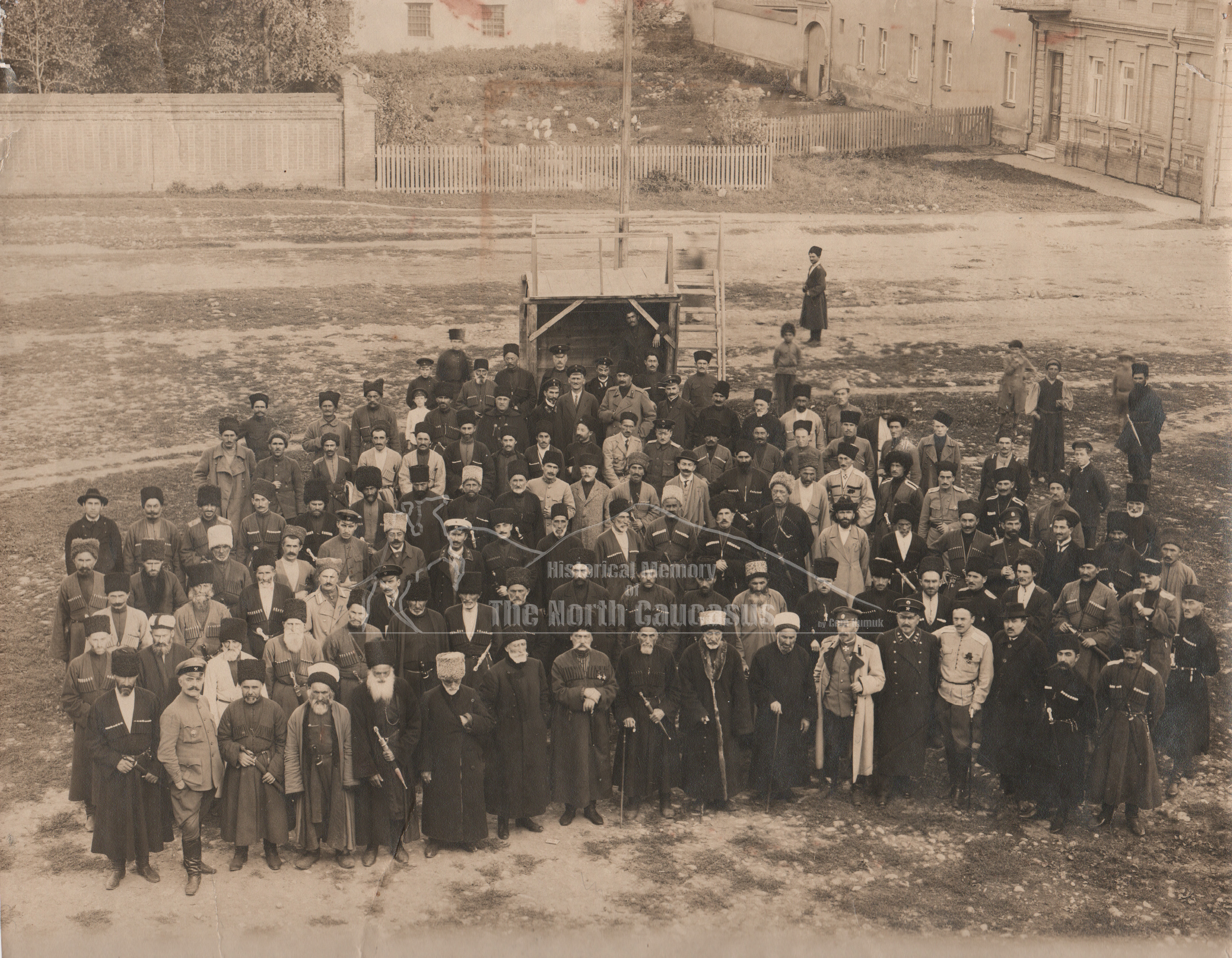
(Click on the image to have a larger view)
The Congress, which lasted three days, concluded after Rashidkhan Kaplanov's speech. It went down in history as a Congress whose legitimacy was unquestioned in this critical period, in that all groups and neighboring peoples were represented and voiced their desires. At the end of the Congress, the 30-article Constitution adopted at the first congress was registered, and a series of important resolutions were taken:Congress Closure and Adopted Documents
Article 1. The Union of Caucasian Mountaineers unites all the Mountaineer tribes of the Caucasus as well as the Nogais and Turkmens in the Stavropol Guberniya (Province); it is a member of the Union of Caucasian Muslims and aims to bring the Mountaineers together to guarantee the peaceful coexistence of all peoples of the Caucasus and Russia; to defend and consolidate the freedoms won by the revolution, to implement democratic principles, and to protect the common political, social, and cultural-national interests of all Mountaineer tribes.Article 2. The authorized organs of the Union of the Mountaineers of the North Caucasus and Dagestan are: 1) The Congress of Delegates and 2) The Central Committee.Article 3. The organs of the Union are tasked with: a) consolidating the civil and political freedoms won by the revolution; b) securing a federative order; c) protecting and strengthening the right of allied peoples to self-determination; d) eliminating inter-tribal conflicts; e) preserving peace and order insofar as local organs are unable to achieve this; f) assisting in the organization of authority (administration) among the allied peoples.Article 4. Each of the allied peoples is autonomous in the sphere of their internal national-economic interests.Article 5. The Congress of Delegates consists of representatives of the Mountaineers, Nogais, and Turkmens. There is 1 representative per 20,000 persons of the population; however, every people has the right to field at least one representative, and population surpluses exceeding 10,000 are considered as 20,000 persons.Article 6. Delegates are elected by general, direct, equal, and secret ballot; if this is deemed impossible by local okrug (district) or people's committees due to local conditions, they are elected—with the approval of the Central Committee—by equal, secret, general, and two-stage voting.Article 7. Delegates are elected for a term of one year.Article 8. Congress members vote without instruction (without a binding mandate).Article 9. The per diem and travel expenses of the delegates are paid from the Union fund.Article 10. The Congress of Delegates is the highest administrative organ of the Union; it holds supreme oversight over the Union administration; determines the organization and election procedure of Union authorities; establishes internal security measures to ensure peace and order; elects the members of the Central Committee and the Spiritual Board; definitively resolves all issues arising within the Union; annuls the decisions of the people's and okrug councils (shuras) if they contradict the interests of the entire Union; determines taxation for general Union needs; and approves the reports of the Central Committee.Article 11. The Congress of Delegates convenes every three months on a date determined by the Central Committee; in emergency situations, the Central Committee convenes the Congress of Delegates for an extraordinary session.Article 12. Every nationality has the right to be represented in the Central Committee. At the current congress, the number of Central Committee members is set at 17: 6 from the Dagestan Oblast (Region), 6 from the Terek Oblast, 2 from the Kuban Oblast and Black Sea Guberniya; 1 from the Zakatala Okrug, 1 from the Abkhazian people; 1 member from the Stavropol Guberniya. Committee members elect a chairman from among themselves. 1st and 2nd substitute candidates are determined for each Committee member.Article 13. Central Committee members and their substitutes are elected at the Congress of Delegates; each oblast or guberniya conducts elections separately, and the Congress subsequently approves them.Article 14. Central Committee members are responsible to the Congress of Delegates.Article 15. The Central Committee is granted the right to subsequently appoint individuals (co-optation) as members with an advisory vote.Article 16. The Central Committee manages Union affairs; oversees compliance with the Union constitution and Congress resolutions and takes necessary measures upon its own initiative or upon complaint to ensure compliance; takes care to maintain security and peace in Union territories, observes the Union's interests, and submits drafts and reports to the Congress of Delegates; it possesses the authority to inspect the activities of officials.Article 17. The Central Committee represents the Union externally. All Mountaineer organizations must harmonize their activities with the stance taken by the Central Committee towards non-Mountaineer organizations.Article 18. All forces of the Union, the people's Mountaineer militias, and the permanent salaried militias are at the disposal of the Central Committee.Article 19. The Central Committee determines the procedures for the formation, training, supply, appointment, and dismissal of unit commanders, and generally takes all necessary measures for the optimal utilization and organization of the Union's forces.Article 20. The Central Committee has the right to demand that oblast, people's, and okrug committees convene a people's or okrug assembly (shura) and submit all issues falling within its jurisdiction to the discussion of these assemblies; if the people's or okrug committees fail to fulfill this demand, the Central Committee has the right to convene a people's or okrug assembly directly.Article 21. If, as a result of internal disputes, power vacuums, and other reasons, a situation arises that poses the threat of severe turmoil within a single people, the Central Committee has the right, upon its own initiative or upon the request of committees and commissars, to temporarily suspend and appoint officials, annul their decisions, and take all necessary measures.Article 22. All issues of a political and social nature emerging among individual Mountaineers or within each people are subject to the judgment of the Central Committee insofar as they cannot be resolved by the competent people's organs.Article 23. All decisions of the Central Committee are binding upon Union members; in the event of disobedience to the Central Committee, the committee may recommend to the Congress of Delegates the expulsion of these individuals from Union membership.Article 24. In matters falling within the jurisdiction of Union organs, the Dagestan Oblast Executive Committee, the Terek Oblast Executive Committee (Mountaineer Faction), the Kuban Oblast Mountaineer Committee, and the people's, okrug, and city committees are the local organs of the Central Committee.Article 25. Should disagreements arise between the Central Committee and local organs as to whether a certain measure falls within the scope of general Union tasks and thus the jurisdiction of the Central Committee, the doubt is resolved in favor of the Central Committee, and the dissatisfied party reserves the right to appeal the actions of the Central Committee at the subsequent Congress of Delegates.Article 26. The affairs of the Central Committee are divided into departments; the sole purpose of this distribution is to facilitate the examination and execution of affairs; decisions are issued from the Central Committee as a single authority.Article 27. In order to establish mutual connection with local organizations, the Central Committee, if it deems necessary, invites representatives of oblast, okrug, and people's committees with an advisory vote.Article 28. The Central Committee sends its own representatives to the assembly (bureau) of the Union of Caucasian Muslims.Article 29. The Union has its own fund and its own seal at the disposal of the Central Committee.Article 30. The meetings of the Congress of Delegates and the Central Committee are considered to have taken place with the presence of half of the members, and decisions are taken by a simple majority.Constitution of the Union of United North Caucasian Mountaineers
Resolution Regarding the Issue of Forests
- Given that forests were in the common use of every people before Russian domination, and that this is in accordance with the interests of the Mountaineers, the Congress has resolved the following: "All types of forests—whether designated as state-owned, private, or common—located on the territory of every people shall be considered the property of that people."
- For the purpose of forest protection and considering the economic significance of the Caucasian forests, the Congress deems it necessary for the Central Committee to oversee the protection and amelioration of the forests.
- The Congress, greeting the Forestry Workers' Union, considers the establishment of an institution of forestry consultants highly important for the democratization of the forest economy and the improvement of the forests.
- Due to the difficulty of protecting the numerous meadows in the Chechen forests, which simultaneously act as a barrier in the fight against livestock thieves, the Congress deems the urgent afforestation of meadows located at the forest edges necessary.
- For the more effective protection of the forests, the Congress deems it necessary, in addition to the election of guards, to allocate a salary to the guards no less than the militia salary in that region.
- Furthermore, in the interest of protecting the forest, the Congress deems it necessary to increase the penalties for forest plundering: 6 months' imprisonment for the first offense, 1 year for the second offense, and 1.5 years for the third offense. The harshening of penalties stems from logging acquiring a plundering character. Loggers are armed, and solitary foresters and rangers cannot resist them.
- The Central Committee brings the necessity of protecting the forests to the attention of the entire populace and invites local and regional committees to participate in forest protection and pursue those plundering public property.
- It is recommended to local committees that they prepare regulations to prevent abuses in forest administration and consider this situation a crime punishable by law.
- The Forestry Union proposes forestry experts whose candidacies will be approved by the Central Committee of the Union of the Mountaineers. Upon B. Dalgat's proposal, the congress accepts the resolution that the forests and lands previously taken from the peoples are, as of today, the property of the people.
Resolution on People's Militias
- To consolidate the gains of the revolution and ensure public security in the territories of the Union of Caucasian Mountaineers, Mountaineer People's Militias are established.
- Except for those unfit for service and those serving in the permanent paid militias, all Mountaineers between the ages of 18 and 40 are obligated to serve without pay in the Mountaineer People's Militias.
- The Mountaineer People's Militias consist of mounted and foot militias.
- Individuals possessing good horses and full equipment for service enlist voluntarily in the mounted militias.
- The people's militias are at the disposal of the Central Committee.
- The Central Committee approves the formation and supply order of the militias, the appointment, rotation, and dismissal of unit commanders, and takes necessary measures for the better organization of the militias.
- The direct management of the Mountaineer People's Militias belongs to the regional and provincial committees dealing with the provisioning and supply of these militias under the control of the Central Committee.
- The regional and provincial committees administer the people's militias through militia chiefs and within local requirements.
- The chief of the people's militias in each district must be an officer who has completed military training.
- All disputes concerning the call-up and conscription order to the militia organization are examined by the provincial people's committees.
- Expenses related to the organization of the people's militias are covered by a special tax levied on the affluent population and determined by the provincial committee.
- The Central Committee approves the draft statute that will be valid until the day the new congress convenes.
- The Central Committee possesses the right to make changes necessitated by local conditions.
The Congress unanimously resolved the following: "A tax of 50 kopecks to be levied on every citizen in the mountainous regions and 1 ruble on every citizen in the lowland regions." This resolution was accepted, but the Central Committee was requested to develop a plan for progressive tax revenues.Financial Issues
In addition to the resolution taken on the agrarian issue by the Congress of Mountaineers, the creation of an agrarian department within the Central Committee is necessary.Resolution on the Agrarian Issue
Resolution on the Religious Department
- For the Muslims of the Terek, Dagestan, Kuban, and Sukhum regions, the Stavropol and Chernigov provinces, and the Zakatala district, the Spiritual Board of the Caucasian Mountaineers, with its center in Vladikavkaz, shall be established.
- The Spiritual Board of the Caucasian Mountaineers consists of clergymen: one as the chairman of the board with the rank of Mufti, and the others as board members with the rank of Qadi. This cadre is approved as follows: 3 members representing the Dagestan and Terek regions; two members each representing the Kuban and Sukhum regions and the Stavropol and Black Sea provinces, as well as the Zakatala region. List of Unanimously Elected Members of the Mountaineer Spiritual Board:
Chairman of the Board – Najmuddin Gotsinski,
Members: Terek province representative of the Ingush; Abdul-Kahar-Haji, of the Chechens, Shuayb Efendi; of the Kabardians, Shogenov Alikhan; Ensign of the Turkic-speaking population; members: Kuban, Sukhum regions and Stavropol province representative; Aliyev Osman, a Teacher at the Higher Oriental School, of the Circassian People; Kuban region and Black Sea province representative; Idrisov Sabit Molla, Dagestan region representative: Elections postponed.
Approving the fundamental principles of B. Dalgat's report regarding the character of the federation and the federative union of Caucasian Mountaineers, and considering that the entrance of Caucasians onto the path of establishing an autonomy based on federation principles complies with the statement made at the congress in Kyiv by the representative of the Provisional Government, M. A. Slavinskiy, that the said government does not hinder efforts to establish not only autonomy but also a federation, the Second Congress of Mountaineers has taken the following resolution: A 7-member commission shall be established immediately to prepare the Constitutional draft of the Union of Caucasian Mountaineers as a federative union of Russian states. These 7 members shall be: B. Dalgat, Dakhadayev, Dzhabagiev, Kaplanov, Is. Bayev, Kotsev, Mutushev. Furthermore, the following individuals shall be included as members in this commission: 1) G. Bammatov; 2) Efendiyev; 3) Britayev; 4) Urusbiyev; 5) Gazdanov; 6) Tambiyev; 7) Basariya; 8) Deni-Arsanov; 9) Shamsudin Hajiyev; 10) K. Toguzov; 11) Qadi Shogenov; 12) Eldarkhanov; 13) Chermoev; 14) Shuayb Molla; 15) Mulayev; 16) Penzulayev; 17) Namitokov; 18) Achmazov; 19) Kochenov; 20) Mutayev.
New Central Committee MembersFrom the Dagestan Region Committee: 1) B. Dalgat, 2) M. Dakhadayev, 3) N.B. Tarkovsky, 4) H. Bammatov, 5) Z. Temirkhanov, 6) Efendiev.From the Terek Region Committee Member from the Kabardian People: P. Kotsev Substitutes: 1) T. Shakmanov, 2) G.G. Sokhov Committee Member from the Balkar People: M. Mulaev Committee Member from the Kumyks, Salotays, Nogais and Auls: R. Kaplanov Committee Member from the Chechen People: T. Chermoev Committee Member from the Ingush People: V.-G. Dzhabagiev Substitutes: 1) S. Temiev, 2) O. Murzabekov Committee Member from the Ossetian People: El. Britayev Substitutes: 1) A. Butayev, 2) Gagkayev. From the Kuban Region, from the Circassians, Abazas, and Mountaineers (They were elected in their locations). Committee member from the Karachay People: Halit Haji Erkenov. Substitutes: The previous ones.From the Stavropol Province, members of the Turkmens and Nogais: 1. M. Muslimov. Substitutes: The previous ones. From the Zakatala District (To be elected in their locations). Committee member from the Abkhazian People: Basariya. Substitute: Ashkhatsava
ConclusionUndoubtedly, the most significant achievement of the Second Vladikavkaz Congress of the Union of the Mountaineers of the Northern Caucasus was the realization among the North Caucasian Mountaineers that the Russian Empire had become irreparably weakened. Although certain decisions were nominally deferred until the plenary session of the All-Russian Constituent Assembly, the conviction that this assembly would never convene had grown substantially stronger. Consequently, the North Caucasian Mountaineers understood that the time had come to take their destiny into their own hands, thereby crossing another critical threshold on the path to absolute independence.
Another crucial outcome of the Congress was the realization that the Islamic spiritual leaders—whom all political factions had previously feared were intent on establishing a Sharia dictatorship—possessed no ambition other than absolute independence. Naturally, although pro-status quo monarchists and socialist Mountaineers aligned with the Russian Bolsheviks were displeased with this development, they no longer possessed any leverage to wield against the religious leadership. Alongside numerous other significant achievements of the Congress, a further notable outcome was the formal application by the Abkhazian delegates—acting upon the legitimate initiative and mandate of the Abkhaz people—to integrate into the Union of the Mountaineers of the Northern Caucasus, and their subsequent admission into the Union.

Istanbul, 20 October 2026