
 Türkçe
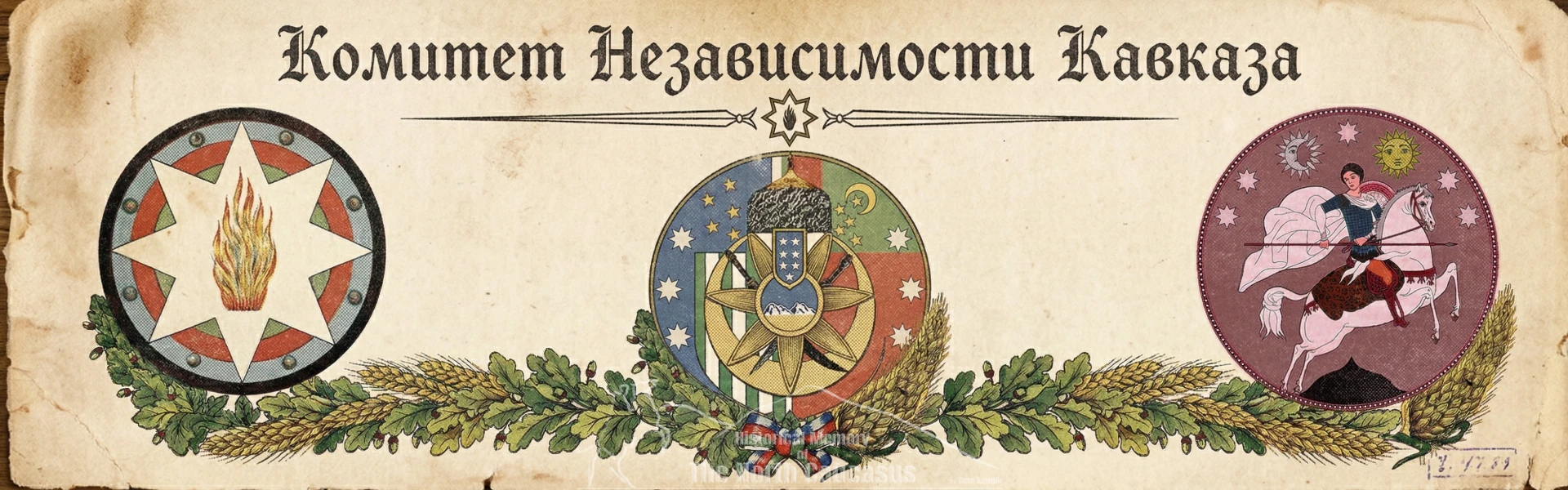
One of the most crucial milestones in the history of the Caucasus is "The Caucasus Independence Committee", established in the early 20th century by members of the political immigration.
Following World War I, the majority of Caucasian politicians who traveled to Paris to represent their countries at the peace negotiations and garner support for their independence demands became political refugees, destined never to return to their homeland. The diplomatic delegations at the time were composed of the following key figures:
North Caucasus: Led by Abdul-Mejid (Tapa) Chermoy, accompanied by Aziz Meker, Haydar Bammat, Ibrahim-Bek Haydar, Hasan Hadzarag, and Ibrahim-Khan Ibrahimbek.
Azerbaijan: Led by Ali Mardan Topchubashov.
Georgia: Led by Akaki Chkhenkeli.
Armenia: Led by Avetis Aharonyan.
Except for Abdul-Mejid Chermoy and Ibrahim-Bek Haydar, the members of the North Caucasian delegation were forced to leave Paris in 1919 and return to the Caucasus following the occupation of their country by the White Russian Volunteer Army. During this period, diplomatic traffic in Paris continued with futile engagements, and the desired results remained elusive due to the conflicting approaches of these representatives.
The Rise and Fall of the "Unity Council"By March 1921, after the Bolshevik Red Army had occupied the entire Caucasus, political refugees who sought asylum in Turkey and France also joined the struggle for independence, intensifying political mobilization in both Istanbul and Paris.
While Caucasian politicians were essentially paralyzed by the ongoing Greco-Turkish War in Turkey, the incompatible policies pursued by the Allies in Europe compelled the political refugees to act collectively. New figures joined the existing diplomatic representatives of the Caucasian Republics:
Azerbaijan: Abbas Bey Atamalibekov, Ekber Agha Sheik-ul-Islamov, Jeyhun Bey Hajibeyli, and Muhammed Muharremov.
Armenia: Alexander Khatisian, N.A. Behzadyan, and Vahan Papazyan.
Georgia: Evgeni Gegechkori, Nikoloz Chkheidze, Noe Ramishvili, Zurab Avalishvili, Konstantin Kandelaki, Konstantin Sabakhtarashvili, Spiridon Kedia, and Mikhail Sumbatov.
North Caucasus: Haidar Bammat (returning to Paris), Vassan-Girey Dzhabagi, Aytek Namitok, and Konstantin Hagundokov.
From mid-1921 onwards, a "Unity Council" emerged as the symbol of a joint struggle.
However, the Unity Council failed to produce substantial results, primarily due to the uncompromising stance of the Armenian representatives toward Turkey and the Council's inability to cultivate a coherent discourse against the Allies. Furthermore, internal factionalism among Azerbaijani and Georgian politicians prevented these two groups from speaking with a unified voice. The Menshevik Georgians and the Azerbaijani Musavatists dragged their feet on every issue, driving the Council into a deadlock.
The Council's efforts were definitively thwarted when the Genoa and Hague Conferences formally recognized the Soviets as the sole interlocutor regarding the territories of the former Russian Empire. Subsequently, the outcomes of the Lausanne Conference deepened the rift between the Armenians and the other three republics. Consequently, the North Caucasus, Azerbaijan, and Georgia began seeking solutions that explicitly excluded Armenia.
The Shift to Istanbul and Archival DiscoveriesThe initial moves toward a new strategy began in Istanbul, where the conditions of refugee life had become unbearable. The Istanbul representatives of the North Caucasian, Azerbaijani, and Georgian political immigration recognized that efforts in Paris were faltering. Congregating under an entity known as the Istanbul Committee, the politicians of these three republics focused on an alternative solution wherein the Paris and Istanbul centers would operate in unison.
Based on previously accessible sources, historians had to settle for the narrative that the Caucasus Independence Committee was established in Istanbul on July 15, 1926, strictly under the instigation of Poland’s Ambassador to Ankara, Roman Knoll, and its Military Attaché, Tadeusz Schaetzel.[1]
However, new archival discoveries reveal that there was no Polish influence during the committee's formative stage; it was entirely a local initiative launched by North Caucasian, Azerbaijani, and Georgian politicians in Istanbul. This revelation strikingly illustrates the historical failure of the North Caucasian peoples to compile their own archives, while underscoring the profound significance of Haydar Bammat’s personal records.
The Exclusion of Armenia and Impending Power StrugglesIn a letter dispatched from Istanbul on November 5, 1924, Alikhan Kantemir shared the following information with Haidar Bammat regarding the latest developments in the formation of the Caucasus Independence Committee's nucleus:[2]
Dear Haydar!
My joint conversations with Gv[arzladze] and M[amed] Em[in] have yielded few results so far, but I am not losing hope. Herewith, I attach a copy of the proposal I made to them as a conditio sine qua non [an indispensable condition], without the acceptance of which we cannot proceed with joint work. This proposal, according to my assumption, was to be signed by us and forwarded to Paris for discussion and formalization as a draft. It consists, as you will see, of a general theoretical part regarding the confederative treaty and a practical one about creating a center.
Gv[arjaladze] accepted the general part and, to be fair, tried all the time to convince M[amed] Em[in] to do the same; however, the latter follows this very sluggishly and, apparently, harbors some unexpressed thought that repels him from the idea of unity. I suspect the reasons are as follows:
1) The Georgians received money in Europe and consumed it without us; now, when something can be obtained with the assistance of the Turks or directly from them, why should we share?
2) The Georgians are more organized and, in joint work, will absorb the Azerbaijanis and the Mountaineers. These are my assumptions, but where the truth lies, only Allah knows.
M[amed] Em[in] objects to the draft of your confederation treaty, arguing that the treaty of [19]21 and the declaration of September 27 of this year contain all the elements necessary from a formal-legal point of view for the unification of the Caucasus, and that the secret lies not in the lack of a paper agreement, but in the absence of practical joint work.
These arguments were initially shared by Gv[arjaladze] as well. I pointed out the defects of the treaty of '21 and the declaration of September 27, and I consider updating the foundation to be necessary.
Among their objections, the Armenian question also occupies a large place. In their opinion, an agreement between the three in Europe will make a bad impression and will play into the hands of the Bolsheviks. Of course, this is partly true, but on the other hand, the Armenians are not suitable for active work, and the treaty of [19]21 contains a specifically repulsive clause regarding them; consequently, we are deprived of the possibility of making any démarche [political initiative] with this compromised document. Thus, it turns out that among the Caucasian republics—neither among the three, nor among the four—is there an agreement suitable for external use.
If the Armenians agree to put their hand to your proposed confederation treaty, it will be very good; if not, then "seven don't wait for one", and we must forge ahead, leaving the Armenians the opportunity to join the confederation in the future, but for now, we should make a triune treaty absolutely confidentially.
Here, the Georgian and Azerbaijani opposition, taking advantage of the behavior of the Mensheviks and Musavatists regarding the Caucasian confederation, are inclined to isolate these two parties and are pulling me along the path of revolutionary separatism. However, my position must be more neutral in the internal struggle of the various parties of our neighbors. Of course, the opposition is more aligned with our shift, and I go along with them secretly. Perhaps the day will come when I will have to take off the mask and declare to these two parties that we are not [on the same path] with them. (Note: The original text cuts off abruptly here).
I add: this must be done not secretly, but only when M[amed] Em[in] categorically refuses, and when the Mensheviks in Paris also shy away from unity.
M[amed] Em[in] promised to forward my draft to Topchibashov; I don't know if he will do it. Gv[arjaladze] promised to do the same with him, who, of course, must know the opinion of his government and parties.
Persuade Topchibashov to also sign the agreement; tell him that M[amed] Em[in] verbally stated to me that he agrees. The rest of the Azerbaijanis all stand on the grounds of this draft. If Ali Mardan does this with the other delegations, then M[amed] Em[in] will remain isolated and will either be with us or alone without his entourage.
Equally influence Ali Mardan-bek so that he does not lose Kh[osrov]-bek and Sheikhul Islam – these two are always on the side of the old man. Moreover, the first, i.e., Kh[osrov]-bek, can have no less success among the Turks than M[amed] Em[in].
Herewith I attach another piece of information.
Mom is healthy. Said returned from Bursa without servants.
Write! Yours Alikhan.
Greetings to Tapa and Gaidarov, I embrace our boy.
Alikhan.
Appendix:
Treaty of the Caucasus Confederation (Copy of the draft)
In the firm conviction that the peoples of the Caucasus failed to preserve their independence solely due to the lack of proper unity among them, that the unity of the peoples of the Caucasus, both during the period of struggle for liberation and in the matter of state-building in the future, is dictated by the commonality of their geographical position, living conditions, historical traditions, as well as the indisputable interests of their economic prosperity and political development, and that, finally, the nationwide aspiration for the unification of the Caucasus, although it was reflected in a whole series of agreements between representatives of the peoples of the Caucasus—both locally during the liberation struggle and abroad between their delegations—was nevertheless not expressed with adequate completeness and clarity.
The plenipotentiary representatives of the republics of Azerbaijan, Georgia, and the North Caucasus conclude among themselves a confederation treaty as the permanent basis of the state unification of the Caucasus,
— in the sense of merging: 1) foreign policy, 2) military forces, 3) finances, and 4) certain areas of the economy: a) currency, b) railway, postal, and telegraph services, and c) customs.
— the contracting parties strive for the liberation and defense of their common homeland from external encroachment, from wherever the threat may emanate, and
— will implement the principles of confederation through solidarity efforts,
— taking into account the vital interests of the Armenian people and considering the entry of the Republic of Armenia into the Caucasian Confederation as an important condition for the good of the Armenian people and for the peaceful life of the whole Caucasus, the contracting parties leave the Armenian nation the opportunity to enter the family of the peoples of the Caucasus based on this treaty.
On Organization;
The representatives of Azerbaijan, Georgia, and the North Caucasus, in agreement with all like-minded parties and groups, organize a common center – the Committee for the Liberation of the Caucasus, which becomes the supreme organ of disposition and action.
The Committee sets as its task the liberation of the Caucasus from foreign occupation and the further strengthening of its independence on the principles of confederation, as the sole base of Caucasian democratic statehood.
Delegations and all national organizations of Caucasians abroad are subordinate to the Committee.
The Committee unifies and directs foreign policy, military affairs, finances, and propaganda through special organs.
The Committee proceeds to organize all active forces of the peoples of the Caucasus.
It establishes communication and necessary contact with active forces operating in the Caucasus to direct their work towards the implementation of the common task in the spirit of a general plan.
The Committee and all its organizations are strictly conspiratorial.
P.S. This part "on organization" has not yet been sent to Paris to either Gv[arjaladze] or M[amed] Em[in], it will be discussed further.
Alikhan.
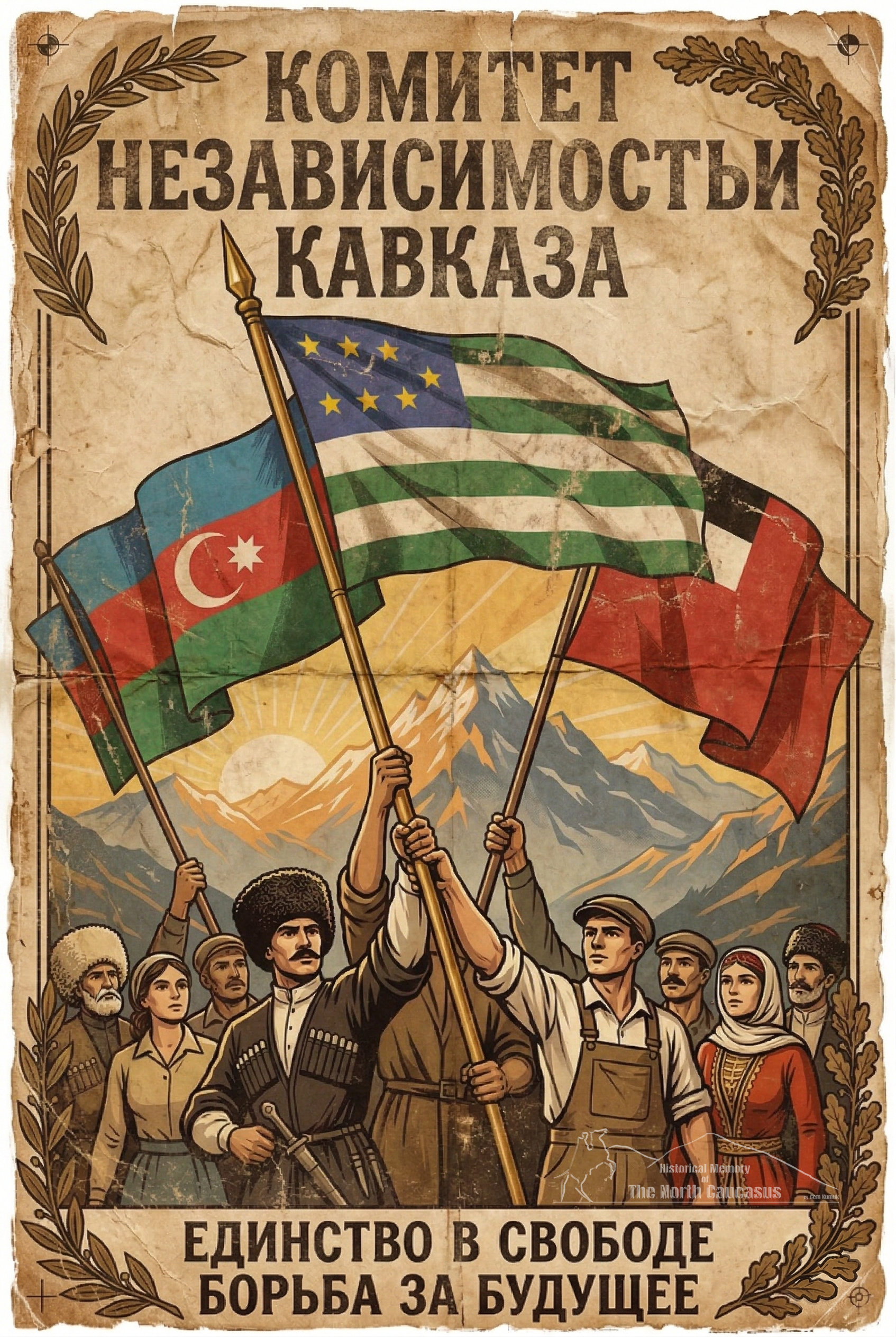
Based on the draft that emerged from the discussions among Kantemir, Gvarjaladze, and Rasulzade in Istanbul, the members of the Unity Council held a series of additional meetings on seven different dates in Paris between October 7 and November 11, 1924—notably, in the absence of the Armenian representatives.
During these meetings, a tripartite confederative alliance was formed outside the existing Unity Council, effectively excluding the Armenians. The attendees included:
Azerbaijan: Ali Mardan Topchubashov and Jeyhun Hajibeyli.
Georgia: Akaki Chkhenkeli, Noe Ramishvili, and Spiridon Kedia.
North Caucasus: Abdul-Mejid Chermoy, Ibrahim-Bek Haydar, and Haydar Bammat.
The trajectory had clearly begun to signal that the Armenians were gradually being marginalized from the Unity Council:[3]
Minutes of the Meetings of the Representatives of the Republics of Azerbaijan, Georgia, and the North Caucasus, held in PARIS, October 7, 11, 16, 22, and 29 - November 6 and 11, 1924.
The Representatives of the Three Republics unanimously note the unity and community of political and economic interests of Azerbaijan, the North Caucasus, and Georgia, declared by them many times in other circumstances; they note the mutual sympathies and friendly relations of their peoples throughout the centuries.
Based on these findings, the representatives judged it essentially indispensable to establish the main bases of a political and economic union of the peoples of Azerbaijan, the North Caucasus, and Georgia, upon which the very Constitution of this Union must be built.
During their deliberations on this primordial question, the Representatives of the three Caucasian Republics unanimously concluded on the necessity of the Union of Azerbaijan, the North Caucasus, and Georgia in the form of a Confederation.
In order to establish the Confederation of the Caucasus, the representatives of the aforementioned Republics deemed it necessary to establish between Azerbaijan, the North Caucasus and Georgia, immediately after the liberation of their territories from occupying forces, customs unity and a defensive military alliance.
It is understood that simultaneously, the diplomatic action of these Republics will be unified.
A special Commission will be created, from now on, for the elaboration of the draft Constitution or the main bases of the said Constitution, as well as the drafts of the above-mentioned unions. The draft of the Constitution will be submitted for ratification to the Parliaments and Constituent Assemblies of each of these Republics, upon the liberation of the Caucasus from Russian Soviet occupation troops.
Regarding the future action program with a view to liberating their countries from the foreign yoke, the representatives of the three Republics conclude on the necessity of unifying the action of the Azerbaijani, Georgian, and North Caucasian bodies residing abroad. For this purpose, a Caucasian Committee is founded, which will have the functions of preparing and leading the peoples of the Caucasus in their struggle for liberation. This same Committee unifies the diplomatic work of the three Republics. The Caucasian Committee comprises four sections: the organization section, the diplomatic section, the financial section, and the propaganda section.
The present minutes are signed in three copies by the Representatives of the Republics of Azerbaijan, the North Caucasus, and Georgia who attended the Meetings.
The Committee Charter manifested as follows:[4]
Charter of the Permanent Council of Azerbaijan, Georgia, and the Northern Caucasus
I
Formed based on the protocol signed on November 11, 1924, by the representatives of the independent republics of Azerbaijan, Georgia, and the Northern Caucasus, the Permanent Council, proceeding from the principle of a "Caucasian Confederation" proclaimed in the named protocol, sets as its task the joint conduct of diplomatic work on behalf of the three Republics and the adoption of all measures for the quickest possible evacuation of the Caucasus by Russian troops and the realization of the unification of the peoples of the Caucasus into a single confederative state.
II
To fulfill the indicated tasks, the Permanent Council discusses and decides on all kinds of questions that are of equal interest to the three Republics and are raised by representatives of one of the Republics or all three Republics.
III
The Permanent Council adopts decisions unanimously and "ad referendum" [subject to approval], whereby all members of a given national representation have only one [collective] vote.
IV
The Permanent Council consists of three representatives from the Georgian Government and three each from the delegations of Azerbaijan and the Northern Caucasus. The Permanent Council elects its own Presidium.
V
The Presidium undertakes diplomatic steps, executes [decisions] itself, and monitors the precise execution of the decisions of the Permanent Council; it also convenes both its own meetings and the meetings of the Permanent Council, wherein the meetings are presided over by a member of the Presidium in whose premises the meeting is taking place.
VI
A Secretariat is attached to the Permanent Council. One of the main duties of the Secretariat is the compilation of the protocols [minutes] of the Permanent Council, wherein only the agenda, proposals, and decisions are recorded in the protocols. The publication, in one form or another, of the content of the protocols and, in general, of information regarding the activities of the Permanent Council or its Presidium is permitted only with the permission of the latter.
VII
The Permanent Council has its own monetary fund, formed from contributions from national organizations and other possible receipts.
In a letter dated December 13 from Alikhan Kantemir to Haydar Bammat—written shortly after the foundations of the Caucasus Independence Committee were laid via signed agreements—one could see the early signs of maneuvers that portended impending power struggles within the committee:[5]
Dear Haydar!
I received your letter dated 4 December, from which it is apparent that you did not receive some of my letters, in which you would have found answers to many questions. Are your letters being intercepted at the reception? It is very possible – the B[olshevik]s do not disdain anything and are following us very closely.
Our affairs never go smoothly, thanks to the mutual trust and solidarity among those called upon to accomplish them. You have Gaidarov, and I have Dzhabagi... but still, one must not despair and "give up on this hassle"; on the contrary, we must patiently wait for new events, which will cast aside the elements that interfere with normal work during the days of our hard times.
I, at least, have decided to stick to this tactic.
Aytek left for Paris on his own business. The Constantinople Committee did not give him a written mandate, but naturally expressed a wish for him to facilitate the signing of a confederative treaty in Paris, and unity among the Caucasians in this roster. What of it? Tomorrow, members of this same committee, Asatiani and Professor Tsereteli, are leaving for Paris. They also do not have written mandates, but they are tasked with acquainting "Paris" with the constructive work and sentiments, which can approximately be formulated as follows:
1) Constantinople should become the center of practical work,
2) "Paris" should conduct general diplomatic work in Europe and be in contact with the autonomously acting "Istanbul".
3) It is desirable to exchange representatives to enliven the work and relations between "Paris" and "Istanbul".
4) The attitude towards Turkey under all circumstances is benevolent.
Tsereteli also raised the question of borders internally between the Caucasian republics and external ones, but I was against raising territorial disputes that could once again shake our unity. Besides, Tsereteli understands the Caucasian confederation as a union of states, considering a cantonal [system] as not answering the conditions of Caucasian reality, and this question was also left unresolved. I repeat that all these questions should be debated in the constitutional section.
The Constantinople Committee, the existence of which is little known, does not include Mensheviks and Musavatists, in view of the fact that M. Emin reacted to the idea of a confederation with restraint, if not hostility, and Gvarjaladze acted "diplomatically".
After the signing of the treaty in Paris, M. Emin remained isolated on the sidelines. A split has occurred in Musavat, Mustafa and Abdul Ali have left, which will be officially announced to everyone one of these days.
The Constantinople Committee is based on an agreement, the foundations of which I sent to you in due time and passed on to Gvarjaladze and M. Emin. Dzhabagi and Aytek were part of this organization, and I see nothing dangerous in this. Aytek, who took Dzhabagi's side, during the course of a short period of work, became convinced himself of Dzhabagi's worthlessness; the same assessment of his personality is given by other non-mountaineers. This is the best way to neutralize such comrades.
Sultanov and Dzhabagi ended up in Constantinople due to a resolution of the committee, which suggested that Khosrov, Asatiani, and I should go, but I was generally against this visit and therefore did not accept the mission itself.
Dzhabagi goes everywhere and anywhere as a journalist and former chairman of the Mountain Parliament, but all this is not worth a penny. Of course, it is unpleasant that he behaves with a lack of dignity, calling himself at the same time the chairman of the Mountain parliament, but you can't put a gag on every mouth. We are only left to blush. Correspond in advance with Ahmed so that the book is published, i.e., guarantee this possibility from his side, and then transfer the money to him, better in installments, otherwise I am afraid he will eat through the francs having done nothing.
I wrote a letter to Agaev again with a request to influence Nukh, and it is desirable to get a final answer from him on this matter in written form. We'll see. Bekir has not arrived yet. It would not be useless if the delegation, for its part, wrote an official letter to Nukh demanding this sum. We need to drag Tapa into this dispute a little, then it will be easier for us to act.
About the regroupings in Ankara and about the inner workings [guts] next time.
I kiss little Nazhmuddin.
Regards to your family.
Yours, Alikhan.
ConclusionThe Unity Council in Paris was no longer the sole representative organ of the Caucasian political immigration. After three long years squandered by the uncompromising attitudes of the Armenians, the primary elements of the Caucasian Union began pushing the boundaries for broad-based representation, successfully emancipating the opposition movement from the hegemony of Paris.
However, Paris had no intention of relinquishing its power easily. The approaching 1925 would be marked by profound rivalries and conflicts along the Paris–Istanbul axis. Ultimately, it would be a third power—not the Caucasians—that would reap the benefits of this friction...
To be continued next week; the Paris–Istanbul conflict...
Cem Kumuk
Istanbul, 8 March 2026
References; (Click on the links to access the original works and documents)
[1] Georges Targalski, “Les Plans Polonais Concernant l’Éclatement de l’URSS, Le Mouvement «Prométhée» et le Caucase”, Bulletin de l’Observatoire de l’Asie centrale et du Caucase, No.4, 1997, p.13-4;
Georges Mamoulia, Les combats indépendantistes des Caucasiens entre URSS et puissances occidentales Le cas de la Géorgie, 1921-1945, Paris, 2009, p.98-101;
Cem Kumuk, Düvel-i Muazzama’nın Kıskacında Kafkasya Dağlıları, Istanbul, 2022, p.579
[2] IRCICA, Haydar Bammat Private Archive, Alihan Kantemir’s letter to Haydar Bammat, Istanbul, 5 November 1924.
[3] IRCICA, Haydar Bammat Private Archive, Minutes of the meeting of the Union Council of Caucasian Republics, Paris, 7, 11, 16, 22, and 29 October- 6 and 11 November 1924.
[4] Sakartvelos Erovnuli Arkivi, Charter of the Caucasus Committee, Paris, November 1924.
[5] IRCICA, Haydar Bammat Private Archive, Alihan Kantemir’s letter to Haydar Bammat, Istanbul, 13 December 1924.