
 Türkçe
End of the Armenian LulabyThe bitter experiences of 1922-23, the largely dysfunctional state of the Council of the Union of Caucasian Republics, and the steadily deteriorating living conditions of emigré groups in Turkey led the representatives of three Caucasian Republics in exile to seek a broader-based solution for their diplomatic representation and political affairs. Consequently, the seeds of the idea for the Committee for the Independence of the Caucasus began to take root. However, the heavyweights of the Union Council in Paris—Tchermoy, Tchenkeli, and Topchubashov—had absolutely no intention of sharing power and actively resisted. Because of this, the vast majority of the other representatives in the Union Council supported the formula for the separation of powers and the concept of an Independence Committee. Indeed, one of the original architects of the Independence Committee idea was Haydar Bammat himself.
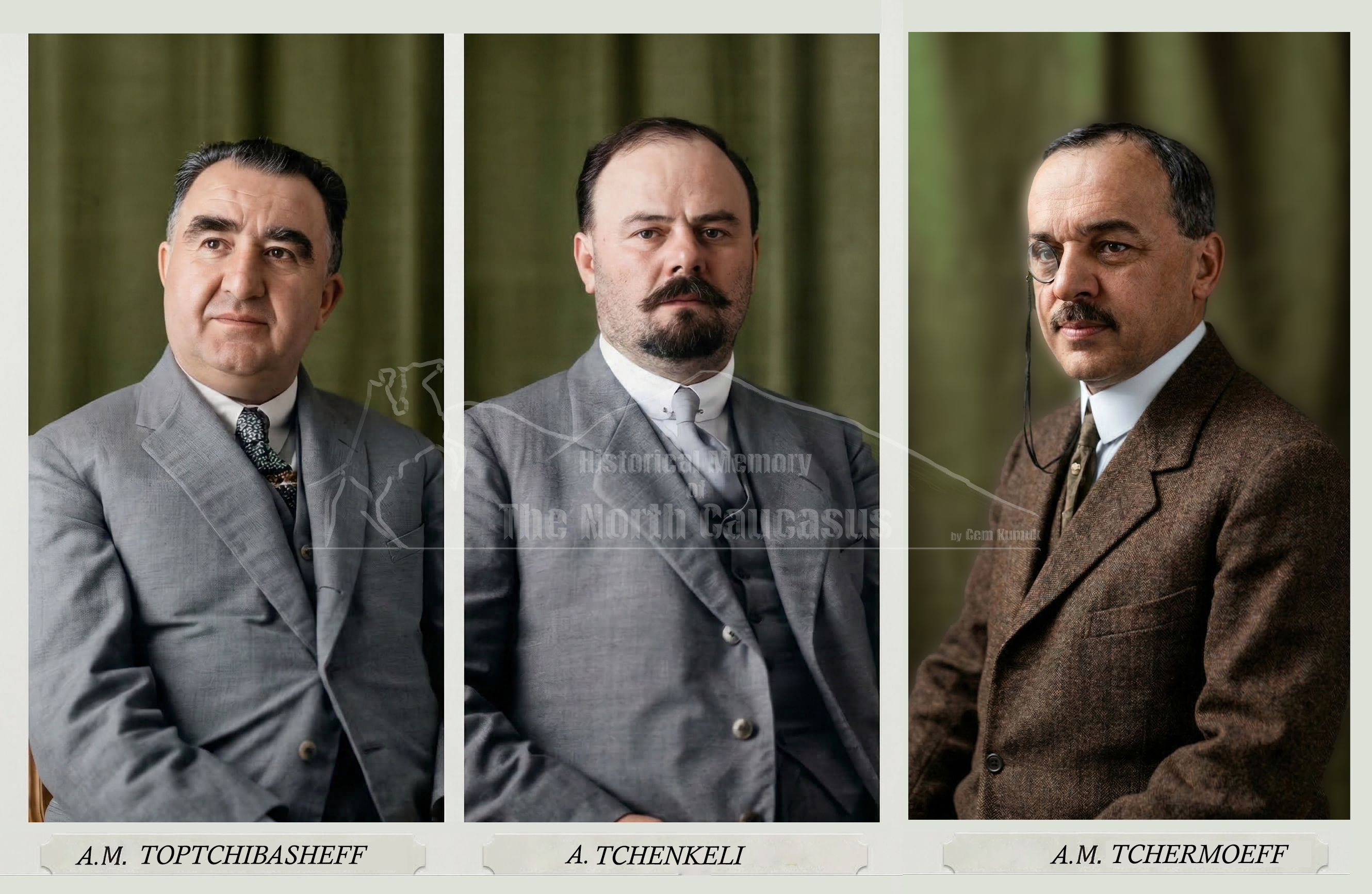
(Click on the image for a larger view)
Mr. President, Ladies, Gentlemen,
First of all, I must ask you to be indulgent and offer my apologies. My French is so insufficient that you will certainly suffer from it. If I take the liberty of putting you through this torment, it is because I have the impression that you will have a certain interest in hearing the testimony of a neighbor of the Georgians on the question that interests you.
We all know from experience that our neighbors do not usually sin by an excess of love for us. It is even rare to see them simply do us justice. Very indulgent of their own flaws, they judge our slightest faults severely.
If you manage to earn the respect and friendship of your neighbors anyway, it is beyond doubt that you have fully deserved these sentiments.
Well, Ladies and Gentlemen, I wish to take this opportunity to declare once again that we, the North Caucasians, although neighbors, are the sincere and devoted friends of the Georgians. We are animated by the same sentiments for liberty and independence, we profess the same political and national conceptions, and we have the same economic interests. In short, nothing divides us. Several ties of a sentimental and material nature unite us.
You know, Ladies and Gentlemen, that during the Russian Revolution, we founded four Republics in the Caucasus: those of Georgia, Armenia, Azerbaijan, and the North Caucasus. And that is where the gravest mistake was made. We failed to properly appreciate the fact that dominates the situation in the Caucasus, which is that the Caucasus, being a geographical, economic, and strategic unit, must necessarily be a political unit. We indeed took a few steps to draw closer together in the Caucasus itself, but it was only here in Paris that we formulated the basis of a future Caucasian Confederation. This is our action plan for the future, and we all have faith in the future. We have, moreover, done better than that, and our union with Georgia, particularly, is already sealed in blood. During the Bolshevik aggression against Georgia, we formed a National Committee of Azerbaijan and the North Caucasus in Tiflis, which was recognized as the provisional federal government for Azerbaijan and the North Caucasus. The detachments of the Committee, formed of Caucasian mountaineers and Azerbaijanis, fought in the ranks of the Georgian army to the very end and were subsequently interned in Turkey. That said, I would like to refute an insinuation that seemed particularly grave to me. It has been said that in Georgia, absolutely the same thing happened as in Russia, and that following internal struggles among political parties, the Georgian people had freely given themselves a Georgian Bolshevik government. I was rather well-placed to closely follow all the phases of the Russo-Georgian war, and I believe it is my duty to protest with all my strength against this insinuation. In accordance with the testimonies brought by the representatives of the allied powers accredited to the National Georgian Government, I must say that during the entire duration of the hostilities, no uprising took place against the regular government. Among the prisoners of war, I saw no soldier of Georgian, Azerbaijani, or even Armenian origin, although the Bolshevik aggression, as you know, used a local conflict between Armenia and Georgia as a pretext—better yet, there were no Red Guards of Ukrainian origin either. All the Russian soldiers who invaded Georgia were of Great Russian origin. These troops were indeed accompanied by a few Georgian figures who subsequently formed the Bolshevik Georgian Government.
To clarify Russia's rights over Georgia, much has been said about the legal question. As for me, I find it quite superficial to treat this question here. To seriously analyze the Treaty of 1784 and the Act of 1801, one would have to bring forward documents whose interpretation provokes multiple and acute controversies. It is not in this assembly that this problem could be resolved. It is perfectly sufficient for us to retain two essential points from this matter. An independent Georgian state existed until the end of the 18th century. At the beginning of the 19th century, this State was incorporated into Russia. Following this incorporation, Georgia lost the autocephaly of its church, its language in schools, and its administrative, municipal, and communal institutions.
Despite all these efforts, up until the Revolution, Georgia was unable to obtain either certain legal guarantees or certain administrative and economic liberties ("Zemstvo") which had been introduced in strictly Russian provinces since 1864. For the legislative elections to the Duma, Georgia was subjected to a restrictive law. If, despite all this, the Georgians loved Russia, as has been claimed here, one must conclude that the Georgian is a very peculiar human species that loves to commit suicide.
The truth, I believe, is that it is Russia that has coveted Georgia, and for a long time. Here, the question arises as to why the Bolsheviks, after having recognized the independence of Georgia and signed a Treaty with its national government, invaded the country. This question is linked to the general question of why Russia, under the Imperial Government, came to the Caucasus. I believe that is the problem. And to solve it, please cast your eyes upon the map. What is the Caucasus? I speak of the Caucasus because Georgia is but a part of the Caucasus, and its fate is tied to the destinies of the country of which it forms an integral part. Here I draw your attention to the fact that Georgia has no borders with Russia; it is bordered by regions populated on the one hand by the Turks, and on the other hand, by Armenians, Azerbaijanis, and the Caucasian mountaineers; that is to say, by the peoples who formed independent Republics and separated from Russia. This is why the comparison with Luxembourg that was made here is completely out of place. Well! What is the Caucasus? It is a formidable boulevard due to the high mountains that surround it, commanding two Seas: the Black Sea and the Caspian Sea, and is connected by these two basins on one side to the Mediterranean and Europe, and on the other to Persia, India, and the whole Asian Continent. At the same time, it is the shortest and most direct intercontinental route. Due to this geographical location of the Caucasus, the power that reigns in its vicinity is assured of one day radiating over Central Asia and threatening both European and Islamic peoples. This state of affairs was well understood by Russia long ago. It was indeed Peter the Great who established Russia's eastern policy, which had to lead sooner or later to the conquest of the Caucasus. It was he who recommended in his famous testament to his successors: "Approach as close as possible to Constantinople and the Indies; whoever rules there will be the true sovereign of the world." It was he who practically laid the foundations of this policy by opening the series of wars against Turkey, by sending General Bekovich-Cherkassky, and by coming in person to the Caucasus as far as Derbent. Over the two centuries that followed, Peter the Great's successors continued his policy. The 19th century is filled with the horrors of Russian penetration into the Caucasus. For over sixty years, my compatriots of the North Caucasus sustained a formidable and far too unequal struggle against the Muscovite colossus, and it is this fierce resistance that delayed Russian conquests in Asia. It is only from the conquest of the Caucasus that the Russian Armies conquered at a running pace Turkestan, Khiva, Bukhara, and came to clash with British Power at the borders of the Pamirs and Afghanistan.
These, Ladies and Gentlemen, are the true reasons why Russia came to the Caucasus and to Georgia in particular. This distinctly imperialist policy was resumed by the Bolsheviks, but they executed it with much more flexibility and intelligence than the Imperial Government. You already know, Ladies and Gentlemen, that the Bolsheviks began by formally recognizing the independence of the Caucasian Republics at a time when they were engaged with the various White armies and the States that formed in the western part of the former Empire; at that time they still dreamed of world revolution, but soon they realized that the West did not want to follow Russia on the path of Bolshevism, and that a barrier, composed of the Little Entente, Poland, and the Baltic States, had been erected between it and Western Europe. Then the Bolsheviks turned their gaze towards the East and realized that there were very considerable advantages to be drawn from the mistakes made by their European adversaries in these parts of the world. Very naturally, the Bolsheviks sought to draw closer to Turkey in revolt against the Western Powers, but to effectively join this new ally, it was necessary to evict all European influence from the Caucasus and suppress the Caucasian Republics that barred their way. That is the political cause of the invasion by the Bolsheviks of Georgia and the entire Caucasus. There were also certainly economic considerations, notably this famous question of oil. If it is true, as Lord Curzon said, that the Allies were carried to victory on a flood of oil, it is no less true that oil prodigiously revived the anemic body of Bolshevik Russia.
These, Ladies and Gentlemen, are the considerations for which the inalienable rights of Georgia and the other Caucasian peoples to a free and independent life were sacrificed; but allow me to conclude, to remind you of a thought of Napoleon's. After the legendary exploits that changed the face of the world, in his distant exile in Saint Helena, Napoleon said: "There are two forces that govern the world: the sword and the mind, but in the long run, it is the mind that triumphs." And in the unequal struggle sustained by the small peoples of the Caucasus for their independence and liberty, we firmly believe in the final triumph of the mind over the brutal power of the sword.
The Committee for the Liberation of the CaucasusImmediately following the agreement concluded in Paris, a similar consensus was reached among the various factions of North Caucasian, Azerbaijani, and Georgian refugee groups in Istanbul. This consensus was communicated to the diplomatic missions in Paris via a letter signed by Vassan-Girey Dzhabagi, Khosrov-Bek Sultanzade, and David Vachnadze:[3]
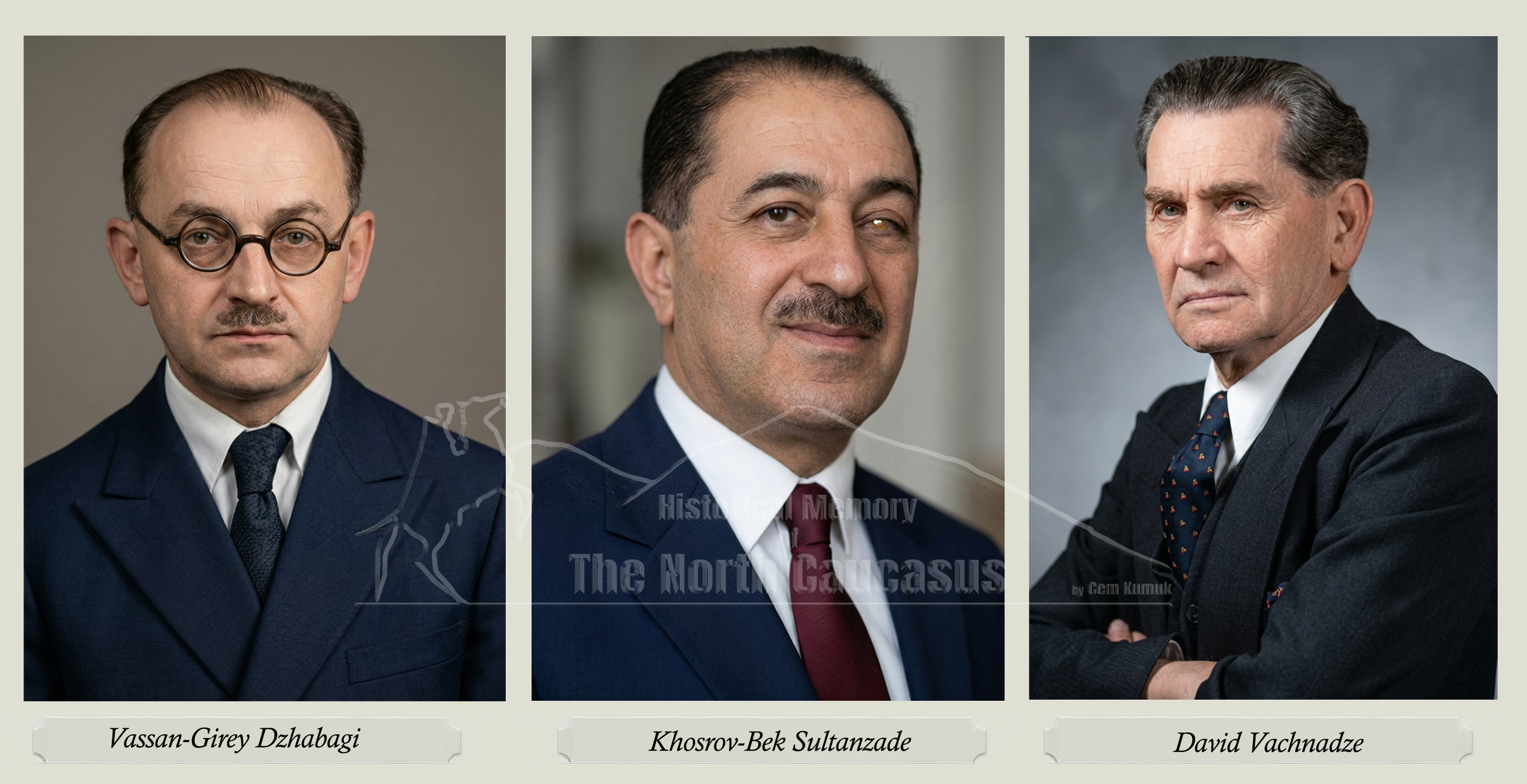
(Click on the image for a larger view)
In October 1924, in the city of Constantinople, responsible political figures of the three Caucasian Republics — Azerbaijan, the North Caucasus, and Georgia — signed a Union Act establishing a Confederation between these republics.
The named Act was signed on behalf of Azerbaijan by: Dr. Khosrov-Bek Sultan Zade, Abdul Ali Amirdzhan, Sheikh-ul-Islamzade; the North Caucasus by: Vassan Girey Dzhabagi, Alikhan Kantemir, Aytek Namitok; Georgia by: Mikhail Tsereteli, Aleksandr Assatiani, David Vachnadze.
Those who signed the Act set as their goal the achievement, through united efforts, of the liberation of the Caucasian republics from the yoke of Russia and, subsequently, the creation and strengthening of a single, independent Caucasian State based on confederative principles.
Taking into consideration that the Union acts concluded in the past by official delegations of the aforementioned republics did not pose or resolve clearly and definitely the problems of a Caucasus Confederation and therefore remained inapplicable to real life, the aforementioned political group of persons who signed the October Act in Constantinople took upon themselves the task of reviving and moving forward the question of a Caucasian Confederation in the political circles of the Caucasus, Turkey, and Europe, placing its resolution on a realistic foundation. They were compelled to take this step by objective reasons as well: The recent uprising in Georgia and its brutal liquidation, which continues to this day and has led to the physical weakening of the population of this republic, has confirmed that the only correct idea is the old thought of all farsighted Caucasian figures: that the divided struggle of the Caucasian republics against a multimillion-strong Russia will always lead to their defeat. That the continuation of the struggle "alone" threatens the Caucasian peoples with extermination. These facts have led everyone to the conclusion that the freedom of the Caucasian Peoples will dawn only when they stand against Russia and before the whole world as one single Confederated State. Only in such a case will they be assured the assistance of European states.
Having informed the Paris political circles of the Caucasian republics about the act that took place, the Constantinople Committee resolved to simultaneously inform the representatives of certain powers friendly to the Caucasian cause about this important event. Met with great attention from this quarter, the Constantinople Committee received from the representative of one of these powers a promise of full moral and real assistance to this important undertaking in the person of the Constantinople Committee, which operates in the center of Near Eastern politics. Almost simultaneously, in Paris, this western center of European politics, a "Committee for the Liberation of the Caucasus" was also organized in November 1924.
For more successful activity in the field of work on the liberation of the Caucasus, the Constantinople Committee set itself the following tasks:
1) Active propaganda of the ideas of a Confederated Caucasus through the press;
2) Establishment of close ties with diplomatic agencies of various states;
3) Establishment of firm ties with the Caucasus and political-technical organizational work locally.
In early February of this year, during a meeting with the Presidium of the Constantinople Committee, a representative of one of the friendly powers, regarding the question of financial aid to the Constant. The committee, for the purpose of realizing the aforementioned tasks, gave assurances that he would undertake all necessary measures and steps before his government in this direction.
The resolution of the question of financial aid stood in this position when, in mid-March, a member of the Paris Committee, Ibrahim-Bek Haydar, who had arrived from Paris, made a report to the Constantinople Committee about the progress of work in the Paris Committee. From this report, it became clear that the work of the Paris Committee is being neutralized primarily due to the following reasons:
1) Inconsistency of views within the Georgian delegation represented in the Committee, which has not yet taken a unified and firm position; 2) The presence of a tendency within a certain Georgian political group to retain for itself exclusive and full leadership in matters of Georgia's internal and external policy, thereby complicating the issue of establishing close and sincere allied relations between the Caucasian republics; 3) Persistent attempts by this group to immediately introduce into the Paris Committee representatives of the Armenians, who are as yet little prepared on the question of the necessity of creating a Union Confederated Caucasus.
The situation that has arisen in the Paris Committee was indirectly confirmed also by the aforementioned representative of the power friendly to the Caucasus, who returned from Europe, during his last meeting with the Presidium of the Constantinople Confederates. Thus, it was confirmed that: There is no firm cohesion among the members of the Paris Committee;
2) That there is currently only a clear inconsistency of views among the political groupings of Georgians;
3) That the receipt of funds from European countries on formal grounds has hitherto been accessible to the [entity] recognized legally — Georgia; 4) That a suspension of the release of funds to the latter is finally possible, pending the emergence of more solid and cohesive actions by the nationalities of the Caucasus.
The Constantinople United Committee of Political Figures of the Confederates of the Caucasus, in its session of March 31, 1925, having discussed the situation that has arisen, issued the following resolution:
During the 4 1/2 months since the signing in Paris by official Representatives of the Caucasian Republics and the organization of the Committee for the Liberation of the Caucasus with the separation from it of a "Council of 3," the latter has not undertaken any practical steps to implement the principles laid down as the basis of the Paris act in the sense of establishing common organizational work. The clarification of the reasons for such inaction by the Council, their elimination, and the immediate commencement of organizational work are imperatively dictated by the interests of the Confederated Caucasus and must become an urgent task of the Paris Committee.
All diplomatic interventions by Confederating units on matters of principle, even if touching exclusively upon only one of the Republics, are permitted only with the consent and decision of the Paris Committee. It is impermissible to obtain material funds and use them by one of the confederating units without the knowledge and consent of all other members of the Confederation.
The internal struggle between Georgian political parties is a great brake on the common work: by dividing and weakening the common forces internally, and being carried out onto the political arena of Western Europe, it hinders the possibility for the Paris and Constantinople Committees to obtain material funds from powers friendly to us, which set as an indispensable condition for support the full unification of work on the principles of a Union of republics of the Caucasus. Energetic and decisive measures must be taken by the Paris Committee to speedily eliminate the causes and grounds for the struggle between Georgian Parties, which is so pernicious for the cause of the Liberation of the Caucasus.
The Constantinople Committee recognizes the right of the Paris Committee to official diplomatic representation on behalf of the Confederation of the Caucasus before foreign powers and will work with it in full solidarity and contact.
While keeping the Paris Committee informed of its work, the Constantinople Committee must, at the same time, have detailed information about the progress of the Paris Committee's work. The establishment of regular communication between both Committees for the purpose of fully unifying their work is a vital necessity.
If the Paris Committee fails to get on the path of practical united work, having eliminated all obstacles thereto, the Constantinople Committee will be forced to take the path of independent work, completely independent of the Paris Committee.
The Presidium of the Constantinople United Committee of Political Figures of the Confederates of the Caucasus considers it its duty to bring all of the above to your attention.
Paris ResistingThe response to the memorandum sent by the Istanbul Committee for the Independence of the Caucasus to the Paris Committee was not delayed. A reply sent in May, signed by Ramishvili, Tchermoy, and Topchubashov, contained the following statements:[4]
To the Constantinople Committee,
Representatives of the republics of Azerbaijan, Georgia, and the North Caucasus, over the course of a whole series of meetings in September-November 1924, arrived at a unanimous decision regarding the creation of a Confederation of the Caucasus and the formation of a so-called "Conference of Representatives of the Three Republics" to lead the struggle for the liberation of the Caucasus from Russian-Soviet occupation. The aforementioned organization selected from its midst a "Committee for the Liberation of the Caucasus," entrusting it, under the general leadership of the Conference, with the conduct of conspiratorial affairs abroad and the creation of organizations in the Caucasus which, at a suitable moment, could lead locally the business of the struggle for the liberation of our peoples from foreign occupation locally.
Having received notification from Constantinople about the creation of a unified committee of political figures of the Caucasus confederates, and welcoming your initiative, the Committee for the Liberation of the Caucasus, not contenting itself with correspondence with official representatives of the republics, empowered its member Haydarov to inform you in detail about the state of affairs in our organization and to take appropriate measures to unite our efforts in the business of organizational construction.
Unfortunately, from the letter received from you, we see that our efforts have not yet been crowned with success, which is explained by a series of misunderstandings.
Based on categorical statements by the representatives of Georgia, we bring to your attention that no material funds were received from the "power friendly to us," and that, in this regard, matters did not go beyond usual sympathies.
Your other assertion, that affairs in the committee are being hindered due to party clashes between the Georgian representatives, is based on the same kind of misunderstanding. In reality, they have always acted in solidarity within the committee. By this, we do not wish to deny the undoubted fact that certain divergences are inevitable between representatives of different political parties, which you could observe not only in Paris but also in Constantinople, both among Georgians and Azerbaijanis. But this did not prevent the creation of a unified anti-Bolshevik and anti-Russian front.
One thing is certain. The Committee, upon commencing the execution of its tasks, acted with exceptional caution, and this was for the following reasons. Here, it managed to unite within its composition representatives of all main currents among the Caucasian peoples (except for the Armenians). But the Committee realized that it would remain a one-sided organization until the moment when, in Constantinople—the other main center of Caucasian emigration—it became possible to unite within its composition all the main groupings among the peoples of the Caucasus. That is why we are following your initiative in this matter of exceptional importance with special interest. However, the organization created by your efforts suffers from one shortcoming: except for the Republic of the North Caucasus, all other republics, namely the Azerbaijani and Georgian, are represented in it one-sidedly, which cannot help but affect the course of the organization's work. It is necessary to eliminate this one-sidedness by reorganizing the Constantinople Committee through the inclusion of representatives of all main political organizations of the Azerbaijanis and Georgians.
Further on, the question will arise before us regarding the establishment of mutual relations between the Committee for the Lib. of the Caucasus and the Constantinople branch. This is a matter of internal regulation, and undoubtedly, the delimitation of the sphere of our activity will not present any difficulties.
The main task standing before us is the strengthening of agitation and propaganda in the Caucasus against the Russian-Soviet occupation and the creation and strengthening of corresponding organizations there.
To accelerate this work, the establishment of full contact among the Constantinople figures is necessary. We express confidence that your efforts in this direction will be crowned with complete success.
With greetings,
Committee for the Liberation of the Caucasus.
Early Symptoms of the Polish InterventionThe emphasis on “Friendly Power" about the Polish Government in the Paris Committee's response, along with the note that no assistance had yet been received, was highly significant. Until now, it has generally been asserted that the development of the Committee for the Independence of the Caucasus was driven entirely by the initiatives of the Polish Government under Marshal Piłsudski, specifically via Ambassador Roman Knoll and Military Attaché Tadeusz Schaetzel in Ankara. However, this document is extremely important because it demonstrates that Poland, identified as the "Friendly Power," was not even involved in the process during the committee's conceptualization by the refugee groups in Istanbul or during the signing of the agreement in Paris.
Furthermore, historical works concerning the formation of the Committee for the Independence of the Caucasus and the activities of the Caucasian branch of the Promethean Movement frequently emphasize the difficulties stemming from the North Caucasian groups’ inability to establish a National Center, in contrast to Azerbaijan and Georgia. Conversely, this document clearly reveals that before Poland stepped in as the "Friendly Power" and began funneling financial resources under the guise of "aid" to groups that would act under its direction, the North Caucasian group was operating as a unified bloc. At that very time, there were deep conflicts among the Azerbaijani and Georgian factions due to clashes between nationalist and socialist groups.
Tensions between the Paris and Istanbul committees escalated further in the following months, particularly with Poland's intervention. Another memorandum sent by the Istanbul Committee to the Paris group in September, signed by Vassan-Girey Dzhabagi, Khosrov-Bek Sultanzade, and Alexander Assatiani, included the following statements:[5]
To the Paris Committee for the Liberation of the Caucasus,
Even before receiving your letter of 23/5-25, we were informed that the C.L.C. [Committee for the Liberation of the Caucasus], having discussed the questions we raised, treated our organization with full sympathy and decided to establish full contact with it. Unfortunately, your letter does not give a clear answer to the questions we posed regarding our future relations. The only thing we could clarify for ourselves is the desire for the reorganization of our committee by "attracting into it representatives of the main political organizations of the Azerbaijanis and Georgians." You know very well that we have been working in this direction from the very beginning of our organization, but having received your letter and assuming that the Paris C.L.C. and the interested organizations had already worked out their proposals for the practical implementation of this task, we entered into negotiations with representatives of the Georgian Social Democracy and Musavat. After a series of meetings, they put forward the following conditions: An all-Caucasian body is to be created in Constantinople from representatives of the republics, numbering 6 persons, two from each republic. Out of the current composition of our committee of the Confederation of the Caucasus (10 people), four members will enter the new committee. Obviously, such a "reorganization" of our committee would not be a "replenishment" of the latter, but its complete liquidation and the creation of a new one. Their statement of this kind is apparently in full accordance with the following lines of your letter: "Further, (i.e., after the reorganization of our committee), we will face the question of establishing mutual relations between the Committee for the Liberation of the Caucasus (in Paris) with its members residing in Constantinople. This is a matter of internal regulation and, undoubtedly, the delimitation of the sphere of our activity will not present any difficulties." We find that the interests of the common cause absolutely do not require such a framing of the question. It would be more correct, in our opinion, if the Paris C.L.C., taking into account the fact of the existence of our organization—which has already been working for 9 months within the limits of conditions and possibilities—would not make the establishment of business relations with us conditional upon the preliminary reorganization of our committee. Moreover, we would not consider its liquidation a successful resolution of the issue. The establishment of business relations and contact between our organizations, with the delimitation of their sphere of activity, would significantly facilitate our task of eliminating their organizational defects. In this way, perhaps we would also be convinced that the interests of the cause do not at all require the reorganization of our committee on exactly the same principles on which the Paris C.L.C. was built. If, for political and diplomatic work in Europe, the C.L.C., allocated from the "Council of Republics", can be considered a suitable organization, then for practical-organizational work, we would consider a more united and cohesive organization to be more suitable, bound both by the common idea of the confederation of the Caucasus and by a common will. Examples of our contact and conciliation organizations in the past are convincing enough. The transfer of all our work to the organizations of the individual republics under the cover of the screen of common organs, we would consider not corresponding to the interests of our common liberation struggle. This would make it impossible to achieve the necessary unity in our work, and the expansion of the circle of leading organizations would create unfavorable conditions for secrecy [conspiracy]. And therefore, the only expedient thing in the interests of the cause, according to the conviction of the C.C.C. [Committee of the Confederation of the Caucasus], is the position carried out also in the past appeal to the Committee for the Liberation of the Caucasus. It boils down to the following:
1) The Paris and Constantinople organizations for the liberation of the Caucasus should represent one organization—the Committee of the Confederation of the Caucasus.
2) Due to the conditions of political work and its historical development, the C.C.C. is forced to have two branches—in Paris and Constantinople.
3) For the full unification of the program and the coordination of the actions of these branches, it is necessary to replenish both committees with representatives of political currents in accordance with the conditions and spheres of their activity. In case of need, to work out details based on the previous point, the CCC considers it possible to agree to personal negotiations between representatives of both organizations.
During the emergence of the Committee for the Independence of the Caucasus, the Caucasian Mountaineers were represented by Alikhan Kantemir, Vassan-Girey Dzhabagi, and Aytek Namitok, who harbored Nationalist-Federalist inclinations.
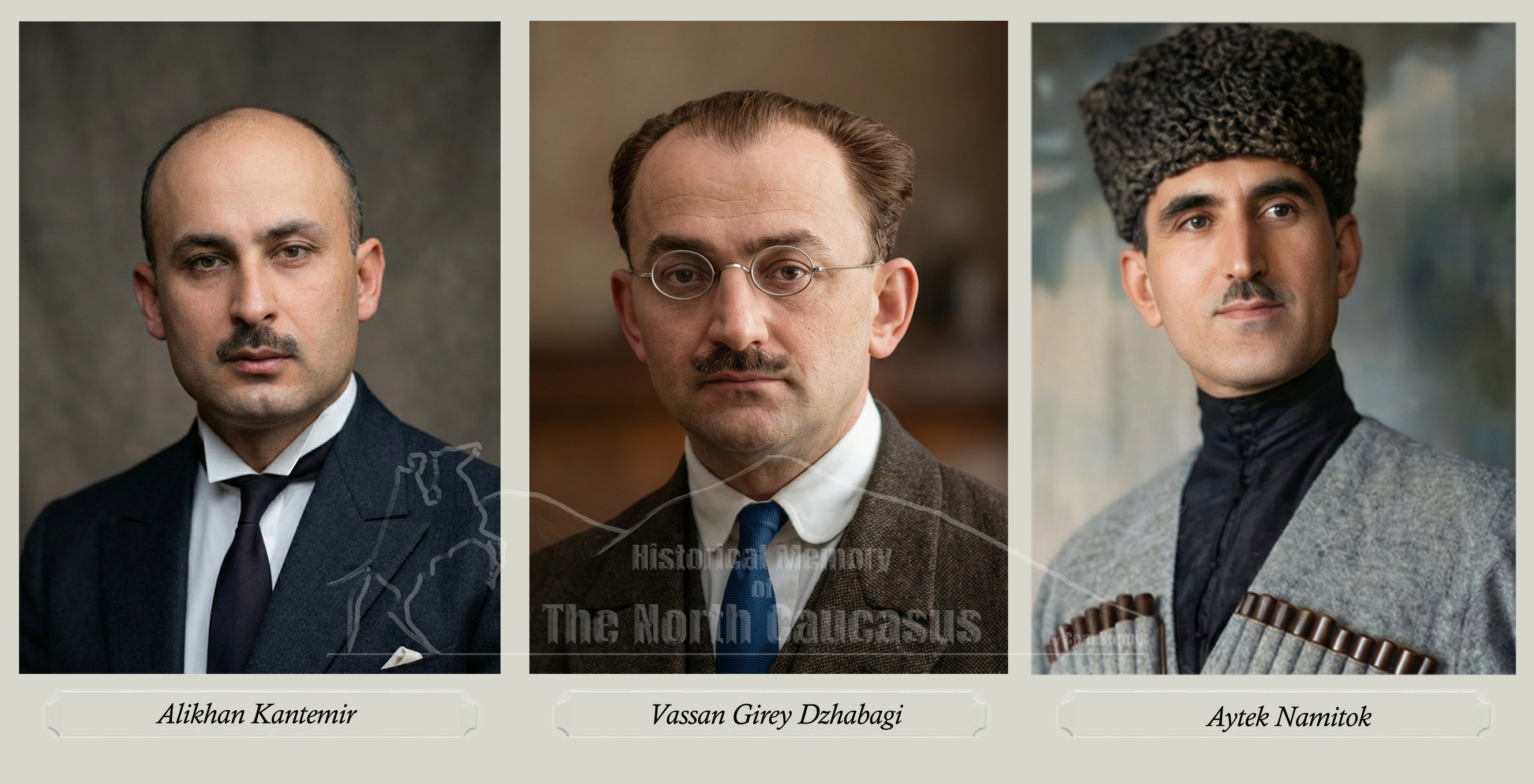
(Click on the image for a larger view)
Polish scholar Professor Georges Targalski, author of one of the first scientific articles on the history of the Promethean Movement, notes that Roman Knoll, Poland's Ambassador to Turkey, sent a report to the Polish Ministry of Foreign Affairs on June 13, 1925, suggesting that the Caucasian branch of the Promethean Movement should consist of Azerbaijani Musavatists, Georgian Mensheviks, and Caucasian Mountaineers affiliated with the Said-Bek Shamil group. Although we lack a document definitively tracing this Polish preference back to the summer of 1925, and despite our inability to access the source and document referenced by Targalski using the provided citation details, the subsequent efforts of Tadeusz Schaetzel—the military attaché at the Ankara embassy—to strengthen ties with these specific groups and purge the nationalist politicians from the existing committee give us an early indication of the Polish Government's overarching strategy.[6]
It was only natural for Poland—initially viewed as a "Friendly Power" by the nationalist Caucasian politicians who laid the foundations of the Committee—to prefer individuals driven by ideological obsessions or personal interests, who could be more easily manipulated, over those with dedicated nationalist sentiments. Therefore, the backing of Menshevik Georgian and Musavatist Azerbaijani groups, whose motivations were ideological rather than spiritually or nationally rooted, was not surprising.
However, the preference regarding the Caucasian Mountaineers was indeed perplexing. Said Shamil was not among the founding cadres of the North Caucasian Republic; nor did he play a role during the state's establishment phase, at the Paris Peace Conference, in the active resistance when the region was invaded by Monarchist and Bolshevik forces, or within the government-in-exile. The most likely reason for selecting this inexperienced young man was his loyalty to his superiors while serving in the French High Military Commissariat. Furthermore, the vast majority of those in the so-called "Said Shamil's group" were Caucasian soldiers who had served in General Denikin's Volunteer Russian Army during the 1919 occupation of the Caucasus, belonging to the "Monarchist Mountaineer Faction" in exile. Driven out by the Bolshevik occupation, the primary dream of most of these individuals was to return to the Caucasus with Wrangel's Army and regain the privileges they had enjoyed during the Tsarist era. As the Bolshevik occupation consolidated its power and became permanent, these dreams were dashed, and the members of this group attempted to reinvent themselves as newfound patriots.
Wolves in sheepskin had begun to lie in wait, ready to fracture the Caucasian political emigration movement...

Istanbul, 22 March 2026
References: Click on the links to access the original documents
[1] IRCICA, Haydar Bammat Private Archive, Meeting Minutes of the Caucasian Republics Union Council, and demands of the Armenian Delegation, 17 March 1925.
[2] IRCICA, Haydar Bammat Private Archive, Haydar Bammat's speech to the Georgian émigré community in Paris on the occasion of the proclamation of the Caucasian Independence Committee, Early 1925.
[3] Sakartvelos Erovnuli Arkivi , The Ultimatum of the İstanbul branch of the Committee for Liberation of the Caucasus. April 1925.
[4] Sakartvelos Erovnuli Arkivi , The letter of the Paris branch of the Committee for Liberation of the Caucasus. 23 May 1925.
[5] Sakartvelos Erovnuli Arkivi , The Ultimatum of the İstanbul branch of the Committee for Liberation of the Caucasus. September 1925.
[6] Georges Targalski, “Les plans polonais concernant l'éclatement de l'URSS, le mouvement « Prométhée » et le Caucase”, Bulletin de l'Observatoire de l'Asie centrale et du Caucase, No 3, 1997, s. 13.