
 Türkçe
In Historical Memory of the North Caucasus, we are bringing to light yet another significant document regarding the history of Abkhazia during the era of the revolutions and the First World War. This historical record, which contains the hitherto unpublished meeting minutes of the Abkhazian People's Council from November 1917 to February 1918, clarifies many unknowns of the period. It is highly probable that these 145-page manuscript records, discovered in the personal archives of Haydar Bammate, were handed over to him by Simon Basaria during the Batumi Conference in June 1918.
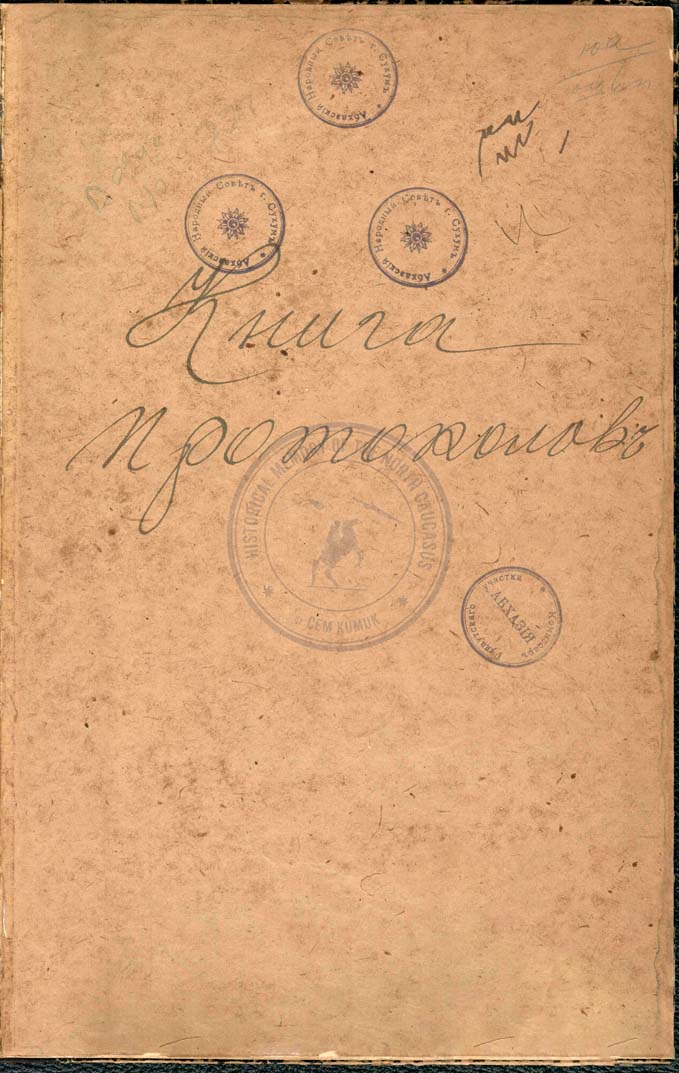
(Click on the image to access the original document)
In alignment with the activities of the Central Committee of the Union of Mountaineers, the peoples of the North Caucasus began holding successive regional congresses to establish self-governance rights and take the necessary steps toward independence. The Abkhazian people, having clearly demonstrated their will to become a part of the Union of United North Caucasian Mountaineers at the Congress of Authorized Representatives of Mountaineers held in Vladikavkaz in September 1917, subsequently held the Abkhazian People's Congress in Sukhum from November 7–10, 1917. Through the resolutions adopted at its inaugural session, the Congress established principles regarding political organization, territorial integrity, and the right to national self-determination. Initially, on November 8, the Congress issued a declaration proclaiming the establishment and the statute of the Abkhazian People's Council:
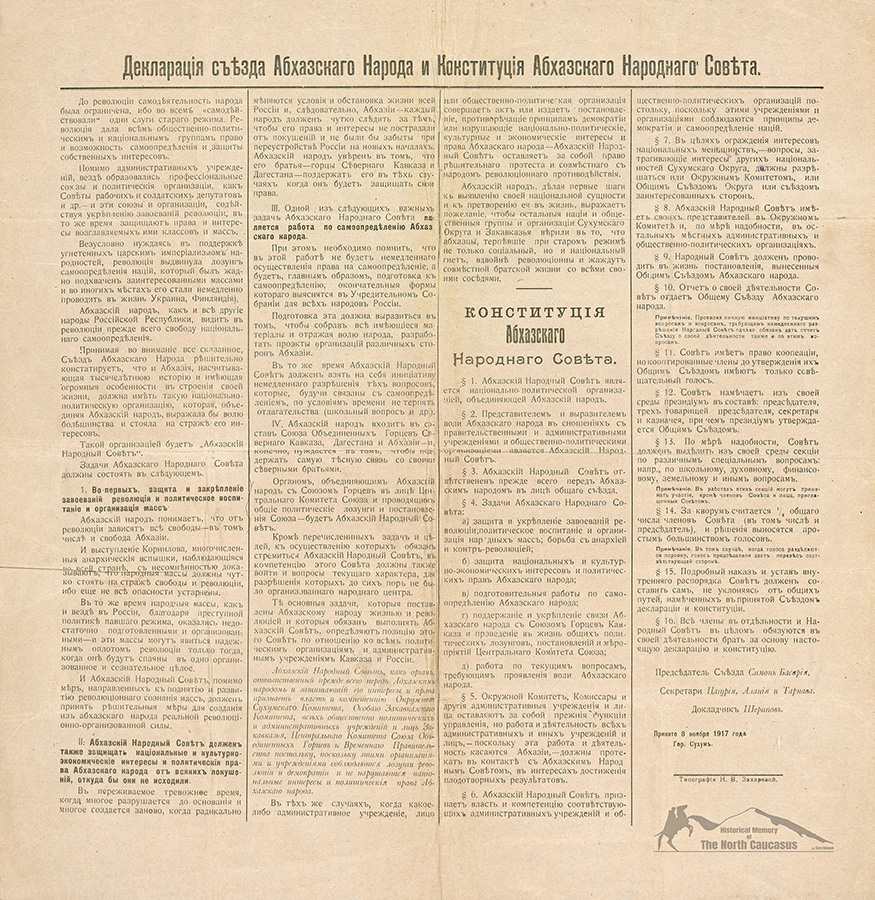
(Click on the image to access the original document)
Founding Declaration of The Abkhaz People's CouncilBefore the revolution, the independent activity of the people was limited, because only the servants of the old regime “acted independently” in everything. The revolution gave all socio-political and national groups the right and opportunity for self-determination and protection of their own interests.
In addition to administrative institutions, trade unions and political organizations were formed everywhere, such as the Soviets of Workers' and Soldiers' Deputies, etc. - These unions and organizations, while helping to strengthen the gains of the revolution, at the same time protect the rights and interests of the classes and masses they led.
Of course, in need of support for the peoples oppressed by tsarist imperialism, the revolution put forward the slogan of self-determination of nations, which was greedily taken up by the interested masses and was immediately put into practice in many places (Ukraine, Finland).
The Abkhaz people, like all other peoples of the Russian Republic, see in the revolution, first of all, freedom of national self-determination.
Taking into account all that has been said, the Congress of the Abkhaz People decisively states that Abkhazia, which has a thousand-year history and has enormous features in the “structure of its life, must have such a national-political organization that, uniting the Abkhaz people, would express the will of the majority and stand as the guardian of its interests.
Such an organization will be the Abkhaz People's Council. The tasks of the Abkhaz People's Council should be as follows:
1. Firstly, the defense and consolidation of the gains of the revolution and the political education and organization of the masses.
The Abkhaz people understand that all freedoms, including the freedom of Abkhazia, depend on the revolution.
And Kornilov’s speech, the numerous anarchic outbreaks observed throughout the country, undoubtedly prove that the masses must sensitively stand guard over freedom and revolution because not all dangers have yet been eliminated.
At the same time, the popular masses, as elsewhere in Russia, thanks to the criminal policies of the fallen regime, turned out to be insufficiently prepared and organized, and these masses can become a reliable stronghold of the revolution only when they are united into one organized and conscious whole.
And the Abkhaz People's Council, in addition to measures aimed at raising and developing the revolutionary consciousness of the masses, must take decisive measures to create a real revolutionary organized force from the Abkhaz people.
2. The Abkhaz People's Council must also protect the national, cultural, and economic interests and political rights of the Abkhaz people from all attacks, no matter where they come from.
In these alarming times, when much is being destroyed to the ground, and much is being created anew, when the conditions and situation of life throughout Russia and, consequently, Abkhazia are radically changing, every people must be sensitive to ensuring that their rights and interests do not suffer from attacks and are not forgotten during the reorganization of Russia on a new basis. The Abkhaz people are confident that their brothers, the Highlanders of the North Caucasus and Dagestan, will support them in cases where they defend their rights.
3. One of the next important tasks of the Abkhaz People's Council is to work on the self-determination of the Abkhaz people.
It must be remembered that this work will not involve the immediate implementation of the right to self-determination, but will mainly be preparation for self-determination, the final forms of which will be clarified in the Constituent Assembly for all the peoples of Russia.
This preparation should be expressed in collecting all available materials and reflecting the will of the people, developing projects for organizations of various parties in Abkhazia.
At the same time, the Abkhaz People's Council must take the initiative to immediately resolve those issues that, being related to self-determination, cannot be delayed due to the conditions of the time (the school issue, etc.).
4. The Abkhaz people are part of the Union of United Highlanders of the North Caucasus, Dagestan, and Abkhazia - and, of course, need to maintain the closest connection with their northern brothers.
The body that unites the Abkhaz people with the Mountaineer Union represented by the Central Committee of the Union and carries out the common political slogans and resolutions of the Union will be the Abkhaz People's Council.
In addition to the listed tasks and goals, the implementation of which the Abkhaz People's Council must strive to achieve, the competence of this Council should also include issues of a current nature, for the resolution of which there has not yet been an organized people's center.
Those main tasks that life and the revolution have set for the Abkhaz people and which the Abkhaz Council is obliged to fulfill determine the position of this Council with all political organizations and administrative institutions of the Caucasus and Russia.
The Abkhaz People's Council, as a body responsible, first of all, to the Abkhaz people and protecting their interests and rights, recognizes the power and competence of the District Sukhum Committee, the Special Transcaucasian Committee, all socio-political and administrative institutions and persons of the Transcaucasus of the Central Committee of the Union of United Highlanders and the Provisional government insofar as these organizations and institutions comply with the slogans of revolution and democracy and do not violate the national interests and political rights of the Abkhaz people.
In the same cases, when any administrative institution, person, or socio-political organization commits an act or issues a resolution that contradicts the principles of democracy or violates the national-political, cultural, and economic interests and rights of the Abkhaz people, the Abkhaz People's Council reserves the right to resolutely protest and join revolutionary resistance with the people.
The Abkhaz people, taking the first steps towards identifying their national essence and putting it into practice, express the wish that other nations and social groups and organizations of the Sukhum District and Transcaucasia believe that the Abkhazians, who suffered under the old regime, are not only socially but also nationally oppressed, are doubly revolutionary and long for a common fraternal life with all their neighbors.
Constitution of the Abkhaz People's Council1. The Abkhaz People's Council is a national political organization uniting the Abkhaz people.
2. The representative and exponent of the will of the Abkhaz people in relations with government and administrative institutions and socio-political organizations is the Abkhaz People's Council.
3. The Abkhaz People's Council is responsible primarily to the Abkhaz people represented by the general congress.
4. Tasks of the Abkhaz People's Council:
a) protection and strengthening of the gains of the revolution; political education and organization of the masses; the fight against anarchy and counter-revolution;
b) protection of national and cultural-economic interests and political rights of the Abkhaz people;
c) preparatory work for the self-government of the Abkhaz people;
d) maintaining and strengthening the connection of the Abkhaz people with the Union of Caucasian Highlanders and implementing the political slogans, resolutions, and events of the Central Committee of the Union;
e) work on current issues that require manifestation of the will of the Abkhaz people.
5. The District Committee, commissars, and other administrative institutions and persons retain their previous management functions, but the work and activities of all administrative and other institutions and persons - insofar as this work and activity concerns Abkhazia - must proceed in contact with the Abkhaz People's Council, in the interests of achieving fruitful results.
6. The Abkhaz People's Council recognizes the power and competence of the relevant administrative institutions and socio-political organizations insofar as these institutions and organizations respect the principles of democracy and self-determination of nations.
7. To protect the interests of national minorities, issues affecting the interests of others must be resolved either by the District Committee, the general congress of the district, or a congress of interested parties.
8. The Abkhaz People's Council has its representatives in the district committee and, as necessary, in other local administrative and socio-political organizations.
9. The People's Council must implement the resolutions adopted by the General Congress of the Abkhaz People.
10. The Council submits a report on its activities to the General Congress of the Abkhaz People.
Note. While showing personal initiative on current issues and issues requiring immediate resolution, the People's Council, however, is obliged to report to Congress on its activities on these issues as well.
11. The Council has the right of co-optation, but co-opted members, until approved by the General Congress, have only an advisory vote.
12. The Council appoints a presidium from among itself: chairman, three fellow chairmen, secretary, and treasurer, and the presidium is approved by the General Congress.
13. As necessary, the Council must select from among its members sections on various special issues, for example. on school, spiritual, financial, land, and other issues.
Note: In addition to members of the Council, persons invited by the Council may take part in the work of these sections.
14. A quorum is considered to be 1/2 of the total number of members of the Council (including the chairman), and decisions are made by a simple majority of votes.
Note: In cases where the votes are evenly divided, the chairman's vote gives the upper hand to the relevant party.
15. The Council itself must draw up a detailed order and internal regulations, without deviating from the general paths outlined in the declaration and constitution adopted by the Congress.
16. All members individually and the People's Council as a whole undertake to base their activities on this declaration and the constitution.
The Meeting Minutes of the Abkhaz People's CouncilAs a national governing body intended to unite the Abkhazian people and guide them toward self-determination, the Abkhazian People's Council, through the decisions taken at its first meeting, established the Congress's principles regarding political organization, territorial integrity, and the right to national self-determination. The Congress unanimously elected Prince Alexander Shervashidze honorary chairman and appointed representatives from various regions.
Addressing political disputes, the Congress declared the Samurzakan population and the rest of the Abkhazians to be a single people, and granted the people of Samurzakan a two-month period to decide whether to join the Abkhazian People's Council and the Union of United Caucasian Mountaineers. The Congress also decided to annex the Gagra region to the Sukhum okrug (district) and proposed elevating the Sukhum okrug to the status of a province (guberniya).
The Congress voted to reorganize the existing Abkhazian volunteer cavalry squadron into a fully-fledged military regiment and decided to issue an appeal for Abkhazian officers currently serving in the Russian army to join it. Acknowledging that the Abkhazian people were too small in number to send their own representative to the All-Russian Constituent Assembly, the Congress resolved to grant a detailed mandate containing their demands to a representative of the Union of North Caucasian Mountaineers to advocate on their behalf.
A motion was introduced urging Abkhazian nobles to voluntarily transfer their privately owned lands to the peasantry before any agrarian law was enacted. The nobles requested a one-month grace period to discuss the matter among themselves before giving the Council a final answer.
To prevent their closure, the Congress decided to transfer schools previously administered by the Society for the Restoration of Orthodox Christianity to the Ministry of Public Education. It also granted Muslim Abkhazians the right to elect their own religious leader, a Qadi, who would reside in Sukhum.
In its second meeting on November 12, 1917, the Abkhazian People's Council focused on early economic, financial, and administrative organization. It unanimously agreed to create a fund to cover current and unforeseen expenses. The primary sources for this fund were voluntary donations from individuals and institutions, alongside a 3-ruble per-household tax levied on the Abkhazian population in the Sukhum province. To generate additional revenue, the Council planned to organize public events, performances, and readings, including a proposed lecture titled "The Conquest of the Caucasus" by Aslanbek Sheripov, a Chechen revolutionary and representative of the Union of Mountaineers. The Council also decided to take over the administration and assets of the Society for the Spread of Education Among the Abkhazians. Declaring itself a revolutionary organ, the Council established a four-person commission tasked with securing office premises. This commission was authorized to negotiate with property owners and, in coordination with other revolutionary organizations, to confiscate properties. A three-person commission consisting of Sheripov, Margania, and Basaria was elected to draft the Council's internal working rules. The same group was also tasked with drafting the Constituent Assembly mandate approved at the previous Abkhazian congress.
The third meeting of the Abkhazian People's Council, held on November 16, 1917, centered on diplomatic relations, education, and administrative finance. Responding to an invitation received by telegraph, the Council appointed two delegates, Sheripov and Adjamov, to attend the Georgian National Congress in Tiflis. The delegates were instructed to convey their greetings and express the Abkhazian people's determination to unite with the Union of United Caucasian Mountaineers to protect their revolutionary gains from political collapse. The Council discussed the necessity of opening a primary school within the Sukhum Teachers' Seminary and decided to initiate action and provide financial support for its establishment. Formalizing the remuneration of its officials, it set a monthly salary of 500 rubles for Aslanbek Sheripov and 300 rubles for the Council secretary. A per diem of 500 rubles was also approved for both Sheripov and Adjamov for their diplomatic trip to Tiflis.
During the fourth meeting on November 19, 1917, regional tensions, administrative appointments, and land disputes were addressed. The Council officially protested the appointment of an individual named Georgobiani as the director of the Sukhum Teachers' Seminary. While explicitly stating they had no personal objection to Georgobiani, the Council argued that the Transcaucasian Commissariat of Education had violated the democratic principle of electing individuals for such positions. Acknowledging the difficulties of assembling all members during the organization's formative phase, the Council ruled that meetings would be deemed valid if at least one-third of its members were present until the internal statute was finalized. To address escalating tensions between the native Abkhazian population and settlers in the village of Eshera, the Council dispatched a delegation consisting of D. Alania, S. Chanba, and M. Tarnava. In the face of rising crime rates and the collapse of local executive authority in the Kodor region, the Council sent Basaria, Kartozia, and D. Gulia to intervene and restore order. The Council also clarified alarming reports regarding "Abkhazian muhajirs" forcefully reclaiming their former lands. Sending an urgent telegram to the Gudauta district commissar, it declared the Council's opposition to unauthorized land occupations and ordered the suppression of lawless acts until the Council formally addressed the broader agrarian issue on November 25. A five-member commission was formed to find a location for a new Abkhazian printing press. Konstantin Dmitrievich Margania was appointed to manage the equipment and operations.
Various administrative, military, and public order issues were tackled during the fifth meeting on November 22, 1917. The Council demanded exclusive control over the distribution of scholarships for Abkhazian students, refusing to recognize external authorities in this matter, and requested representation on the pedagogical councils of local educational institutions. To combat the widespread robberies along the Sukhum-Ochamchira-Gudauta highway, the Council ordered the closure of all roadside dukhans (taverns/shops), identifying them as nests of banditry. An exception was made only for those located in major settlements like Sukhum, Gudauta, and Ochamchira. The Council also intervened to expedite the investigations of Abkhazians detained from the Kodor region and petitioned for the return of weapons to those already released. It ordered the confiscation of the Novy Afon (New Athos) monastery metochion (guesthouse) and the buildings on the "Sinop" estate to be allocated as quarters for the Abkhazian volunteer cavalry squadron. Furthermore, the Council explicitly declared that the cavalry squadron and the future Abkhazian regiment would be under its direct command. Blaming the Gumista district commissar for provocative actions leading to the uprisings in Eshera, the Council resolved to demand his immediate dismissal by the District Executive Committee. A commission was established to oversee the operations and profitability of the newly acquired "Abkhazia" restaurant. The Council also recorded that 1,534 rubles had been collected in donations by Prince Astamur Inal-Ipa, which would be deposited into a bank. It was decided that travel per diem for Council representatives would not compensate for "intellectual labor" but only cover food and transportation costs. The Council accepted Semen Ashkhatsava's offer to purchase his fully equipped printing press for half its value. To supplement missing equipment, it authorized the confiscation of idle printing machinery owned by an individual named Vinogradov, reimbursing him for the purchase price.
Between November 25–27, 1917, the Abkhazian People's Council held a joint plenary session with peasant representatives. In a meeting predominantly discussing regional administration, military mobilization, and comprehensive agrarian reforms, the Council exhibited caution toward the newly established Transcaucasian authority, issuing a declaration of "conditional trust." It decided to adopt a wait-and-see approach until the intentions of the Union of Mountaineers became clear, reserving the right to ignore directives conflicting with the interests of the Abkhazian people. To protect local natural and cultural resources, the Council immediately took the Gagra region under its protection and appointed Ivan Margania to govern it. It officially transformed the Gagra region into a sub-district within the Sukhum okrug, transferred various Abkhazian communities to its jurisdiction, and nominated Kalistrat Bartsits as the new sub-district commissar.
The Council ordered the immediate formation of an Abkhazian regiment without awaiting central authorization. It began identifying men fit for military service between the ages of 18 and 45, provided military training under expert instructors, and issued instructions to procure rifles from the Tiflis cavalry arsenal. Prince Dirmit Marshania reported that the nobles of the Kodor region definitively rejected the request to voluntarily cede their private lands to the peasants. The nobles argued that a premature surrender would damage their honor and stated they would await a nationwide land law from the All-Russian Constituent Assembly. To forestall peasant uprisings following the nobles' refusal, the Council adopted a radical decree transferring all lands in Abkhazia—including large private estates between the Mzymta and Ingur rivers, state, appanage, monastery, and church lands—directly to the disposal of the Abkhazian people and the laboring peasantry. The Council organized an Okrug (District) Land Committee to manage the newly confiscated lands and elected Simon Basaria as its chairman. The Committee was tasked with allocating land, establishing standard rental rates, strictly prohibiting unauthorized land seizures, and protecting forests against predatory exploitation. Acutely aware of severe land shortages in areas such as Eshera, Anukhva, Guma, and Psyrtskha, the Council prioritized peasants and Abkhazian muhajirs in those regions for land allocation, while explicitly forbidding any violence or oppression against settlers who had established themselves there before the revolution.
In its session the following day (November 28), the Council discussed the protection of state property, the acquisition of medical supplies, and the financing of educators. Following intelligence that soldiers planned to occupy the Prince Oldenburg palace in Gagra, the Council decided to deploy a military unit from the Abkhazian cavalry squadron to protect the palace and secure the state property within. Varlam Lakerbaia reported that the Novy Afon infirmary, operated by the Union of Zemstvos, was undergoing liquidation and contained valuable equipment needed for hospitals, such as beds, carts, and medicines. The Council assigned Lakerbaia and Konstantin Margania to prohibit the disposal of the infirmary's property, conduct their own inventory checks, and negotiate with the central administration of the Union of Zemstvos for the transfer of these assets. To provide additional stipends to the teachers of the Sukhum Mountaineer School, the Council decided to request an allocation of 1,000 rubles from the Society for the Spread of Education Among the Abkhazians, authorizing Dirmit Gulia to handle this task.
In the eighth meeting of the Abkhazian People's Council on December 1, 1917, reports regarding hoarded wealth in the Novy Afon Monastery, the financing of cultural institutions, and various administrative and logistical matters were addressed. According to a report presented by Kryuchkov, claiming the existence of immense unused and mismanaged wealth in the Novy Afon Monastery, two million rubles in Russian and Greek gold coins were located in the abbot's room. Additionally, the monastery held large stockpiles of leather goods sold secretly, manufactured textiles worth 200,000 rubles, food provisions, and numerous technical machines and workshops. Postponing a comprehensive review of this report to the next meeting, the Council invited Kryuchkov, who had drafted the report, to attend. To cover the establishment costs of the Abkhazian club, the Council decided to borrow 1,000 rubles from the Abkhazian Cultural and Educational Society. The Council also elected a four-person commission—Ashkhatsava, Gurdzhua, K. Shakirbei, and Mikhail Tarnava—to oversee the Abkhazian club and its affiliated theater. The Council instructed the Sukhum postal and telegraph administration to temporarily deliver all correspondence addressed to the Abkhazian People's Council and the Abkhazian club directly to the club's treasury. Responding to a request from the Abkhazian Youth Congress, the Council agreed to assist them in securing transportation (a motor vehicle or stagecoach) for an official trip to Ochamchira, Gudauta, and Gagra to establish regional branches of their Union. Semen Ashkhatsava was authorized to petition General Gerardi, chairman of the Society for Assistance to Soldiers' Families, to obtain permission to temporarily use furniture from a closed asylum to furnish the Council.
Reconvening on December 10 after a nine-day recess, the Abkhazian People's Council worked on improving its division of labor and workflow. To intensify its efforts, the Council decided to form specialized departments based on different fields of expertise. The newly established branches and their appointed members were:
Schooling Branch: Andrey Chochua, Dirmit Gulia, Vladimir Adleiba, and Mikhail Tarnava. Financial Branch: Djota Shervashidze, Astamur Inal-Ipa, Khasi Avidzba, Georgi Adjamov, and Varlam Lakerbaia. Agrarian Branch: Dirmit Alania, Samson Chanba, and Georgy Gurdzhua. Health Branch: Ivan Margania, Mikhail Tsaguria, and Varlam Lakerbaia. Furthermore, to ensure coordination on major general issues in external relations, the Council decided to invite representatives from the Soviets of Workers' and Peasant Deputies to its meetings and to send its own representative to their councils.
Military deployment, local security, and financial management were under the spotlight at the Council's tenth meeting on December 13. The Council decided to dispatch a detachment from the Abkhazian cavalry squadron to Gagra to maintain order and assist local executive authorities. Highlighting the recent riots in Sukhum and the inadequacy of the city militia, the Council declared its intention to take over the organization of the city militia and tasked the presidium with discussing the matter with the city administration at a suitable time. Konstantin Akirtava was elected to the Council. The Council also agreed (with seven votes in favor, four against, and one abstention) to grant the Abkhazian Youth Union a representative seat on the Council. The Council accepted the offer from General Gerardi, chairman of the Society for Assistance to Soldiers' Families, to provide two stipends of 15 rubles per month for the families of soldiers in the Abkhazian cavalry squadron. Facing financial constraints, the Council sent Konstantin Akirtava to Ilori to secure a 5,000-ruble loan from the local clergy. The Council also approved a 300-ruble loan to the Abkhazian club and reimbursed Konstantin Margania 100 rubles for his prior trip to Novy Afon regarding the Union of Zemstvos infirmary. The Council authorized the hiring of a custodian to work in its premises for a monthly salary of 100 rubles and a room, delegating the recruitment process to the Council secretary.
Three days later, during its meeting on December 16, the Abkhazian People's Council addressed land conflicts, public safety, and administrative appointments. The Council protested the clandestine attempt by the workers' and peasants' deputies to form a Public Security Committee and an armed detachment. It also sent a telegram to the Union of United Caucasian Mountaineers condemning the clashes that had erupted between the Ingush and the Cossacks. In response to unauthorized land seizures and commercial logging perpetrated by peasants (particularly Mingrelians and Armenians) in the Gumista and Kodor regions, the Council dispatched representatives to the region to regulate land and forest usage, expedite the distribution of weapons, and collect the 3-ruble household tax. Mikhail Tsargush was appointed as the Council's permanent representative across the entire Sukhum district, with a monthly salary of 500 rubles, to propagate the Council's ideas among the people. The Council decided to petition the city administration for his dismissal from his teaching post and to propose Elena Adleiba as his replacement. Samson Chanba replaced Tsargush as the secretary of the Land Committee. The Council agreed to lease the Abkhazian club and its cafeteria to an entrepreneurial art troupe on a half-share basis for provisions and staff salaries. The troupe was required to host an evening performance twice a month exclusively for the benefit of the Council. Vasili Gurdzhua was hired as the club manager. Dr. Varlam Shervashidze and Grigori Zukhba were elected to the Council. Furthermore, the Council nominated Martin Tarnava for the position of justice of the peace mediator in the Gudauta district.
The topics of the Council's meeting on December 18, 1917, were territorial expansion, military coordination, and local governance. Razhden Kakubava reported that the people of the Sochi district desired to come under the protection of Abkhazia and join the Sukhum okrug. The Council supported this request and agreed to take the region under its patronage, advising Kakubava that the people of Sochi must first submit a formal petition. The Council decided to demand that the commander of the Sukhum garrison rely on local military forces instead of requesting aid from Tiflis, and operate in direct contact with the Council and the Abkhazian cavalry squadron. Furthermore, they requested that the commander notify the Union of United Caucasian Mountaineers that the current garrison was ineffective and request the deployment of two Cossack companies from the North Caucasus. Representatives from Gagra presented issues regarding the administration of the Gagra climatic station and local estates to the Council before departing for Tiflis to report to the Transcaucasian Commissariat. The Council set a monthly salary of 700 rubles and a per diem for Ivan Margania, the authorized representative for the Gagra region. Varlam Lakerbaia was dispatched to the Gudauta district to expedite the collection of official requests and funds required for arms procurement. Additionally, a joint committee was established to address an arms shipment destined for the Gumista region that had been detained in Tiflis. The Council supported Semen Ashkhatsava's proposal to organize a fundraising evening for the benefit of the Abkhazian periodical press. Administratively, the Council requested firewood from the city food committee and ordered the installation of an electric chandelier in the meeting hall.
In its first meeting of 1918, held on January 2 under the chairmanship of Simon Basaria, food supply, military leadership, and public order measures were deliberated. Council member Dirmit Gulia was appointed as a representative to the Kuban Cossack Host Government to request grain supplies to meet the needs of the Sukhum okrug population. The Council approved the candidacy of Sultan Klych-Girey for the command of the Abkhazian regiment and decided to immediately notify the Central Committee of the Union of United Caucasian Mountaineers of the situation by telegram. After reviewing the report of the Kodor region delegation regarding the establishment of robust authority, the Council approved a comprehensive series of security measures. Each region was ordered to compile lists of criminals and establish guard units consisting of at least 25 honest and honorable citizens to patrol the roads at night. Captured criminals, prior to being handed over to judicial authorities, were to be fined 300 rubles (payable to the guards) and sentenced to six months in prison. If the perpetrator could not be found, the inhabitants of the region where the crime occurred—along with the populations of neighboring regions where the criminal's trail was lost—would be held jointly liable to compensate the victim using the properties of the criminals. Strict disciplinary practices were instituted for civil servants, and all citizens were required to perform the public services assigned to them. Evasion of service would be punishable by three months in prison (along with the cost of hiring a replacement), with harsher penalties for repeat offenders. The Council approved the prohibition of carrying unauthorized weapons, the deportation of crime ringleaders from the Sukhum okrug, the introduction of a passport system, the creation of a transit protection militia funded by passenger fees (1 ruble per stagecoach passenger and 5 rubles per carriage), and the closure of all dukhans (taverns) between Tamysh and Kodor, identifying them as primary dens of banditry.
The agenda of the Council's meeting on December 20, 1917, encompassed economic grievances, military recruitment, regional diplomacy, and administrative restructuring. Inspector-technologist Griboyedov presented a report on the misconceptions held by city organizations and the working class about the Council, blaming it for rising unemployment and cash shortages. He requested that Abkhazian youth be trained as technicians and labor organizers, but due to a lack of time, comprehensive discussion of his report was postponed. Citing his roles in multiple organizations and his heavy workload, Chairman Simon Basaria resigned from his presidency of the Land Committee. Dirmit Gulia was elected acting chairman until the committee's general assembly convened. Mikhail Tsaguria, in his report on his duties in the Kodor region, noted that 400 cavalrymen had been registered for the future Abkhazian regiment, decisions regarding arms were ready, and the 3-ruble household tax had been collected. He also noted that Prince Tatash Marshania, the chief of the detective detachment, held 7,000–8,000 rubles collected from robbery fines without a legal mandate. The Council authorized Tsaguria to secure these funds as a loan or under other terms. Following Razhden Kakubava's previous report, the Council accepted in principle that the integration of the Sochi district into the Sukhum okrug was desirable. However, the Council declined to initiate the annexation itself, stating that the people of Sochi must first submit a formal petition to the relevant authorities, which the Council would then support. Georgi Adjamov was sent to the North Caucasus to report to the Mountaineer Government on conditions in Abkhazia. Finally, the Council resolved to convene a joint plenary session of the Council and the Land Committee in Sukhum on January 4, 1918, to draft detailed land committee instructions and resolve crucial political issues.
During the January 8, 1918 meeting, relations with the North Caucasus, military organization, procurement of medical supplies, and the investigation into a major political assassination were discussed. Giorgi Adjamov presented a report on his visit to the Mountaineer Government. The Mountaineer Government had recognized Abkhazia (the Sukhum okrug) as a member of the Union of United Caucasian Mountaineers and promised to prevent interference by the Transcaucasian Commissariat. Adjamov also refuted Chkhenkeli's claims that Abkhazia had joined the Georgian autocephalous church, confirming the independence of the Abkhazian church, and noted a proposal from the Mountaineer Government to unite the Abkhazian church with the Ossetian church under a single diocese. The Mountaineer Government officially approved the formation of the Abkhazian regiment and proposed three candidates for command. From these, the Council approved Sultan Klych-Girey and requested that literate young Abkhazians be sent to Vladikavkaz for officer training. The Council also requested that the new commander recruit new officers with the Council's knowledge, and issued an appeal for all Abkhazians serving in the Russian army to return to serve their homeland. Varlam Lakerbaia highlighted the severe shortage of medical equipment in regional hospitals and demanded that supplies be procured from the liquidating Novy Afon Union of Zemstvos infirmary, by confiscation if necessary. The Council decided to secure these materials at all costs, to finance the purchase through a special tax levied on the Abkhazian population along with contributions from other nationalities in the region, to convene a congress of regional doctors, and to keep Lakerbaia, along with his assistant Adjamov, in charge of procurement.
Council Secretary Mikhail Tarnava presented a report concerning the December 28, 1917 congress of Gudauta district representatives regarding the political assassination of Dirmit Kobakhia, a teacher who had spoken out against the privileged class. The congress had prepared an indictment against two hired assassins (paid 8,000 rubles) and six conspirators alleged to have plotted against various public figures, including Nestor Lakoba and Kalistrat Bartsits. Due to ambiguities in the indictment and the absence of Lakoba and Bartsits, the Council postponed its final decision and appointed a three-person investigative commission (Zukhba, Basaria, and Gurdzhua).
To investigate and trace the source of dangerous rumors and claims that Abkhazians planned to deport and massacre Russian officers and soldiers, the Council dispatched Alexander Shervashidze, Varlam Lakerbaia, and Andrey Chochua to the commander of the Sukhum garrison. Finally, the Council established a committee to organize a fundraising evening to bolster the treasury.
The Abkhazian People's Council held its sixteenth meeting on January 9, 1918. This session focused on the investigation into the murder of teacher Dirmit Kobakhia and the administrative structure of the Gagra region. Council members Vasili Gurdzhua and Chanba proposed the admission of Arzakan Emukhvari, Nikolay Janashia, Ephrem Eshba, and Mikhail Khasaya to the Council, but the decision was deferred to the next meeting per standard procedure.
Nestor Lakoba, the commissar of the Gudauta district, presented a detailed report describing Kobakhia as a sympathetic pedagogue whose outspokenness at political gatherings had angered local princes and nobles. Finding the December 28, 1917 indictment insufficient on its own, the Council reaffirmed its previous decision to send an investigative commission to Gudauta. The Council unanimously rejected the proposal to subject the conspirators to a mob trial (samosud), deeming it ignorant and bigoted, and left the final punishment open until the investigation concluded. Nevertheless, it ordered strict solitary confinement with a visitation ban for the detained suspects Mkan Gabelia and Rosim Kosto-oglu. By a simple majority—despite opposition from Chairman Simon Basaria and Andrey Chochua—the Council also ordered the arrest of the alleged revenge conspirators Murzakan Lakerbaia, Vladimir Lakerbaia, Georgi Zvanbaya, and Kamshish Gablia. Furthermore, the Council resolved to request the introduction of trial by jury in Abkhazia.
Following Ivan Margania's report on the inadequacy of security forces in Gagra, the Council requested the commander of the Abkhazian cavalry squadron to temporarily deploy a cavalry detachment to the region. This detachment was authorized to take over artillery guns, ammunition, and machine guns from departing military units until a reliable local militia force could be established.
Observing that the administration of the Gagra Climatic Station controlled all of the urban economic life and properties virtually, the Council voted to abolish the Gagra municipal self-government. A three-person commission (Ivan Margania, Nestor Lakoba, and Kalistrat Bartsits) was formed to audit and reorganize the Station's board of directors under Council supervision. Ivan Margania was appointed as the director of the Climatic Station, granted full authority to protect and manage all state and private properties in Gagra and the surrounding district.
In the session continuing the following day (January 10), military organization, coastal artillery, administrative disputes, and diplomatic representation in the North Caucasus were addressed. Reviewing the petitions of seven Abkhazian officers (including Vissarion Ladaria and Vladimir Anchabadze) requesting transfer to the forming Abkhazian regiment, the Council decided to retain these officers in Abkhazia at its disposal while nominating them to the headquarters of the Caucasian Native Cavalry Corps. The Council also resolved to immediately summon the newly appointed regimental commander, Sultan Klych-Girey, by telegraph for urgent consultations. Following intelligence that soldiers were abandoning the 15th coastal battery and an offer from a representative named Kicha to remain as an instructor, the Council instructed the commander of the Abkhazian cavalry squadron to conduct negotiations to retain one instructor from each battery held near the "Sinop" estate and the "Trapetsiya" square. Furthermore, the Council ordered an inventory of all abandoned artillery guns, shells, and machine guns along the Abkhazian coast, and decreed their takeover by national military units or district commissars.
The Council scheduled a plenary session for January 22, 1918, to determine the date for a broader Abkhazian People's Congress. Upon reading the complaint of the abbot of the Novy Afon Monastery regarding an unauthorized search and confiscation of funds by an audit commission subordinate to the Sukhum Executive Committee, the Council condemned the committee's actions and demanded the return of the confiscated money. Semen Ashkhatsava requested permission to move his printing press to Gudauta and transfer it to the local municipal self-government. The Council agreed to transfer the press to Gudauta, provided the local government submitted an official document accepting responsibility for its receipt.
Discussing the permanent representation before the Provisional Mountaineer Government, the Council addressed accusations that Semen Ashkhatsava was incapable of representing the interests of the Abkhazian people and had neglected his duties to attend to his personal printing business. By a vote of 10 to 2 (with 1 abstention), the Council passed a vote of no confidence against Ashkhatsava, noting that the official decision on his dismissal or replacement would be made by the upcoming Abkhazian People's Congress.
During its eighteenth session on January 13, the Council addressed food supply logistics and reported disruptions along the Black Sea Railway. In response to a request from Citizen Novikov, chairman of the Gudauta city food committee, the Council decided to seek assistance from the Kuban Cossack Host Government to aid the two dispatched representatives—Shipulin and Gigiberia—in purchasing flour and other essential goods. The Council instructed the Gagra district commissar to assist Novikov in recovering two train cars of flour intended for Gudauta that were mistakenly unloaded in Gagra. Technical commissar Citizen Fedorov and a railway engineer reported that railway union workers had seized control of the railway construction administration. According to their reports, these workers were halting operations, dismissing and arresting technicians and engineers, appointing ordinary laborers to technical roles, and causing disorder through unauthorized actions. Citing the severity of the railway situation and the absence of key experts needed to resolve the issue, the Council postponed a substantive decision. Instead, it resolved to discuss the matter in future sessions, subsequently inviting the main speakers as well as relevant external individuals—particularly Engineer Dolinsky, the mayor, and Commissar of Labor Chkhikvishvili.
In the nineteenth meeting of the Abkhazian People's Council on January 14, topics such as military training and recruitment, procurement logistics, healthcare, fundraising, and public relations were debated. In response to a request from the Provisional Mountaineer Government, the Council decided to carefully select candidates from among secondary school graduates to attend a military school in Vladikavkaz, noting that Council members who enrolled would retain their Council status and be priority candidates for the national regiment. The Council formed a commission consisting of Dr. Varlam Shervashidze and Mikhail Tsaguria to draft, alongside Captain Prince Vladimir Shervashidze, detailed rules and regulations for the formation of Abkhazian battalions. The Council also resolved to negotiate with the commander of the Abkhazian cavalry squadron regarding the practical feasibility of recalling former cavalrymen to military service. To procure necessary equipment for the organizing Abkhazian battalions, the Council decided to dispatch one of its members to Tiflis alongside Captain Shervashidze. They also decided to send a letter to Haydar Bammate, the representative of the Mountaineers’ Government in Tiflis, asking him to assist the Council's delegates in acquiring these materials from the Transcaucasian Commissariat. The Council approved sending an official notice to Georgian society clarifying that its failure to attend the January 14 meeting of the Georgian National Government was due to a delayed invitation caused by a Council member's error. Through members Gurdzhua and Shakerbaya, the Council planned to ask the manager of the Abkhazian club theater to organize a charity evening for the Council's benefit. The Sukhum Abkhazian Women's Society was requested to assist with the event, primarily by organizing the buffet. After reviewing a report from a junior medical officer regarding the condition of the Gudauta field hospital, the Council resolved to forward the notification to the Chief Medical Directorate in Tiflis and send a copy to Commissar Chkhenkeli. Furthermore, a request from an individual named Vekua for an Abkhaz language teaching position in Sukhum was rejected due to a lack of vacancies, but noted for future consideration. To inform the regional population about its activities, the Council decided to distribute its public declarations through local school teachers. It also resolved to allocate a special section in the newspaper Sotsial-demokratov to publish the Council's work and decisions on socio-political and economic issues.
The Abkhazian People's Council held its twentieth meeting on January 15, 1918. The meeting reviewed a decree regulating local food transport, alongside a protest by accused Abkhazian nobles regarding the investigation into the murder of teacher Dirmit Kobakhia. Speaking on behalf of the nobles targeted for arrest, Murzakan Lakerbaia argued that the murder of Kobakhia was not politically motivated, stating that the teacher rarely gave political speeches and, on one occasion, when criticizing princes and nobles, was merely translating the words of agronomist Efimov. Lakerbaia asserted that the nobles had no intention of assassinating political speakers. He pointed out that if they had, they would have first targeted prominent revolutionaries like Efimov, Nestor Lakoba, or Kalistrat Bartsits, and accused Lakoba and Bartsits of prejudice and attempting to provoke a class-based civil war. The nobles rejected the indictment of the December 28, 1917 Gudauta congress as a fraudulent attempt by Lakoba's supporters, claiming the testimonies were gathered by biased individuals (Priest Vasili Agirba, Murat Abukhba, and Gid Tarba). They demanded a comprehensive investigation by the Council's three-person commission (Zukhba, Basaria, and Gurdzhua) and declared that no noble would be taken alive for arrest until the findings were revealed. Promising to accept the severest punishment if found guilty, they demanded that Lakoba and Bartsits receive the same punishment for slander should the nobles be exonerated. Taking these arguments into account, the Council decided to suspend the execution of the January 9, 1918 arrest warrants for the accused nobles and to expedite the investigation to determine their guilt or innocence.
The Council issued a region-wide decree exempting the transport of corn and other foodstuffs between settlements within the district's borders from obstruction, while strictly forbidding the export of these provisions outside the district limits.
Crucial topics such as military mobilization, multi-ethnic defense integration, arms procurement, and diplomatic relations with Georgia were discussed at the Council's January 19 meeting. Following a report from representatives of the Kodor district inhabitants that resolutions had been passed and travel funds collected to procure weapons from the Tiflis reserve arsenal, the Council decided to immediately dispatch personnel for the shipment. The regional representatives were instructed to contribute 25 rubles per rifle for their share of the 400 rifles allocated to them. The Council fully adopted the military branch's report on the formation of Abkhazian battalions and decided to send delegates to execute the plan. Responding to a verbal statement by Dr. Stupanis, a representative of the Greek community, expressing the desire of the Greeks of the Sukhum okrug to form a military unit and join the emerging Abkhazian national army, the Council agreed to take the initiative in forming a Greek unit. The Council also authorized a delegation—consisting of the commander of the Abkhazian cavalry squadron, Varlam Lakerbaia, Varlam Shervashidze, and Vladimir Shervashidze—to negotiate with other national organizations to form national units under the central authority of an Abkhazian Brigade and an Abkhazian Cavalry Regiment.
After reviewing the Georgian National Council's invitation aimed at clarifying Georgian-Abkhaz relations and Akaki Chkhenkeli's private letter to Alexander Shervashidze, the Council selected Prince Alexander Shervashidze, Mikhail Tsaguria, and Dut Tarba to attend the Tiflis conference. The delegates were given strict instructions to firmly defend Abkhazia's unbreakable alliance with the North Caucasian Mountaineers, reject any foreign political, economic, or cultural agreements, and repel any external interference in internal governance, remaining exclusively within the bounds of discussing mutual understanding, mutual assistance in national matters, and good neighborly relations. The Tiflis delegation was also tasked with applying for the establishment of the Abkhazian brigade, procuring necessary materiel from the quartermaster department, and acquiring weapons for the regional populace under the militia regulations of the Special Transcaucasian Committee.
The General Assembly of the Abkhazian People's Council was held between January 22–25, 1918. Amid discussions on a radical change in leadership structure, the crisis with the Abkhazian cavalry squadron, comprehensive agrarian reforms, and new taxation measures, Simon Basaria resigned from the chairmanship following criticism of weak leadership and internal friction. Lawyer Grigori Zukhbaya was unanimously elected as the new chairman. Despite initial hesitation to accept the presidency, primarily due to his Samurzakan origins and his inability to speak fluent Abkhazian, Zukhbaya accepted the position. The Council renamed the board of directors as the Executive Committee and elected Georgi Adjamov as vice-chairman. To prevent the resignation of Secretary Mikhail Tarnava, his salary was raised. Arzakan Emukhvari and Ephrem Eshba joined the Council as members. General speeches were limited to five minutes, and strict confidentiality rules were imposed for closed sessions.
The command echelon of the Abkhazian cavalry squadron threatened to demobilize the unit due to severe food shortages, unpaid guard duty wages, and a disputed 3,000-ruble municipal grant. To preserve the unit as the region's sole security force, the Council unanimously allocated a fixed-price food ration, agreed to pay accumulated wages for bank and city guard duties, and instructed the Abkhazian Cultural-Educational Society to disburse the 3,000-ruble grant to the soldiers. However, the Council rejected the cavalry's financially unfeasible demand for a 200-ruble monthly salary and called for a general Abkhazian People's Congress on February 10 to resolve the crisis.
The Council decided to establish Land Committees, overseen by a multi-ethnic central Land Department, to manage all state, private, church, monastery, and appanage lands. Additionally, Samurzakanians and returning muhajirs in various regions were exempted from paying land rent until a final agrarian settlement was reached, though they remained subject to general land taxes.
The Council increased opportunities for adequately educated Abkhazian youths aged 18 and over to enter military ensign schools. It also added Nestor Lakoba to the Tiflis delegation—alongside Alexander Shervashidze, Dug Tarba, and Mikhail Tsaguria—to attend the Georgian National Council conference and negotiate the formation of a separate Abkhazian brigade with a mandate advocating for Abkhazia's full internal autonomy.
Following Murat Abukhba's report, the Council approved the organization of the "Kiaraz" peasant union in the Gudauta and Kodor districts to defend the revolution and unmask counter-revolutionaries. District commissars were also ordered to eradicate quackery, fortune-telling, and superstitious rituals among the peasantry through bans, fines, and arrests.
To bridge the severe financial deficit, the Council replaced the fixed 3-ruble household tax with a graduated, income-based household tax ranging from 5 to 15 rubles, and abolished Mikhail Tsaguria's paid role as traveling inspector. It also dispatched Vasili Khasaya and Konstantin Margania to Novy Afon to inventory and purchase medical supplies on credit from the liquidating Union of Zemstvos infirmary.
After hearing complaints from the Gagra Soviet representative Bigvavaski, who accused Council envoy Ivan Margania of ignoring local democratic organizations, the Council reaffirmed its prior decisions regarding the governance of Gagra. The decision to send an investigative commission to Gudauta regarding the murder of teacher Dirmit Kobakhia was confirmed. Suspect Luka Kartozia was issued a certificate documenting his socialist beliefs and affirming that he had acted in a state of temporary insanity.
Under the chairmanship of Vice-Chairman Mikhail Tsaguria, the Executive Committee of the Abkhazian People's Council held its first meeting on January 28, 1918, tackling medical procurements, administrative and military tensions in Gagra, military recruitment, and local affairs. The Executive Committee decided to take over the inventory of medicines and supplies from the liquidating All-Russian Union of Zemstvos infirmary in Novy Afon jointly with the Sukhum municipal self-government, granting the city the right of first selection for needed materials while billing separately. The Committee also resolved to petition the Chief Medical Directorate in Tiflis to cover the Council's share of the invoice and authorized the sale of a very small portion of the medical supplies to the Novy Afon Monastery for cash to help pay off the Zemstvo Union debt.
Due to the absence of key officials and speaker Feodorov, the Black Sea Railway discussion was removed from the agenda. Invitations were sent to the Sukhum mayor, Commissar of Labor Chkhikvishvili, Engineer Damensky, and military-technical commissar Feodorov to schedule a special session on January 30.
Following Varlam Lakerbaia's report on acute tensions with Gagra's democratic organizations, contested local elections, the refusal of Climatic Station director Ivan Margania to cooperate with local organs, and the undisciplined behavior of the Abkhazian cavalry squadron detachment stationed in the region, the Committee assigned member Arzakan Dgebuadze to stabilize the area. Dgebuadze was instructed to form a collective board of directors for the Climatic Station, clarify the legal status of the Gagra municipal self-government, address the abuses of the cavalry detachment, investigate the validity of local elections, and organize local guards to protect major state and private estates. Upon the desertion of soldiers from coastal outposts along the Black Sea coast of Abkhazia, the Committee ordered the Gudauta and Kodor district commissars to immediately muster 150 Abkhazians (75 from each district) and deliver them to Sukhum by February 10 to maintain public order. The Committee also resolved to ask the Guard Squadron commander to petition for the preservation of existing supply and funding allocations for these replacement forces.
After hearing the report from Abkhazian Club manager Tsulukia regarding the condition of the club and the demands of entrepreneur Krishevskaya, the Committee formed a three-person commission endowed with broad powers to manage the club's affairs, consisting of Varlam Lakerbaia, Vasil Tsulukia, and Akhvled Khashba.
The meetings of the Executive Committee of the Abkhazian People's Council held on January 29-30 addressed the pacification of the crisis in Gagra, securing the Black Sea railway, and planning regional boards. Following a telegram from the Gagra Soviet of Workers' and Soldiers' Deputies warning of potential armed clashes between local public organizations and the Abkhazian cavalry squadron detachment led by Ivan Margania, the Executive Committee decided to intervene peacefully. The Committee strictly ordered Margania to avoid violence under his personal responsibility, forwarded a copy of this directive to the Sukhum port commander, and sent V. A. Shervashidze, V. G. Gurdzhua, and L. O. Kartozia to Gagra with broad powers to resolve the dispute.
After military-technical commissar A. V. Fedorov and railway engineers reported widespread looting and disorder threatening the Black Sea railway, two-thirds of which ran through Abkhazia, the Committee unanimously agreed to place the line and its properties within Abkhazia under Council protection. Alexander Shervashidze was authorized to petition the Transcaucasian Commissariat to secure formal approval and funding to protect the railway.
With the idle railway construction stalled by financial and supply shortages, M. A. Rabinovich, a Jewish banker representing a London bank, proposed that a private British company take over the project, reimburse prior expenses, and invest 120 million rubles to complete the line, provided the Council guaranteed security. The Committee accepted the proposal in principle and left formal contract negotiations to Rabinovich and the Transcaucasian Commissariat, pledging to support Rabinovich's petition. The Committee decided to combine the Congress of representatives of the Sukhum district inhabitants with the general assembly regarding the demands of the Abkhazian cavalry squadron, postponing the joint meeting from February 10 to February 20. Alexander Shervashidze was tasked with negotiating the postponement with the cavalry squadron. The Committee assigned Simon Basaria, Andrey Chochua, Khana Lakerba, Arzakan Emukhvari, Samson Chanba, and Vasili Gurdzhua to participate in local village assemblies.
Meetings No. 26 and 27 of the Abkhazian People's Council were held on February 1 and 5. Efforts to defuse political tensions in Gagra, enforce forest protection laws, investigate regional crimes, and regulate food supplies through local trade were the main agenda items of the meetings.
Following a report from the Gagra detachment, the Executive Committee determined that the unrest in Gagra was instigated not by Council representatives, but by a hostile reactionary group attempting to provoke conflict between Abkhazians and Mingrelians. To resolve the dispute peacefully, the Committee decided to expedite the delegation's deployment and invite the Executive Committee of the Soviets of Workers', Soldiers', and Peasants' Deputies to join a mixed delegation.
Addressing the issue of firewood carts detained by cavalrymen of the Abkhazian cavalry squadron under the command of Ensign Dzidzaria to protest predatory logging, the Council ordered the release of state food committee timber following permit verification, and allowed private owners to reclaim their wood after paying 15 rubles per cubic meter to the District Land Committee. The Council also reiterated its strict ban on the felling of live trees and instructed the District Land Committee to take extraordinary measures against ongoing forest looting, especially in the Gumista district. The Council condemned the unauthorized attempts by the Gumista Land Committee to confiscate the office and businesses of G. D. Shervashidze's estate, referring the complaint to the District Land Committee. Additionally, after Varlam Lakerbaia reported that the "Otradnoye," "Kolkhida," and "Marinovo" estates in Gagra were being destructively plundered, the Council assigned Lakerbaia and Varlam Shervashidze to manage Gagra affairs and examine a long-term lease proposal for the estates.
In response to a complaint from the border guard commander, the Council requested the Abkhazian cavalry squadron to send an officer and cavalrymen to Ochamchira to address the inappropriate actions of the city commissar. Regarding the murder of six peasants in the village of Jgerda, the Council deferred a comprehensive review of Semen Ashkhatsava's investigative report due to time constraints, but called upon the District Commissariat to dismiss inadequate administrative officials in the Kodor region. Chairman G. M. Zukhbaya also submitted the written findings of the Gudauta commission regarding the murder of teacher Dirmit Kobakhia, but discussion was postponed.
To alleviate the food shortages in Sukhum caused by rural militias blocking deliveries, the Council ordered commissars to ensure unobstructed transport within the Sukhum district, while maintaining the ban on the export of corn, flour, livestock, and dairy products outside the region. The Council also tasked the Presidium with negotiating with Sukhum Mayor Chkhikvishvili to secure a 1-ruble share per pood from the city's 3-ruble tobacco export tax.
The Council pledged broad support for an Abkhaz-language theatrical play proposed to be staged for its benefit, stating it would notify organizers once the date for the Abkhazian People's Congress was set. It also established a new four-person commission to oversee the properties of the Abkhazian Club.
Military mobilization, coastal artillery defense, judicial reforms, financial structuring, and local administrative matters were discussed at the February 8 meeting of the Executive Committee of the Abkhazian People's Council. While noting that Abkhazians legally remained exempt from conscription under current laws, the Executive Committee deemed it appropriate to participate in the Transcaucasian mobilization during a turbulent military period to secure weapons and uniforms, referring the final decision to the general assembly on February 10. Furthermore, concerns raised by Duguj Tarba that unpaid Sukhum city militiamen planned to desert with their rifles were resolved after the Committee noted a new City Duma decree guaranteeing their wages. In response to reports from artillery officers in Gudauta regarding undefended cannons and their own uncertain status, the Committee took the officers into Council service under the command of the Abkhazian cavalry squadron. The cavalry squadron commander was instructed to take delivery of battery equipment and allocate five to six cavalrymen to the officers, who were tasked with establishing and training a local volunteer artillery detachment.
The Committee resolved to expedite the introduction of trial by jury in the Sukhum district and initiate proceedings to establish a special Sukhum District Court—nominating Kutaisi court members Petrov and Skiadovski, and granting the Council the right to propose or reject judges. Following the escape of convicts Astan Chkotua and Rajden Kosto-oglu from the Sukhum prison, the Committee decided to send representatives to the Gudauta district to publicly explain the circumstances of the escape and the Council's position.
The Committee decided to operate the Abkhazian Club directly under the management of the Sukhum Abkhazian Women's Society, lease the club theater as a cinema, and approve Andrey Chochua's request to host a student charity evening for the benefit of the Sukhum Higher Primary School. Additionally, a petition from the abbess of the Komani convent seeking to protect land lease rights was referred to the District Land Committee. The Committee abolished the position of Council treasurer and transferred financial record-keeping duties to the secretary. Under the new rules, expenditures required Executive Committee approval based on official budget estimates, and it was mandated that all funds be kept in a bank and withdrawn solely with the signature of the Council chairman.
At the General Assembly of the Abkhazian People's Council on February 11, 1918, discussions surrounded the walkout of the Abkhazian cavalry squadron, ongoing unrest in Gagra, political friction with Gudauta representatives, and the planning of a general national congress.
The Council rejected a request from the head of the 5th construction zone of the Black Sea Railway to send an observer to verify the legality of railway workers' committee elections, stating it could not interfere in the workers' internal affairs.
Following reports of encroachments by Count Olsufiev and agronomist Svekhovski on the "Marinovko," "Otradnoye," and "Kolkhida" estates, alongside conflicting accounts of recent clashes in Gagra, the Council confirmed V. D. Lakerbaia and V. A. Shervashidze as its authorized envoys to resolve all Gagra issues. During the session, Gagra Soviet representative Bochareishvili stated that local democratic organizations would recognize the Council's authority if it respected electoral principles rather than directly appointing local officials. Noting the unexcused absence of the Gudauta district representatives, the assembly, despite having a quorum, agreed as a courtesy to postpone all non-urgent agenda items. Before proceeding to the next item, Luka Kartozia accused Nestor Lakoba of organizing a boycott and forcibly spreading Council-hostile Bolshevik ideas, calling for an official protest against the absent members.
Citing severe material hardship, neglect, and uncertain military status, the personnel of the Abkhazian cavalry squadron announced their desire to demobilize with their rifles and equipment, leaving behind only 30 cavalrymen to train potential recruits. Despite persistent pleas from General Assembly members, they walked out of the hall. Speakers also reported that baseless rumors in Gudauta claiming the Council's new income tax was funding the cavalry squadron had led to tax resistance. At the insistence of the cavalry squadron commander, the Council appointed a delegation to persuade the unit to remain on duty for at least one more month until the upcoming national congress.
To resolve major socio-political issues, the cavalry squadron crisis, and the representation of other nationalities on the Council, the assembly resolved to convene a general Abkhazian People's Congress on February 24, on the basis of electing one delegate per 100 households.
Regional representatives also attended the thirtieth meeting of the Abkhazian People's Council. This joint session with the Public Security Committee focused on regional unrest, the multi-ethnic policing system in Sukhum, leadership disputes, and administrative affairs.
Because an armed uprising by Mingrelians in the Dranda region—fueled by Bolshevik-influenced agitators, deserters from the Sukhum guard squadron, and rumors that Abkhazian nobles were preparing to attack—prevented the participation of Samurzakan and Kodor delegates, the February 24 meeting was declared legally invalid and incapable of making general national decisions. The delegates elected a three-person peace delegation (Gid Tarba, Yuda Achirba, and Martin Tarnava) to negotiate in Dranda, and postponed the National Congress to March 10 and the General Peasant Congress to March 13.
In a joint session held on February 25, chaired by Sukhum Mayor Veniamin Chkhikvishvili—who urged Abkhazian intellectuals to culturally oppose class divisions without stripping former nobles of their civil rights—Abkhazian delegates proposed using force to protect Sukhum. Chkhikvishvili presented the Public Security Committee's plan to create a 300-strong city militia comprising 100 Abkhazians, 70 Armenians, 50 Georgians, 50 Greeks, and 30 Russians, for a monthly salary of 225 rubles plus housing and utility expenses, and demanded an official response through the Abkhazian People's Council.
On February 26, Armenian representatives from the Labra and Kvitavli districts reported violence, theft, and murder perpetrated by Abkhazian nobles, who were also demanding a rent of 200 rubles per dessiatin. The Congress resolved to request the Abkhazian People's Council to immediately coordinate with district and village commissars and land committees to protect the Armenian population until they could return to their homeland.
The delegates granted the Abkhazian People's Council the authority to expel members who disseminated unilateral decisions or personal opinions contrary to Council resolutions. Chairman G. M. Zukhbaya rejected accusations of pro-nobility bias and conditionally agreed to remain in office provided there was strict solidarity among Council members, whereas Varlam Lakerbaia insisted on resigning immediately due to the distrust of the Gudauta peasants.
Following these developments, Bolshevik organization in Abkhazia gained significant momentum. After the coup attempts organized by the Bolsheviks to seize Sukhum, the Abkhazian People's Council, due to the chaotic situation in the North Caucasus, found no alternative but to seek assistance from the Menshevik Georgian Government. The Menshevik Georgian regime, using the joint struggle against Bolshevism as a pretext, accelerated its efforts to cultivate a subservient faction within the Abkhazian administration in order not to miss the opportunity to seize Abkhazia. There are no further entries in our available Abkhazian People's Council meeting minutes register as of the end of February 1918. Only a brief, insignificant note dated July 6 is found at the very end of the register. No other register containing Council meeting records has survived from March 1918 until May 17, when German-backed Menshevik Georgian forces occupied Sukhum.

Istanbul, 16 November 2026