
 Türkçe
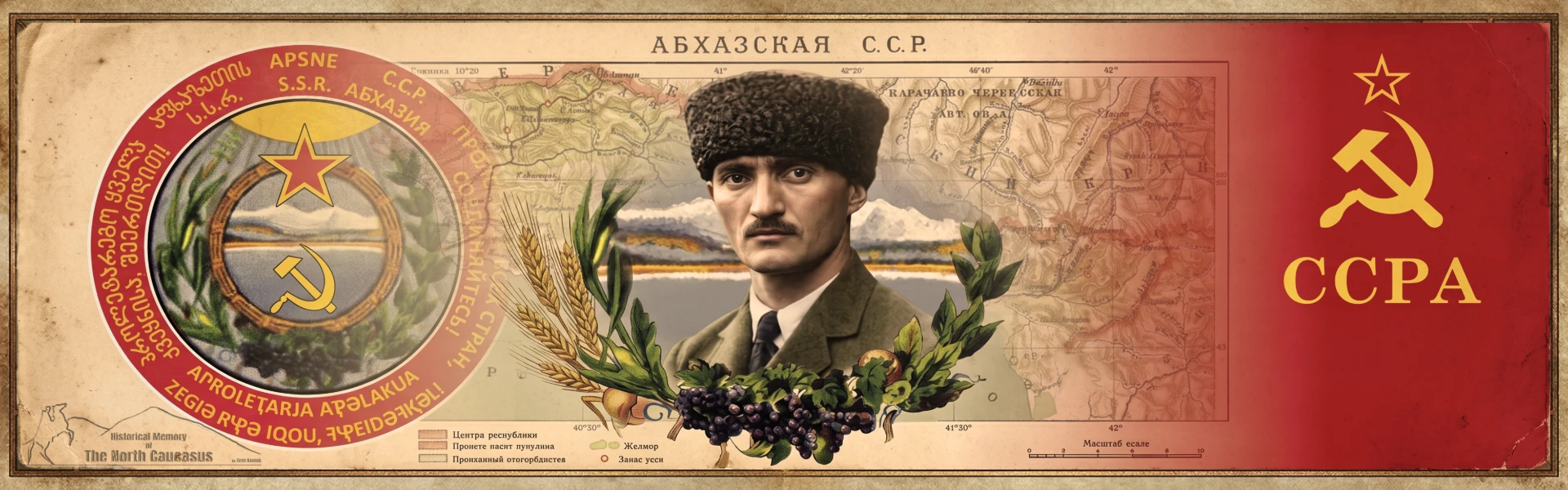
The inauguration of every new archive and the accessibility of every new document provide a fresh perspective on our historiographical discourse. Consequently, our critical assessments of historical cult figures are continually reshaped. In a similar vein, our understanding of Nestor Lakoba—a figure who was once elevated to the status of the 'Father of the Abkhazian Nation' through various political dogmas—has acquired an entirely new dimension following the recent scholarly release of the Lakoba Papers at Stanford University's Hoover Institution. The Lakoba Papers at the Hoover Institution were first studied by Research Professor Timothy Blauvelt, who published his findings in 2022 in a monograph titled "Clientelism and Nationality in an Early Soviet Fiefdom: The Trials of Nestor Lakoba." In preparing this blog post, I have benefited from both the archival documents and Blauvelt's monograph.
The political history and formation of the early Soviet leadership cohort in Abkhazia during the early 20th century provides a striking precedent for the entrenchment of the Bolshevik regime in the Caucasus. This marks the region's transition from a marginalised agrarian society to a Soviet republic, focusing heavily on the rise of the Bolshevik movement, the mobilisation of the peasantry, and the subsequent factional struggles for power led by influential figures such as Nestor Lakoba and Efrem Eshba.
Pre-Revolutionary Context and National AwakeningIn the late 19th and early 20th centuries, the revolutionary fervor sweeping the Russian Empire had very little resonance among the ethnic Abkhaz. The Abkhaz population was largely comprised of peasant farmers who had been living under a formal Tsarist edict as a "guilty people" since the uprisings and deportations of the 1860s and 1870s. Tsar Nicholas II lifted this edict of guilt in 1907, which allowed a nascent Abkhaz intelligentsia to begin emerging in the 1910s. This early national awakening was spurred by resentment over the resettlement of Georgians and focused initially on religious and linguistic consolidation, such as translating religious texts into Abkhaz.
The 1917 Revolutions and the Rise of "Kiaraz"The February and October revolutions of 1917 initially provoked only a modest reaction in Abkhazia, with socialist ideology having little impact on the traditional peasantry. However, Bolshevik activists, notably the charismatic Nestor Lakoba, began building support among the Abkhaz peasantry by appealing to their dissatisfaction over land issues and taxation. Lakoba successfully mobilized the peasantry by invoking "Kiaraz," a traditional Abkhaz form of peasant organization based on mutual aid and defense. Kiaraz evolved into a revolutionary armed peasant association, solidified by traditional oath-taking and a desire for vengeance against the nobility following the murder of Dmitry Kobakhiya in November 1917.
The 1918 "Sukhum Commune" and the Underground EraIn early 1918, local Bolsheviks led by Efrem Eşba and Nestor Lakoba made their first major attempt to seize power, aided by Russian sailors from the battleship Dakiya. In April 1918, Kiaraz insurgents successfully captured the capital, establishing the "Sukhum Commune," which was notable for its lack of executions, bloodshed, and terror compared to other Bolshevik takeovers. The Commune lasted only 42 days before being defeated by Georgian government troops, forcing the Bolshevik leaders to flee to Soviet Russia or operate underground. Between 1918 and 1920, the political situation remained volatile; the Georgian government cracked down on Bolsheviks, while an "Independentist" faction within the Abkhazian People's Council became increasingly frustrated with Georgia's handling of autonomy and began sympathizing with revolutionaries. In May 1918, Abkhazia formally declared its independence, catalyzed by its incorporation into the state structure of the Republic of the Union of Caucasian Mountaineers—which recognized Abkhazia as an intrinsic component of the Mountaineers’ Union—and a concurrent resolution by pro-independence factions.
However, during the subsequent occupation of Abkhazia by Menshevik Georgians, who were bolstered by the Imperial German Army, the national forces of the Republic of the Union of Caucasian Mountaineers were unable to provide military assistance, as they were simultaneously compelled to resist occupying forces across multiple fronts.
Consequently, this strategic vulnerability precipitated a political shift, prompting the Nationalist-Democratic masses and the broader populace to increasingly align themselves with the Bolsheviks.
The Imposition of Soviet Power (1921) and Consolidating PowerRecognizing the tactical advantage of an Abkhaz peasant insurgency to destabilize the Georgian government, the Bolshevik leadership supported an uprising in Abkhazia. In February 1921, the Soviet Red Army invaded the region. Underground Revolutionary Committees quickly seized control of Sukhum, and Eşba and Lakoba returned to Abkhazia to head the new Soviet government.
Once Soviet power was established, a significant rift emerged between the two primary Abkhaz leaders regarding the region's future. Efrem Eşba prioritized formal territorial status and fought for Abkhazia's recognition as an independent Soviet republic. Conversely, Nestor Lakoba cared less about formal status and instead focused on building a massive, loyal patronage network. Lakoba immediately began installing his own clients—family members, friends, and Kiaraz veterans from his native Gudauta district—into key government and party positions. This blatant clientelism sparked fierce factional conflicts between Lakoba's "local" Abkhaz group and the "arrivals" (Russian and Georgian officials assigned to the region by the central Communist Party).
Lakoba successfully outmaneuvered his political opponents by leveraging his popularity and framing his group as the legitimate titular representatives of the region. By 1924, Lakoba had engineered the removal of his most vocal critics, including central party officials and former Abkhaz allies, consolidating his unquestioned leadership over what critics mockingly called "Lakobistan."
Political Status and Economic Control in Early Soviet AbkhaziaFollowing the declaration of Soviet Power in 1921, Abkhazia was initially recognized as a full Soviet Republic. By February 1922, it was transitioned into a "Treaty Republic" united with Georgia, eventually entering the Transcaucasian Federation (ZSFSR) through Georgia. Tobacco was the region's most valuable asset, and recovering production after the civil war was a central concern. Lakoba supported centralizing tobacco purchasing and sales through state organizations like Abgostorg, which was managed by Ismet Kady-Zade. This monopolistic approach was heavily criticized by political rivals, such as Nikolai Bakhtadze, who argued for a free-market approach to prevent ideological corruption and middlemen.
The Azatyan Commission and the "Rif Revolt"In 1925, fears from the Georgian leadership regarding Abkhazia's autonomous ambitions led to a series of investigations and political crises.
The Transcaucasian Central Executive Committee (ZakTsIK) dispatched a commission led by Azatyan, which delivered a scathing report in late 1925. The report claimed that Abkhazia was not a true socialist republic, but rather an oligarchy dominated by ethnic Abkhaz and ruled as a personal dictatorship by Lakoba. The report highlighted extreme nepotism, corruption, and nationalist hiring practices.
Although the higher Transcaucasian leadership (Zakkraikom) chose not to remove Lakoba, the situation sparked a major rebellion among Abkhazian elites. Several high-ranking Abkhaz commissars resigned in protest, initiating what was dubbed the "Rif Revolt". The rebelling officials submitted a document with 41 specific accusations against Lakoba. They accused him of ignoring dissent, ruling as an autocrat, and protecting a corrupt patronage network, with a particular focus on the violent and illegal activities of his half-brother, Mikhail Lakoba.
Lakoba's Triumph and Evolving PatronageDespite the intense local opposition, Lakoba maintained his grip on power through the steadfast support of central Soviet figures.
Powerful figures like G.K. "Sergo" Orjonikidze and Lavrenty Beria firmly backed Lakoba during the crisis. Orjonikidze dismissed the opposition's actions as petty infighting and a breach of Party discipline. The opposition group, led by Bakhtadze and several Abkhaz commissars, was ultimately reprimanded and recalled for violating Party rules by acting outside official Obkom channels. Lakoba emerged victorious by portraying himself as the only capable leader who could maintain stability and implement the Party line. Following the near-disaster of the "Rif Revolt," Lakoba realized he could not rely solely on family members. He began to extend patronage and share rents with broader titular Abkhaz elites, using the threat of Georgian dominance to unify his clients around shared ethnic interests.
The Tsebelda Tobacco ScandalsThe Topchyan family dominated Tsebelda through violence, extortion, and speculation. They infiltrated local Soviet and Party institutions to control the regional tobacco cooperatives. The clan was implicated in severe crimes, including the murders of local party officials and witnesses, embezzlement of state funds, and rampant tobacco speculation. The Topchyans operated with near impunity because they enjoyed the protection of top officials in Sukhum, including Nestor Lakoba. Investigations were frequently derailed or manipulated by officials loyal to Lakoba's network. By 1928, increasing pressure and reports of corruption drew the attention of central control committees. A new Abkhazian Obkom secretary, A.S. Amas, pushed forward an investigation that exposed the deeply compromised local Party cells. This culminated in the expulsion of several corrupt officials and set the stage for a major public show trial regarding the "Tsebelda Affair".
The Gathering Storm: Denunciations and the Mirzabekyan Commission (1928)In the summer of 1928, a series of anonymous letters and a signed statement by an Old Bolshevik named Martyn Tarnava were sent to the top Soviet leadership in Moscow. These letters accused Lakoba and his inner circle of widespread embezzlement, nepotism, and covering up political murders. The system of corruption and patronage was explicitly referred to by one anonymous author as "Lakobovshchina". The allegations caught the attention of the central control organs in Moscow, which prompted the formation of a joint commission led by Aram Mirzabekyan to investigate the situation. The Mirzabekyan commission's findings, reviewed by the Georgian Central Committee in early 1929, resulted in a routine whitewash of the situation. The leadership issued mild reprimands to some lower-level officials but brought no criminal charges against Lakoba or his close associates. Tarnava, the primary named accuser, allegedly submitted a second statement retracting his accusations, claiming they were driven by personal animosity over losing his job.
The Kadyrov and Tseitlin Reports: Escalating Pressures (1929)Despite the Mirzabekyan commission's lenient conclusions, the political pressure on Lakoba intensified in 1929 through two highly critical reports. Seit Kadyrov, an Azerbaijani official, produced a detailed ethnographic and political report connecting the corruption in Abkhazia to historical clan structures and the privilege of the Abkhaz nobility. Kadyrov's report brought significant attention to the "Tsebelda affair," an ongoing situation where a local kulak mafia operated with the blatant protection of Abkhazian secret police and Soviet officials. A subsequent Moscow-backed commission, led by senior investigator Boris Tseitlin, conducted a much more aggressive investigation. Tseitlin unearthed severe abuses of power, nepotism, and unpunished murders linked to Lakoba's relatives. Tseitlin concluded that Lakoba had consolidated too much power, fostered subservient sycophancy, and explicitly recommended that Lakoba be removed from his position.
Stalin's Intervention and the Sturua Whitewash (1929-1930)The momentum against Lakoba, fueled by the Tseitlin report and the ongoing Tsebelda show trials, was abruptly halted by a direct intervention from Iosef Stalin. In October 1929, Stalin wrote a letter defending Lakoba, arguing that Tseitlin had relied on untrustworthy sources and misunderstood the specific political conditions in Abkhazia. Following Stalin's directive, the Transcaucasian leadership formed a new commission headed by Vano Sturua to re-investigate Tseitlin's claims and neutralize the threat to Lakoba. The Sturua commission systematically discredited Tseitlin's investigative methods and labeled Lakoba's accusers, such as Tarnava, as "kulaks" and "anti-Soviet elements". In April 1930, based on the Sturua report, Lakoba was fully rehabilitated and cleared of all charges. Following his exoneration, Lakoba cemented his authority by installing his loyal client, Vladimir Ladariya, as the Party Obkom secretary.
Key Investigatory Commissions (1928-1930)Mirzabekyan Commission: Lead Investigator Aram Mirzabekyan whitewashed early accusations; issued minor reprimands to lower officials while protecting Lakoba.
Kadyrov Commission Report: Lead Investigator Seit Kadyrov exposed deep-rooted clan corruption, ethnic friction, and the Tsebelda mafia.
Tseitlin Commission: Lead Investigator Boris Tseitlin confirmed severe corruption and nepotism; recommended Lakoba's immediate removal.
Sturua Commission: Lead Investigator Vano Sturua discredited Tseitlin's report on Stalin's orders and fully exonerated Lakoba.
The Tsebelda AffairThe "Tsebelda affair" involved a deeply entrenched kulak mafia that operated with near-total impunity in the Tsebelda region for years, heavily protected by local Soviet and secret police officials. The region was effectively controlled by the Topchyan family, who acted as "overlords". They terrorized the local peasantry and engaged in extortion, arson, rape, murder, and racketeering. The Topchyans were shielded by officers of the Abkhazian secret police (GPU) and high-ranking Soviet officials. Kadyrov's report noted that the GPU apparatus was "rotten through and through," with officials covering up murders because the killers were their friends or allies. Even after the Topchyan brothers were arrested, their network remained powerful enough to murder a poor peasant who had given damaging testimony against them. Furthermore, the local People's Court was robbed, and all investigation papers and case files related to the Topchyans were burned. Following pressure from the Georgian Central Committee, a massive show trial was held in October and November 1929. Forty-four defendants were tried, resulting in ten death sentences. Those sentenced to death included key local officials who were part of the syndicate: Tsebelda selsovet chairman Karapet Topchyan, Regional Tobacco Cooperative Chairman Arzuman Topchyan, Abgostorg tobacco grader Pogos Topchyan, and Markoz Topchyan, a member of the Abkhazian Central Executive Committee. The scandal implicated several high-ranking members of Lakoba's central leadership. Former Abkhazian GPU head Nachkebia, Sukhum Executive Committee head Ermolai Dameniya, and Abgostorg head Ismet Kady-Zade were among those removed from the Party for their roles in the cover-ups.
High-Profile Political Murder CasesLakoba's opponents frequently accused him of orchestrating or covering up the murders of political rivals, often framing them as blood feuds or personal vendettas.
Nestor Lakoba was accused of ordering bodyguards to murder Dmitry Kobakhiya in 1917 out of revenge (claiming Kobakhiya's family killed Lakoba's father) and because of a romantic rivalry over a girl named Gaguliya. Lakoba allegedly killed one of the bodyguards' brothers to cover his tracks. Lakoba argued his father was accidentally killed by a friend, not a Kobakhiya. He claimed he actually helped Kobakhiya marry Gaguliya. Lakoba stated Kobakhiya was murdered by a man hired by local nobles, and that the killer was later legally shot by Lakoba's brother.
Nestor Lakoba was accused of protecting the assassin who murdered Maksim Gobechiya, a respected Communist and early rival of Lakoba who had just been named Military Commissar in 1921. Lakoba flatly denied any involvement, asserting that Gobechiya was killed by a peasant named Arizba as a result of an unrelated blood feud.
Nestor Lakoba was accused of ordering Yakov Mikhailov's murder because Mikhailov married Lakoba's relative against his wishes and due to a land dispute in 1927. The Kadyrov report explicitly accused Lakoba's brother, Mikhail Lakoba, of being the shooter. Lakoba denied the land dispute and stated Mikhailov had scandalously seduced his own cousins. A man named Dorote Dzhergeniya confessed but was acquitted. The case remained officially unsolved, though Kadyrov claimed local officials were too terrified of Lakoba to prosecute his brother.
Nestor Lakoba was accused of forcing the court to execute two veteran revolutionaries (Chich Vozba and Reshid Vandzhash) to cover up the true circumstances of Djoto Shakryl's death in a drunken brawl in 1927. Lakoba denied any connection to the participants. Court records showed that another man confessed to the killing, but the court deemed the confession fake, convicting and executing Vozba and Vandzhash instead.
The 1930s and Shifting Power DynamicsDuring the early 1930s, the political landscape in the Soviet Union began to change dramatically due to Stalin's aggressive centralization and collectivization policies. Nestor Lakoba initially used his close ties with Stalin to help Lavrenty Beria ascend to the position of First Secretary of the Transcaucasian Regional Committee in 1932. The Soviet campaign to collectivize agriculture triggered a massive peasant uprising in the Gudauta district of Abkhazia in 1931. Lakoba attempted to pacify the uprising through negotiation rather than violence, which led to local party members criticizing him for avoiding class warfare and protecting the Abkhaz peasantry. As Beria consolidated his power in the Transcaucasus, he no longer needed Lakoba's support and began actively undermining Lakoba's regional authority. A major blow to Lakoba's network occurred in 1936 when Beria orchestrated the removal of Lakoba's right-hand man, Vladimir Ladariya, replacing him with Aleksei Agrba, a long-time rival of Lakoba.
The Death of Lakoba and the 1937 Show TrialsThe power struggle between Lakoba and Beria culminated in Lakoba's sudden death and a brutal purge of his political allies. In December 1936, Lakoba died suddenly in Tbilisi shortly after dining at Beria's residence. Although the official cause was a heart attack, all the evidence pointed to Beria poisoning him.
Although Lakoba was initially given a state funeral with honors, he was covertly declared an "enemy of the people" shortly thereafter, and his remains were secretly exhumed and relocated. In the fall of 1937, a highly publicized show trial was orchestrated in Sukhumi to eradicate the remnants of Lakoba's political network. Lakoba's former associates were tortured and forced to confess to fabricated counterrevolutionary crimes, including plotting to assassinate Stalin and Beria, economic sabotage, and conspiring to create an independent Abkhazian state under Turkish protection. The trials resulted in the execution of Lakoba's closest allies, family members, and clients, effectively annihilating the Abkhaz political elite.
The Aftermath, Georgification, and Historical LegacyWith Lakoba's network destroyed, Abkhazia fell under the absolute control of Beria and his Georgian loyalists, an era remembered in Abkhazia as the "Berievshchina". The new leadership initiated a mass resettlement program, bringing primarily Megrelians, thousands of ethnic Georgians, and other groups belonging to different ethnicities into Abkhazia, significantly altering the region's demographic balance. The regime launched aggressive "Georgification" policies, which included forcing the Abkhaz language to adopt a Georgian-based script and effectively eliminating Abkhaz-language education. The downfall of the Lakoba's order was ultimately facilitated by a broader shift in Soviet nationality policy, which abandoned its initial protection of small autonomous groups in favor of larger union republics, such as the Georgian SSR.
In the post-Stalin era, Abkhaz historians and intellectuals mythologized Nestor Lakoba, elevating him to the status of a flawless national hero and founding father. The violent purges of the 1930s, combined with the structural flaws of Soviet ethno-federalism, deeply politicized ethnic identities and laid the groundwork for the modern, violent conflicts between Georgia and Abkhazia.
Appended to this article are links to a 190-page file comprising selected primary source documents from the Hoover Institution, housed within our archives, alongside three pamphlets containing the writings of Nestor Lakoba and his photo album.

Istanbul, 5 August 2026
— Selected Archival Documents: https://www.historycaucasus.com/archives/selected-documents-from-the-lakoba-papers/reader
— Сталин и Хашим: https://www.historycaucasus.com/archives/stalin-i-xasim/reader
— От VI к VII Съезда Советов АССР Абхазии: https://www.historycaucasus.com/archives/ot-vi-k-vii-sieezda-sovetov-assr-abxazii/reader
— К Истории Революционного Движения в Абхазии: https://www.historycaucasus.com/archives/k-istorii-revoliucionnogo-dvizeniia-v-abxazii/reader
— Nestor Lakoba Photo Album: https://www.historycaucasus.com/archives/nestor-lakoba-photo-album/reader