
 Türkçe
During the years of the First World War, as the Russian Empire entered its process of dissolution, intriguing phenomena were unfolding in the Caucasus. Although revolutionary proletarian ideologies were not widespread in the North Caucasus—home to a predominantly agrarian peasant population—nationalist intellectuals had begun preparations, buoyed by the hope that this era might finally deliver the freedom and independence awaited for centuries.
As is often the case, the intellectual landscape of Caucasian society was diverse and fragmented. While nationalist groups bifurcated into liberals and conservatives, religious factions similarly lacked a homogeneous structure. Given that the last few generations had been born and raised under Russian occupation, the number of Caucasians desiring the continuation of the Russian Monarchy was by no means negligible. Conversely, those who had suffered under the oppression of Russian imperialism and its local subcontractors constituted a group that embraced socialist revolutionary ideas.
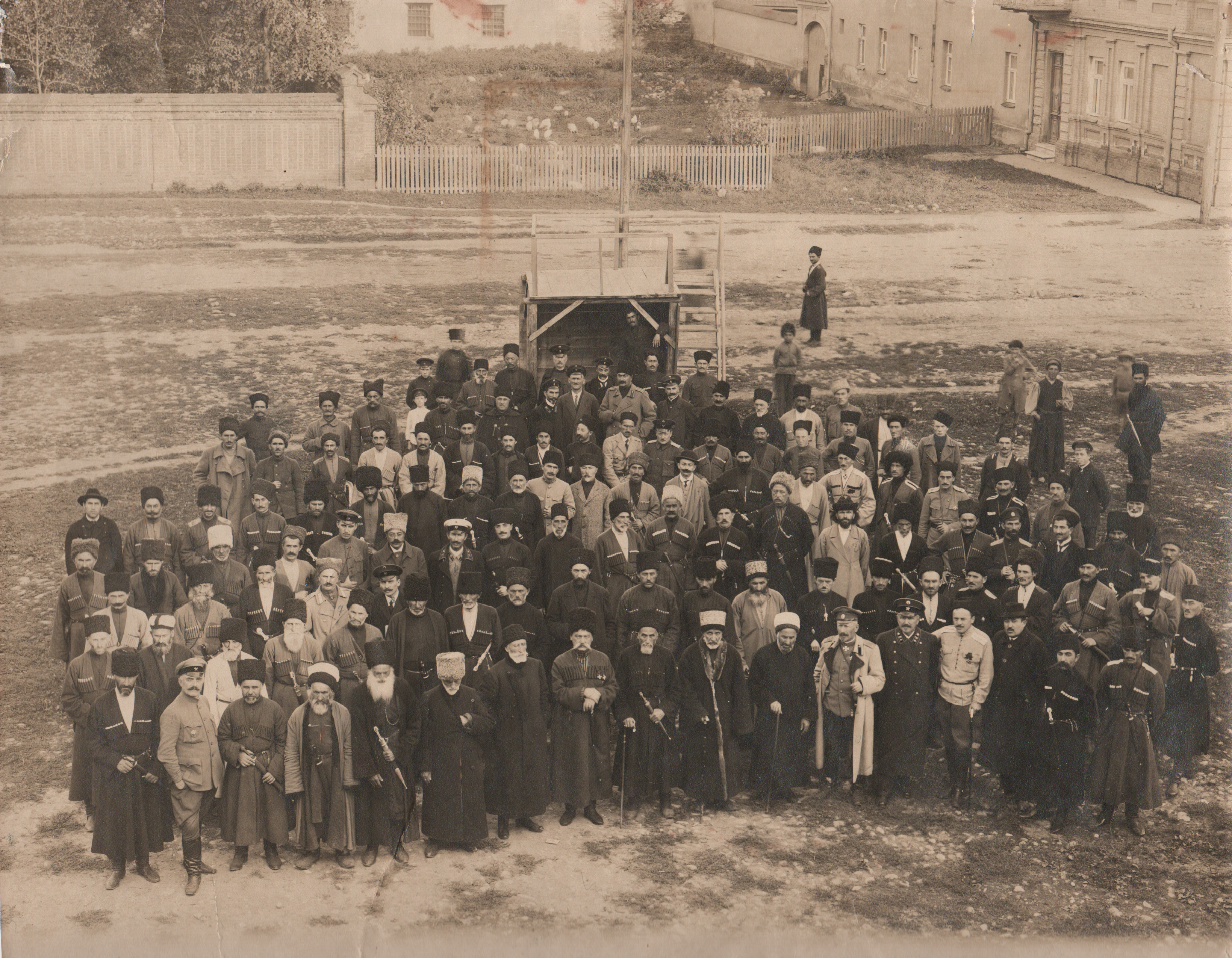
(click on the image for a larger view)
However, these developments also exposed a fissure within the Mountain Government. On December 5, 1917, the Chairman of the Central Committee, Tapa Chermoy, announced his resignation from the presidency of the Union Central Committee via a published manifesto. Citing the inadequacy of the Committee's administrative functions as justification for his departure, Chermoy stated that merely changing the Committee's title to Government did not alter the outcome. The fact that Chermoy was not offered a position in the Terek-Dagestan Government indicated that grievances had begun to surface among the elites of the Union of Mountaineers. (Cem Kumuk, Düvel-i Muazzama’nın Kıskacında Kafkasya Dağlıları, Istanbul, 2022, p.268)
While Haydar Bammat conducted lobbying activities in his capacity as Minister of Foreign Affairs for the Mountain Government, Tapa Chermoy, observing that Uzden Haji Murad Arsamakov (known by the pseudonym Gazavat) was being acknowledged as an interlocutor by the Germans, attempted to bypass Bammat and establish contact with the Germans through Gazavat. Such initiatives, indicative of a statecraft and diplomatic tradition yet to fully mature, caused severe tensions among the Mountaineer politicians. (Institut Istorii, Arkheologii i Etnografii Dagestanskogo Federalnogo İssledovatelskogo Tsentra, H. Bammat's letter to T. Chermoy, Istanbul, 31 August 1918, F. 2. O. 1. D. 59. L.42.)
The government displayed inconsistent attitudes in its communications, treating the North Caucasian Government's representative in Istanbul differently from the Speaker of the Parliament. Consequently, the ties between Haydar Bammat and Tapa Chermoy were pushed to the breaking point on multiple occasions; as Foreign Minister, Bammat was compelled to send messages containing stern admonitions to Chermoy, insisting that no foreign contacts be established, nor binding commitments made, without his knowledge. (Institut Istorii, Arkheologii i Etnografii Dagestanskogo Federalnogo İssledovatelskogo Tsentra, H. Bammat's letter to T. Chermoy, Istanbul, 5 September 1918, F. 2. O. 1. D. 59. L.27-30.)
Mustafa Butbay offered striking observations regarding the profiles of Caucasian leaders, and his comments certain intellectuals and feudal figures within the liberal wing of the North Caucasian independence movement. Butbay accused these individuals of squandering financial aid entrusted to them for the struggle on their own personal pleasures, employing the following expressions: (Mustafa Butbay, Kafkasya Hatıraları, Ankara, 1996, pp.6,12,95.)
[...] The sin of the Caucasian intellectuals is great. History shall never forgive them for failing to seize the great opportunity events cast before them, and for submitting once again to the yoke. The negligence and procrastination of the North Caucasian intellectuals regarding self-sacrifice is particularly egregious. I would not be exaggerating to say that in Dagestan and Chechnya, where we traveled for months, we encountered almost no Mountaineer intellectuals other than a few Soviet members. We did not witness even a prepared propaganda organization.Chermoy’s popularity was not particularly high among Mountaineer politicians in those days. Speaking at the 5th Congress of the Terek Peoples on November 25, Ahmed Tsalykkaty asserted that the British intended to exploit the riches of the Caucasus through Chermoy. (Kakagasanov ve Kaymarazova (Ed.), Soyuz Obedineniy Gortsev Severnovo Kavkaza i Dagestana (1917-1918), Mahachkala, 1994, p.175.) Yet, contrary to Tsalykkaty’s claim, Chermoy’s popularity among the British was also poor. The British were unwilling to engage with Tapa Chermoy, whom they characterized as Pan-Islamist and Pan-Turkist. (The National Archives, Foreign Office Papers, 26 July 1919) Consequently, Chermoy resigned from the presidency on December 15, 1918, and was succeeded by the Pshemakho Kotse Cabinet on December 19, 1918.
I have not engaged in literary embellishment in these memoirs, nor have I resorted to exaggeration. I have recorded facts and events as they were, in all their naked truth. Yes, the North Caucasian delegates did not refrain from playing politics in the salons of the Pera Palace and the boulevards of Paris, spending a lira per person per hour, nor did they hesitate to lavish the 40 million rubles they borrowed on venues of pleasure and entertainment.
Only Aziz Meker, Haydar Bammat, and Agayef went to Switzerland with ten thousand liras received from the Minister of National Defense, Enver Pasha; with this money, they stayed in Switzerland for six months, printing maps and books, and publishing newspapers. The European press and political notables were informed of the existence and initiatives of the North Caucasian Government. Of the money that passed into the hands of intellectuals, only this sum was spent in its proper place and served a benevolent purpose. President Chermoyef squandered 20,000 francs of the mere 37,000 francs held by the delegates returning to Paris. [...]
[...] Abdulmedjid is a Chechen. He served as an aide-de-camp to Emperor Nicholas, possesses naphtha wells in Grozny, has adopted Russian culture, and is a frivolous prince addicted to pleasure and entertainment. He is a proponent of Caucasian independence only on the condition that his peace and comfort remain undisturbed. He intends to relive the grandeur and magnificence of the Imperial era by becoming President.
The Peace Negotiations in Paris commenced on January 18, 1919. The North Caucasian delegation, consisting of Tapa Chermoy, Ibrahim-Bek Haydar, and Dr. Hasan Hadzarak, had only just departed from Batum for Istanbul when the talks in Paris began.
Regarding Chermoy and his entourage, who were kept waiting in Istanbul for a long duration for their Paris visas, the reluctance of the British General to grant a visa to Chermoy is clearly evident in the Secret Message sent by General Milne from Istanbul to the War Office: (The National Archives, War Office Papers, GC 198, 18 February 1919)
[…] I strongly insist that permission be granted to send Chermoyev, the head of the Caucasus Republic peace mission, back home. […]
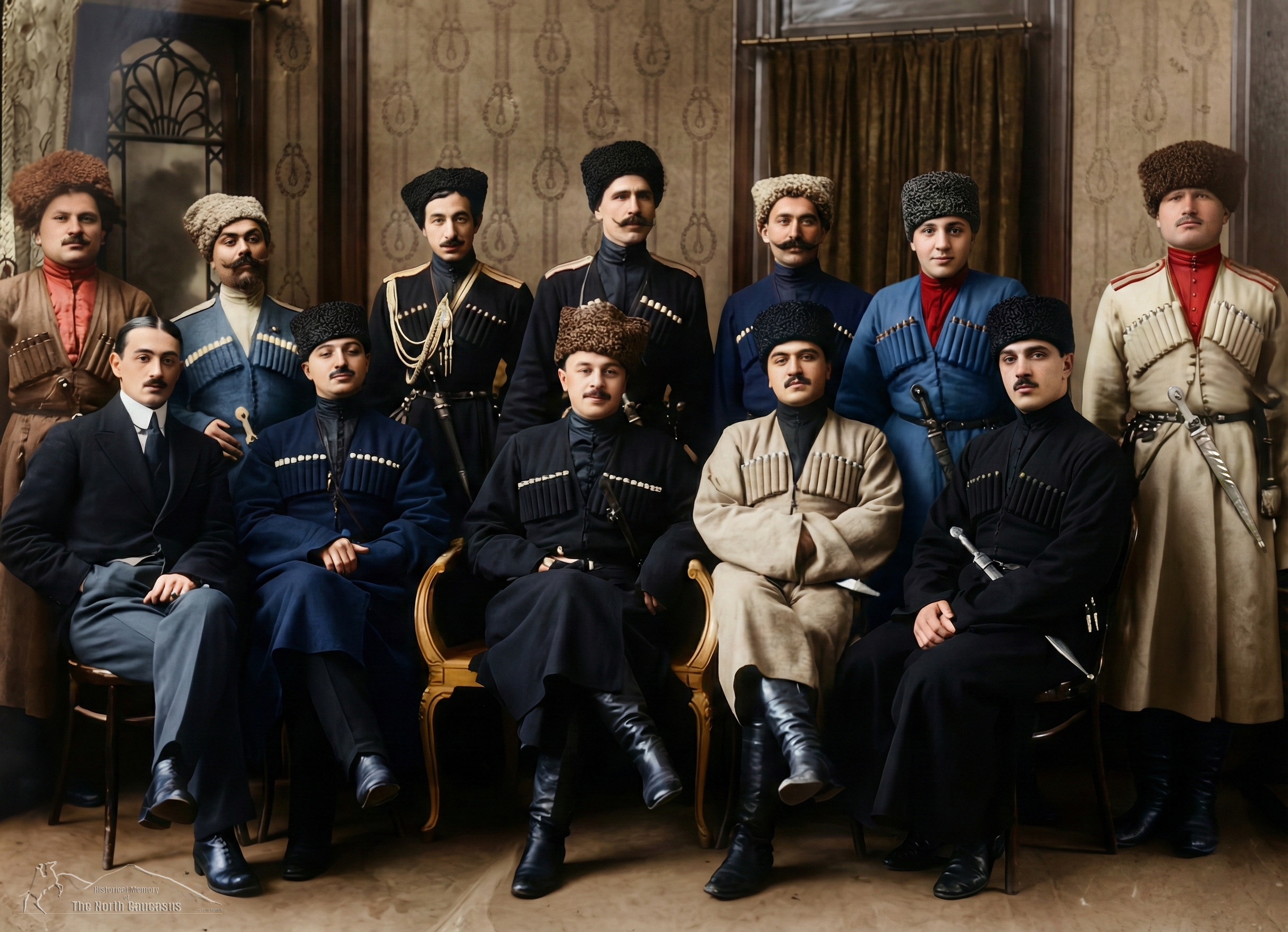
(Click on the image for a larger view. Image enhanced and colorized with AI)
Front Row from left: Djemaleddin Albogachi, İbrahim-Bek Haydar, Tapa Chermoy, Hasan Hadzarak, Ibrahim-Khan Ibrahimbek
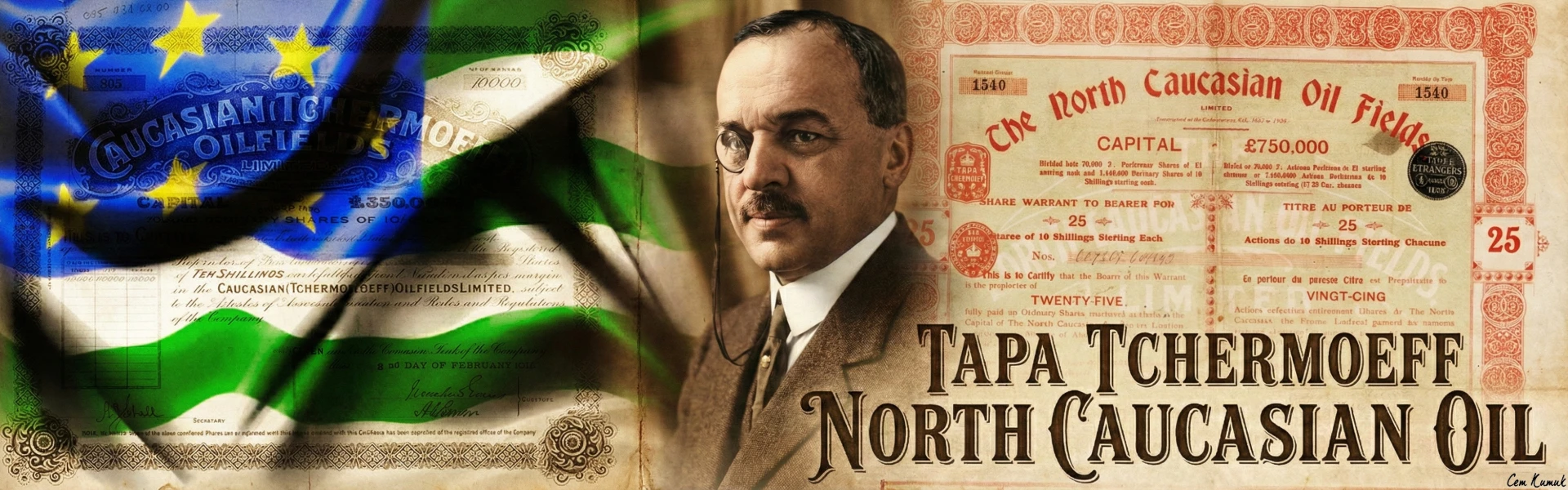
Following the occupation of the North Caucasus by Bolshevik Russian Armies in mid-1920, Mountaineer dissidents who took refuge in Georgia were forced to seek asylum in Turkey in the first quarter of 1921, when Transcaucasus also fell to the Russian Red Army. For these politicians, who fell into destitution bordering on starvation in Turkey—where conditions were severe starting from April 1921—Tapa Chermoy was one of the greatest sources of hope. Although Tapa Chermoy, presiding over the delegation that organized an alternative meeting to the Andi Congress in Vedeno on August 20, 1917, had signed the clause stating subterranean riches are the national wealth of the Caucasus, he had sold his family shares in the Grozny Oil Fields to Henri Deterding, owner of Royal Dutch Shell, at the end of March 1920, against the danger of this wealth falling into the hands of the Bolshevik Red Armies.
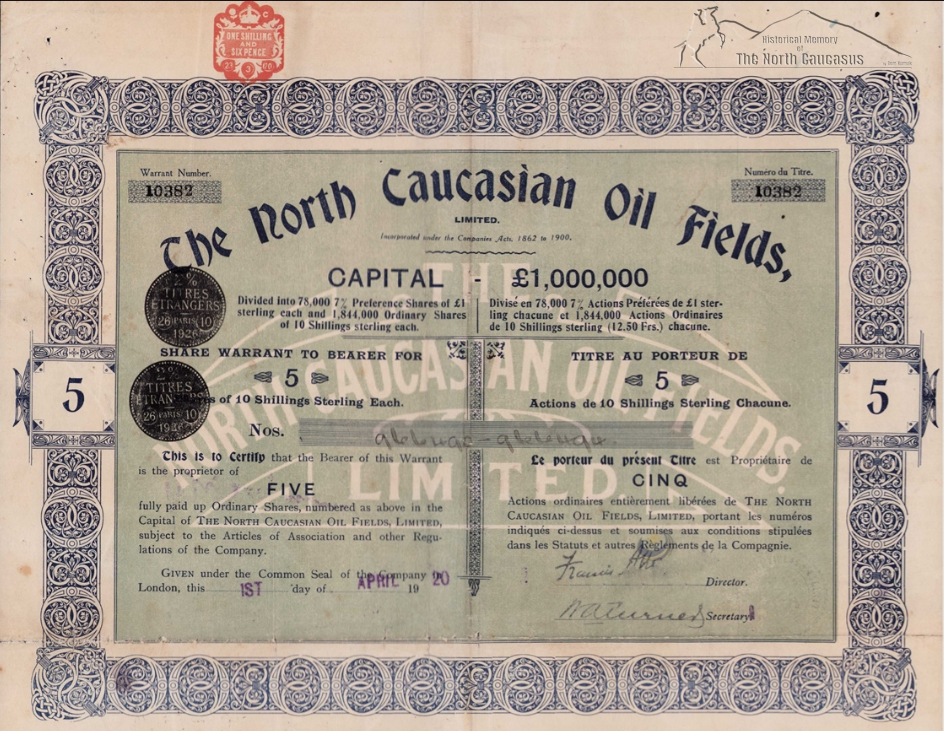
Deterding’s dreams did not materialize, at least not on the visible stage. The Bolsheviks nationalized the Grozny oil through the Grozneft enterprise. Whether Deterding’s calculations were realized remains a question without a definitive answer today, given that the Soviets, unable to withstand the West's economic blockade, established Ruskombank in 1922 and integrated into the global financial system. However, for the Chermoy family, selling their properties in the Caucasus, to which they could never return, for a negotiated price was an extremely gratifying development.
While it was thought that the revenue from this property, deemed national wealth according to the Vedeno consensus signed by Tapa Chermoy, would be used to organize anti-Soviet political movements and resistance activities, developments would take a decidedly different turn. While Tapa Chermoy endeavored to retain the title of leader of the political emigration movement, he did not relinquish his rights of disposal over the income derived from the sale to Shell.
As the Red Armies rapidly occupied the Caucasus, Tapa Chermoy succeeded in extracting over 80 members of the Chermoy family from the region. Since he was in Paris at the time, there was no doubt that his greatest supporter in orchestrating this was Haydar Bammat, who presided over the Mountaineer Committee in Tbilisi. Tapa Chermoy’s objective was to ensure his family members reached Paris as soon as possible. During those feverish days, the decision was taken in Turkey for the marriage of Haydar Bammat and Zeinab (Raia), the daughter of Tapa Chermoy’s elder brother, Abdul-Muslim (Mina). Considering that Bammat’s last two years had been spent in the traffic of national defense and diplomacy across the Istanbul-Bern-Paris-Tbilisi line, and that Zeinab Chermoy was merely sixteen years old, the impression arose that this marriage was realized through dynamics other than a decision taken mutually by the couple over time. Indeed, in the telegram he sent to Haydar Bammat regarding this marriage, Tapa Chermoy expressed that they were entrusting him with a young girl to protect and tutor in life, rather than congratulating a married couple: (IRCICA, Telegram from Tapa Chermoy to Haydar Bammat, April 24, 1921)
I have just received and approved the letter from you and Epsi [Zeinab Chermoy’s mother]. I am supremely confident that you will be able to teach the fundamental laws of life and morality to my little niece Raia [Zeinab], who is stepping into a new life under your responsibility. I believe she will succeed in establishing a beautiful family, especially thanks to the meticulous assistance of a rare woman like your mother. I embrace you all.
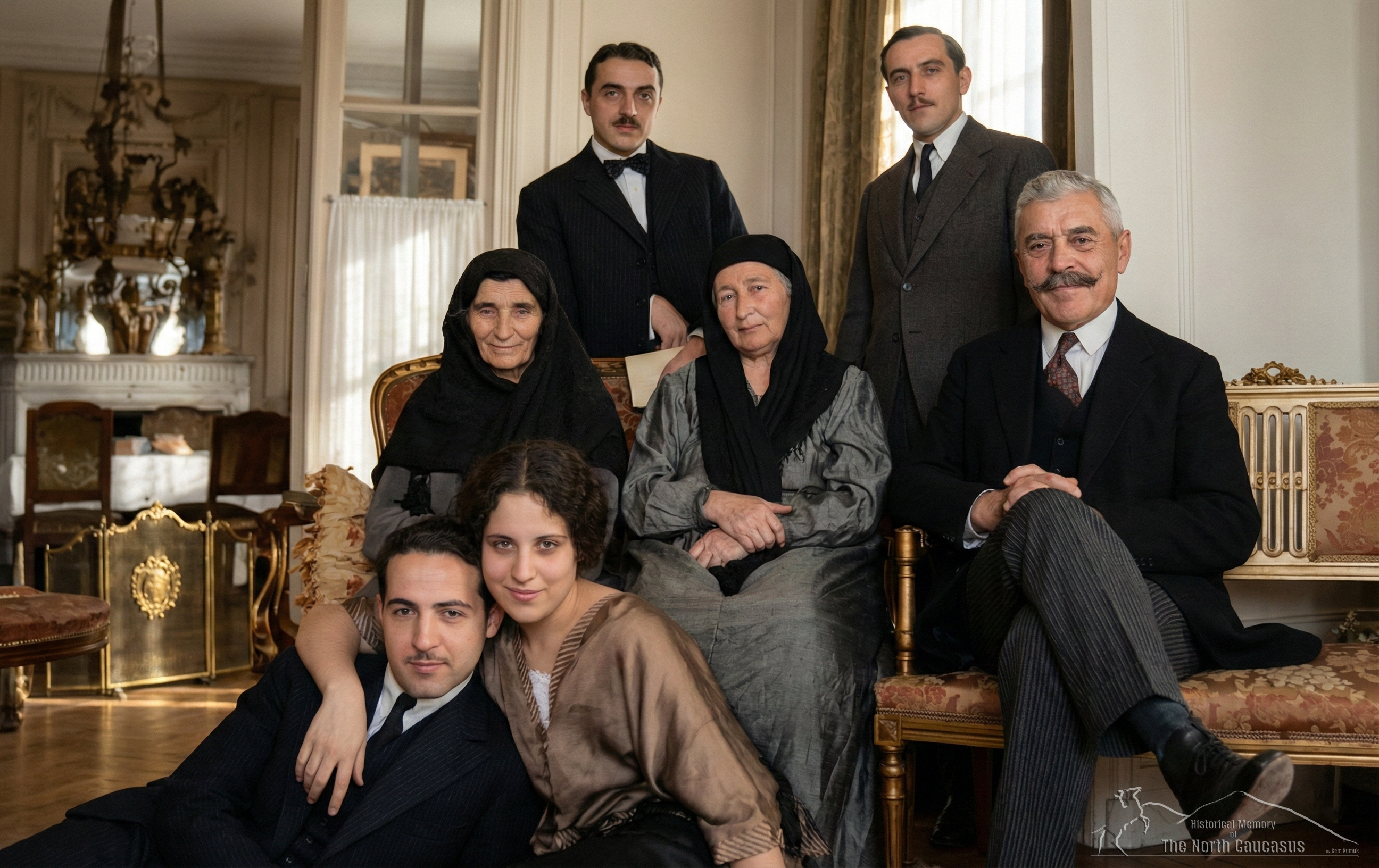
Front Row: Magomet Chermoy and Zeinab Chermoyeva (Bammat)
Middle Row: Rashidat Bammat, Epsi Chermoyeva, Abdul Muslim Chermoyev
Top Row: Haydar Bammat (Left), -?- Daidash Said-Amin Tukaev (Right)
(Click on the image for a larger view)
North Caucasian politicians like Pshemakho Kotse and Ahmed Tsalykkaty, who had taken refuge in Turkey and were living on the brink of starvation, requested permission to leave the country. They argued that their dependence on the Ankara Government would cease if they could gain access to the state treasury of the North Caucasian Republic held in European banks. (Mesud Çapa, "Kuzey Kafkasya Cumhuriyeti’nin Rus Egemenliğine Girmesi Üzerine Trabzon’a Gelen Devlet Erkânı", Türk Dünyası Araştırmaları,1996, pp.288-299) However, that treasury resided not in state accounts, but in the personal accounts of Tapa Chermoy.
This situation became understood in a far more striking manner following the arrival of Vassan Girey Jabagi, Pshemakho Kotse, and Haydar Bammat in Paris. Figures remaining in Turkey, such as Alikhan Kantemir, Ahmed Tsalykkaty, Gube Osman Saidnur, Abu Bekir Pliev, and Cemaleddin Musalayev, were waiting for auspicious news from Haydar Bammat in a financial sense during the most arduous days of the Greco-Turkish War, when employment and earning opportunities had all but vanished.
The expressions in Alikhan Kantemir’s letter to Haydar Bammat on September 29, 1921, showed signs that the situation had become untenable: (IRCICA, Letter from Alikhan Kantemir to Haydar Bammat, Sept 29, 1921)
[...] As I wrote to Tapa, I am sitting penniless. I need to pay at least 250 liras immediately. I believe a trip to Paris, at least for a few days, would bring more clarity to matters, because I repeat; I have very valuable information. If our organization has financial resources, I ask you to send them to me as a comrade. If not, I would not ask a single penny from anyone, for I know that you do not have it and Tapa is already fed up. [...]Similarly, in his letter to Bammat dated October 19, 1921, Ahmed Tsalykkaty sent an estimated monthly budget of 2,634 liras for the Mountaineer Political Commission and Information Bureau to be established in Istanbul, emphasizing sensitivity in financial matters and stating that strict tracking of accounts was essential: (IRCICA, Letter from Ahmed Tsalykkaty to Haydar Bammat, Oct 19, 1921)
[...] If Tapa can provide financial support, a positive answer to this question is required for the benefit of the issue. But everything related to money must be arranged to have a full accounting at all times to avoid any criticism. [...]Tapa Chermoy’s frugal attitude, initially perceived as a cautious approach to prevent the waste of resources on unnecessary expenses, began to create the impression in subsequent days that decisions on resource allocation were based entirely on personal and arbitrary whims.
[...] After receiving the money, I will establish a political commission similar to the Georgian political commission and invite our experienced comrades Ebubekir Pliev and others to join, including representatives of the most prominent Mountaineer peoples. [...]
This situation found expression in Alikhan Kantemir’s letter from Istanbul to Bammat on October 30, 1921: (IRCICA, Letter from Alikhan Kantemir to Haydar Bammat, Oct 30, 1921)
[...] Working under conditions of private charity (even with the support of our great friend and patriot Tapa Chermoy[ev]) will bring no change in political reality and can at best be a proof of our patriotism, which is of course not enough. [...]Toward the end of 1921, the condition of the refugees in Istanbul had reached the starvation line. Many refugees were preparing to return to the Caucasus, knowing full well that Siberian exile or death at the hands of the GPU awaited them. The sentences reflected in the lines of Ahmed Tsalykkaty’s letters to Bammat in those days were striking indicators of this: (IRCICA, Letter from Ahmed Tsalykkaty to Haydar Bammat, Nov 17, 1921)
[...] The fatal weakness of Mountaineer politics from its inception to the present day has been the amateurish conduct resulting from the lack of clear and stable financial resources. Frankly, we will not escape the poverty that will ruin all our achievements anytime soon. The Caucasian Confederation has no money, the Mountaineer delegation has none; therefore, we cannot conduct active work aimed at saving our homeland from Bolshevism. [...]
[...] Under these conditions, it is difficult to establish a diplomatic mission in Istanbul. Your request for a feasibility study is also incomprehensible—as if you couldn't send an advance without feasibility if you had the money... However, not to upset Ahmed, I did not discuss this with him: I allowed him to indulge in illusions regarding budget estimates. [...]
[...] All sorts of rumors are circulating here: Tapa Chermoy[ev] squandered millions, [Ahmet] Khan Avarski was appointed by Tapa as military attaché to Istanbul. Is all this true? [...]
[...] if I had a little financial support, I would be free from the constant anxiety of finding money for provisions [...]Similar lines could be seen in Alikhan Kantemir's letters from the same days: (IRCICA, Letter from Alikhan Kantemir to Haydar Bammat, Nov 21, 1921)
[...] I do not know how to explain the silence of our delegation. Neither Ahmed nor I receive anything, that is, letters, and we do not think of money; I do not expect it anyway! There is plenty of room for useful and necessary work here. Azerbaijanis under the pressure of [Ekber Aga] Sheikhulislam[ov] are organizing. Georgians are working. We are sitting here, I am sitting here, while the Georgians are exploiting Ahmed for three pennies. Ahmed is conducting a tremendous and very valuable intelligence work. It is a fate that seems so clear that we will forever serve the cause of others, not our own. [...]The establishment of a North Caucasian Permanent Commission within the diplomatic mission following the arrival of Bammat, Jabagi, and Kotse in Paris offered hope for a more systematic approach to financial matters. The fact that this commission was in close contact with Hussein Tosun, Mahmud Hayri, and Şevket Kundukh Beys, who were active in Europe representing the Circassian émigré circles in Turkey, was another promising situation for the solution of the financial issues of the North Caucasian cause.
Indeed, after meetings in Paris, the Circassians of Turkey, returning to Rome, decided to provide monthly financial aid of 2,000 francs for the common national cause and sent the first payment. In the Permanent Commission meeting, it was decided to send 1,000 francs of this sum (equivalent to 70,000 USD in today's terms) to Istanbul for the needs of the Istanbul organization, to give 500 francs to Vassan Girey Jabagi for travel expenses, considering he would settle in Poland, and to pay 300 francs to Ibrahim-Bek Haydar and 200 francs to Pshemakho Kotse. (IRCICA, Minutes of the North Caucasian Permanent Commission, Feb 14, 1922)
Encouraged by such news, Ahmed Tsalykkaty asked Bammat to inform him in detail: (IRCICA, Letter from Ahmed Tsalykkaty to Haydar Bammat, March 1, 1922)
[...] They say you joined the Council. Is this true? They say we were allocated some money (your letter to Osman [Said-Nur]). What kind of money and to which organization? To avoid misunderstandings, specify everything when sending the money. [...]Hopes for financial aid expected from the French Government under Aristide Briand by the Union of Caucasian Republics were dashed when the Briand Government was replaced by a new government led by Raymond Poincaré on January 15, 1922. The fate of the North Caucasian cause was now financially left to the decisions that would issue from the lips of Tapa Chermoy.
[...] There is an opportunity to conduct more active politics in the Caucasus, but there are neither funds nor resources. Perhaps if you join the council, your energy and initiative will provide us with these funds. Otherwise, I do not know how we will fulfill the hopes others place upon us. [...]
Alikhan Kantemir, who also had to struggle against the Monarchist mountaineer group trying to gather émigré circles around themselves in Turkey with Russian financial support, drew attention to the helpless situation they fell into against rival groups due to lack of funds in his letter: (IRCICA, Letter from Alikhan Kantemir to Haydar Bammat, dd. 4 February 1922)
[...] However, financial impossibilities and the absence of a sufficient number of mature political figures have once again brought our activity to a freezing point, despite our sincere desire, and thus the platform we prepared remained unsigned. [...]In another letter, Alikhan Kantemir complained that the sum donated by the Circassians in Rome had not reached him, and he could not even collect the allocated 250 liras: (IRCICA, Letter from Alikhan Kantemir to Haydar Bammat, March 29, 1922)
[...] I am in absolute torment: Attacks are coming at me rabidly from our Monarchists (Tsarists), they accuse me impertinently. And I, without a single penny in my pocket, am trying to conduct a patriotic organizational work among the Mountaineers by opposing them. [...]
[...] The Monarchists bombard us from the Russian Embassy, while we parry the blows taking shelter in the Circassian School as we do not even have a single room for activities. [...]
[...] As for the money issue, I received a total of 150 liras from Khottaria. He refuses to pay more due to the deterioration of his business, and it is unlikely he will give anything else. Tapa must write to him again to finally ensure stability in our affairs, which depends heavily on regularly receiving a certain sum that cannot be less than 250 liras a month. I took only 70 liras of the received 150 liras myself; the rest had to be distributed. I could not receive the 1,000 francs for which there is a delegation decision — what does this mean? [...]Shortly after, in another letter, Alikhan Kantemir held those in Paris responsible for the non-arrival of the sum donated by the Circassians in Rome and stated he suspected the money might have been embezzled: (IRCICA, Letter from Alikhan Kantemir to Haydar Bammat, April 28, 1922)
[...] I am penniless, in debt. Our delegation has left me in a terribly difficult position. I am deprived of the means of self-sufficiency and, as a result, I am left shoeless. Someone from the delegation has embezzled the thousand francs. Although the secretary wrote that he transferred the money, it did not reach me. This is a scandal. I ask you to speak with Tapa [Chermoy]. Let him personally send me three thousand francs. Otherwise, I can no longer work. I sent an official letter to the delegation the day before yesterday so that someone would notice me. I insist on this and also ask you again to send me money to liquidate my debts in some way. Our organization is morally strong but we are all passive. We are literally starving. [...]Kantemir's letters were followed by a vitriolic letter from Abu Bekir Pliev. Referencing the Vedeno Consensus and reminding that the riches of the Caucasus belonged to the people, Pliev drew attention to the contradiction between the luxurious life of the Chermoy family and the national cause: (IRCICA, Letter from Abu Bekir Pliev to Haydar Bammat, May 2, 1922)
[...] I am furious at the behavior of our delegation, which devours even the aid given to us by our friends in Rome. This is a disgrace! Please telegraph the delegation's decision on money and Tapa's answer. I ask you and Tapa to save me from this difficult situation. [...]
[...] I believe that the Mountaineer idea in Paris is treated only in passing and as a side issue. Let me speak of Tapa Chermoy[ev]. Recently he bought an automobile for three hundred thousand francs—I believe this is his third. You will say that Tapa bought these only with his own money. Yes, this is true, but in the future Mountaineer Republic, will not the subterranean riches of our lands and mountains be the property of the people? Our compatriots' approach to this question is still ambiguous. Yet, it would have been sufficient for Tapa to donate the cost of his third automobile to the Mountaineer cause for serious work that needs to be conducted in Istanbul. But let Allah and the people judge him and all of you. In Paris, Tapa helps all the old Convoy Generals—representatives of the 'Black Reaction' and sworn enemies of Mountaineer independence—much more than us. [...]When Pliev's letter was disclosed to the audience at the Permanent Commission meeting in Paris, Tapa Chermoy reacted with great indignation, implying he might leave the delegation presidency and essentially deadlock the political movement: (IRCICA, Minutes of the North Caucasian Permanent Commission, May 13, 1922)
[...] Haydar, do not think there is a misunderstanding between us because of money. I assure you, I am ready to starve for a few more years for the Mountaineer cause, but I will not give up working with true Mountaineer figures and I am not chasing money. [...]
[...] I asked a question and I want a sincere answer. Discuss among yourselves and decide; would it not be better if I withdrew and you continued to work independently? Especially since I am tired. Mr. Pliev's letter causes deep indignation in me. [...]These final words of Tapa Chermoy were of the sort to put a definitive end to the matter. The principle that subterranean riches are the national wealth of the Caucasus, included in the Vedeno Consensus and reminded by Pliev's letter, was thus struck out. This was also a warning directed by Tapa Chermoy to other delegation officials to ensure the subject was not raised again. He had given a clear signal that if he were kept under pressure on this issue, he would abandon the Caucasian Cause. Furthermore, the decision recorded in the minutes during the continuation of the meeting conveyed the "No Pay, No Play" mentality clearly to the political refugees in Istanbul:
[...] As long as I am at the head of the Delegation, everyone will always confuse my personal means with public means. [...]
[...] It is emphasized in no uncertain terms that there is no government money in the delegation's safe, that the delegation possesses no financial means, and therefore cannot be held morally or legally responsible for the possibility of the cessation of work in Istanbul...Apart from the 250 liras sent—which was far below the budget previously requested for activities in Istanbul—an additional 250 liras requested by Alikhan Kantemir was also rejected on the grounds of lack of resources.
In the following years, to escape Chermoy's financial bondage, members of the North Caucasian political émigré circles scattered in different directions to secure their own livelihoods. Bammat accepted the invitation of the Afghan King in 1925, entered Afghan citizenship, and served in Afghanistan's diplomatic missions in Paris and Bern. Vassan Girey Jabagi began working as a correspondent for the Polish News Agency in Warsaw, where he settled towards the end of 1922. Ibrahim-Bek Haydar came to Turkey in 1925 upon the invitation of the Turkish Government and served as an engineer in various railway construction projects. Politicians like Pshemakho Kotse, Ahmed Tsalykkaty, and Alikhan Kantemir were not as lucky as their friends. They never possessed a regular income and had to struggle with financial difficulties throughout their lives. Bammat and Kantemir's attempts to establish commercial enterprises for the national cause bore no fruit. In fact, due to one of these initiatives, Alikhan Kantemir was accused by his political rivals of being a Soviet spy and had to struggle for two years to clear his name.
As for Tapa Chermoy, he continued to take the stage in politics with the title of representative of the North Caucasian political emigration in the formation called the Council of Three until the early 1930s. The distress he created in the allocation of financial resources caused greater issues due to the funds provided to Caucasian politicians within the framework of the Promethean Movement led by Poland. The claim appearing in some works published about Tapa Chermoy’s life that Chermoy sponsored Haydar Bammat’s publishing activities is unfounded. Bammat’s publishing activities began with the Prometheus Journal, which started publication in 1926 with funds provided by the Polish Government within the framework of the Promethean Movement. The first issue of the journal was designed in Bammat’s apartment in Paris, and he himself coined its name. However, when the Promethean Movement later came under the sway of the Polish Government, Bammat distanced himself from this group and did not publish any periodicals until January 1936, when he began publishing the Kavkaz journal with Japanese financial support. Furthermore, the fact that Haydar Bammat divorced his wife Zeinab Hanum, a member of the Chermoy family, in 1930 due to her infidelity was another factor that frayed his relations with Tapa Chermoy. (Archives de la Préfecture de Police Paris, Intelligence File of Zeinab Chermoyeva)
Upon the establishment of their own national centers by Georgian and Azerbaijani politicians, the Council of Three lost its functionality. The only power opposing the Promethean Movement in émigré circles' politics became Haydar Bammat’s Kavkaz Group, and Tapa Chermoy was left with no influence. When the Prometheus Lodge, to which Caucasian Freemasons belonged, ceased its activities in 1930, Tapa Chermoy completely withdrew from the Caucasian political arena until he died in 1937.
(Click on the image for a larger view)
(Click on the image for a larger view)
Cem Kumuk
Istanbul, January 22, 2026