
 Türkçe
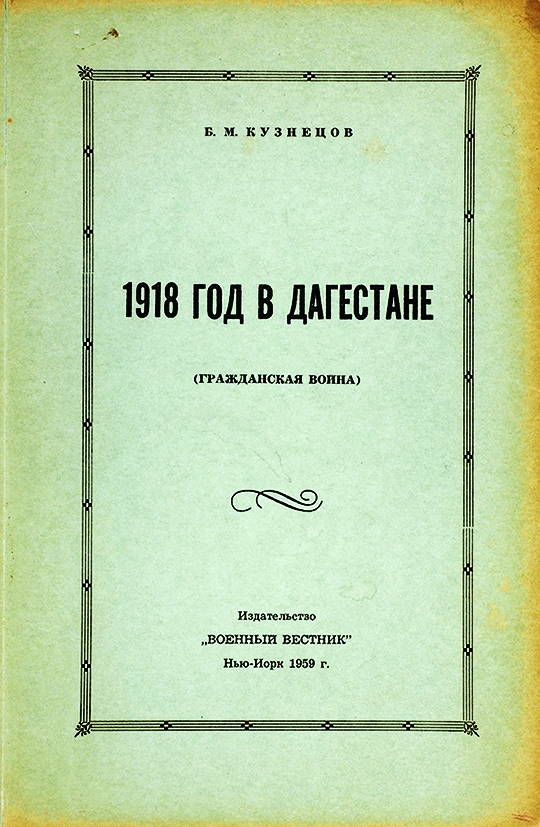
In a recent announcement, I reported that an original copy of the work titled "THE YEAR 1918 IN DAGESTAN (Civil War)" with an autoghraph —published in New York in 1959 by Boris Kuznetsov, the aide-de-camp to the young republic’s Defense Minister Nuh-Bek Tarkovski and a witness to the early days of the foundation of The Republic of Union of the United Mountaineers of The North Caucasus—had been donated to our library. Although I cannot disclose the name of this esteemed brother as I do not have the donor's permission, I would like to take this opportunity to express my gratitude to him once again.
In that same announcement, I mentioned that I would prepare a digital copy of the work as soon as possible and share condensed English and Turkish versions with you.
I can already imagine some readers murmuring who might feel angry with Kuznetsov's statements. I recommend evaluating the author's observations through the eyes of a Russian officer who found himself on the wrong side at the absolute wrong time. I believe that by doing so, you will be able to distinguish the difference between reality and prejudice easily. Apart from the author's abstract remarks regarding the character of the Mountainers, I hope you will enjoy reading this text as a significant work that reflects the atmosphere of those days firsthand.
Cem Kumuk
Istanbul, 11 January 2026
THE YEAR 1918 IN DAGESTAN (Civil War)The war concluded in ignominy. This was not the denouement the Caucasus mountaineers had envisioned for the greatest of conflicts. They had longed to return to their ancestral auls bedecked in crosses and medals, bearing the epaulettes of sergeants, cadets, or officers. They imagined recounting endless tales of valor upon the thresholds of their saklyas (a hut), displaying trophy blades and rifles. Instead, they were dispatched home in haste, subject to the hostile scrutiny and jeers of an unruly mob of former soldiers and laborers.
Following the abortive campaign against Petrograd led by Generals Krymov and Krasnov—provoked by Kerensky—all regiments of the Native Division were repatriated to the Caucasus to rejoin their original formations. The six regiments were consolidated into the Native Corps under General Polovtsev, headquartered in Vladikavkaz. The division commanders, General Prince [Amanullah Mirza] Qajar and General [Iosif Zaharovich] Khoranov, remained there.
The Chechens went further, dismantling the railway flanking Gudermes station. They razed the station, removed rails, and drove rolling stock back to their villages on buffalo, even ploughing the tracks. Consequently, units arriving from the Caucasian and Persian fronts were forced to disembark at Petrovsk and march through a hostile Chechnya. The Terek region was in a state of volatile ferment. Russian settlers and Cossacks bordering Chechnya and Ingushetia were robbed indiscriminately, clinging to passing trains for salvation. Vague rumors of Volunteer Detachments circulated, yet none materialized. Under such duress, each region was compelled to forge its own defense.
In Dagestan, the resistance against anarchy and its Bolshevik progenitors was initiated by two [Dagestani] officers of the Russian [Army]: Colonel Rusul Bek Kaitbekov of the Baku Regiment and Colonel Prince Nukh Bek Shamkhal Tarkovsky, commander of the 1st Dagestan Cavalry Regiment.
Here, I must cite Pshemakho Kotsev, former chairman of the Mountain Republic, regarding the First Congress of Plenipotentiary Representatives of the Mountaineers, held in Vladikavkaz in May 1917. He writes:
The First Congress... was unprecedented. It was an assembly of elected representatives of all tribes and peoples of the North Caucasus, from the Black Sea to the Caspian... Colonel Prince Tarkovsky delivered a detailed report, illustrating that Order No. 1 had wreaked its intended havoc: the front was destroyed. Kerensky’s commissars were persuading soldiers to fraternize with the enemy, and the death penalty was abolished.Thus, the Republic of the Union of Mountaineers was born—high in ideal, yet destitute in resources.
On September 18, at the village of Andi, a new congress convened. Alarming news arrived that Nazhmuddin Gotsinsky had been proclaimed Imam at a self-appointed congress and intended to eliminate the intelligentsia and the Central Committee. However, following the arrival of Tarkovsky and a meeting with Nazhmudin Efendi, an agreement was reached. All accepted the Republic —the Republic of the Peoples of the North Caucasus.
On September 20, a major holiday in Andi, the decision was read to thousands. The committee members, including Chairman Tapa Chermoev and Prince Tarkovsky, sat on a rooftop alongside the clergy. The meeting opened with an address in Chechen, translated into Arabic, Avar, and other local dialects. Following prayers and a general celebration, Chairman Chermoev expressed gratitude for the people’s trust.
The first chairman, Tapa Chermoyev, a Chechen oil magnate and former officer in His Majesty's Convoy, was personally known to the late Empress Maria Feodorovna. Accusations of his Russophobia are unfounded; he supported the Dowager Empress until the end. Indeed, the highlanders displayed no Russophobia; they desired strong Russian authority over foreign intervention.
The Mountaineers Republic’s reach was effectively limited to Dagestan, yet even there, recognition was not universal. The government lacked a permanent residence, funds, an army, and experience. Consequently, they relied on enterprising officers like Tarkovsky and Kaitbekov to purge Dagestan of the Bolsheviks, whose stronghold was Port-Petrovsk.
Appointed commander of the 1st Dagestan Cavalry Regiment in November 1917, Prince Tarkovsky faced a critical situation. The regiment was disintegrating under the influence of a committee comprised of machine gunners and sailors. Tarkovsky successfully extracted the regiment from the anarchy of Khasavyurt, transferred it to Temir-Khan Shura, and purged the Bolshevik elements.
By early 1918, the defense of Port-Petrovsk by the 2nd Dagestan Cavalry Regiment had failed. Colonel Kaitbekov had organized the operation, but despite heroic resistance, the unit suffered heavy losses and retreated. Kaitbekov, a decorated hero of the Japanese War and World War I, was a distinctive figure resembling Napoleon. He was later executed by the Bolsheviks, meeting his end with the courage befitting a Knight of St. George.
Dagestan survived solely on grain from the Khasavyurt district, but the Chechens had severed the railway and plundered Russian settlements. The highlanders, viewing robbery as a display of martial prowess, preyed upon anyone available. Various factions vied for power, accepting any currency, though the rifle remained the only reliable tender.
Social order collapsed. The Mountain Jews closed shops on Saturdays, Muslims on Fridays, and Sundays remained public holidays, halting commerce for three days a week. Mondays were consumed by bazaars and gossip, leaving Tuesdays for groggy recovery. Productivity ceased.
Prince Tarkovsky merged the two Dagestan regiments and occupied the Shamkhal railway station, hoping to recruit units returning from the front. Sergeant Major Shkuro refused to share ammunition, while General Elmurza Mistulov provided limited supplies before continuing to his tragic suicide on the Terek.
To bolster their forces, "Shamilev Battalions" were formed, and a Lezgin mountain cavalry battery was established under my command. Our only significant ally was a makeshift armored train commanded by the dashing Captain Brzezinski. To secure the coastal cities, however, we required the support of the Tavlin highlanders. Staff Captain Kaitmas Alikhanov, the "last titan of the mountains," proved indispensable. A noble Avar and veteran of the Japanese War, Alikhanov raised a militia and brought antique artillery from the Khunzakh fortress.
In March, we captured Petrovsk. The Soviet of Deputies fled to Astrakhan. We established a defense, positioning old guns on Cathedral Hill. However, the decisive moment arrived when a Bolshevik flotilla, including the gunboats Kars and Ardahan, appeared. They shelled the city, outranging our artillery. Simultaneously, Bolshevik echelons landed regular infantry. Our militia, unaccustomed to field combat, retreated. Despite the Dagestan Regiment's valiant stand, we were forced back to Kumtor-Kale.
With the first phase of the struggle lost, Prince Tarkovsky disbanded the detachment to wage guerrilla warfare from the mountains. He moved his family to Chechnya, while a group of fifteen Russian officers, including myself, General Erdman, and Colonel Rzhevutsky, followed Alikhanov to the Khunzakh fortress.
During our retreat, we parted ways with General Mishchenko, who refused to believe Russian soldiers would harm him. This noble delusion cost him his life; he was driven to suicide by Bolshevik insolence shortly thereafter.
Our cause was hampered by unreliable "allies" like Nazhmudin Gotsinsky, the self-styled Imam who offered only delays for prayer, and Uzun Haji, a xenophobic fanatic. Conversely, Ali Mitayev, who held influence in Chechnya, was preoccupied with local vendettas.

In July, Tarkovsky ordered a demonstration attack on Untsukul, the village of the Bolshevik leader Makhach Dagadayev. Amidst a terrifying mountain thunderstorm, we shelled the village and Dagadayev’s house before returning to the fortress. Dagadayev was later murdered, allegedly by his own associates.
By August, a general advance on Temir-Khan Shura was ordered. Our column, a chaotic mix of tribes and dialects marching under the green banner of the Ghazawat, moved from prayer to prayer. We encountered Bolshevik resistance at the Shenshirik Pass but dispersed them with artillery fire. As we approached Shura, we learned of negotiations between Tarkovsky and General Bicherakhov, who had occupied Petrovsk. We were ordered to retreat back to Khunzakh.
During the retreat, an assassination attempt on our officers in the night prompted us to move to the safer stronghold of Gunib. There, we encountered a Turkish military mission. The Turks, having entered the war in the Caucasus, were ostensibly allies, yet their presence was ambiguous.
In Gunib, we received the shattering news of the Tsar’s assassination. The highlanders were bewildered, asking whom they should now serve. Meanwhile, the Turks began mobilizing locals, a farcical endeavor. Growing restless, we attempted to slip away to Shura, but were captured by Turkish guards and returned to Gunib. A protest letter to Colonel Ismail-Hakki [Berkuk] Bey secured our release and an apology, allowing us to finally return to Temir-Khan Shura.

Chunatuko Yusuf Izzet Pasha (Right) and Jereshty Ismail Hakki Berkuk (Left)
(Click on the image for a larger view)
In November, the Turks entered Shura under General [Chunatuko] Yusuf Izzet Pasha. The population remained indifferent. The Mountain Government, now nominally in charge, was powerless. The Turks, hoping to annex the Caucasus, found themselves overextended. Their occupation was brief; with the collapse of the Ottoman Empire, they departed, leaving the British to fill the vacuum.
The British military mission under Colonel Rowlandson arrived, bringing new complications. Desperate to contact the Volunteer Army advancing from the north, Tarkovsky dispatched a detachment to meet them. However, the Volunteer Army made a tragic error. Mistaking the Dagestanis for the Chechens who had opposed them, the Cossacks engaged in punitive requisitions. This culminated in the annihilation of a Cossack battalion in the Mekegin Gorge—a senseless slaughter born of ignorance.
In Shura, a semblance of peace returned. Officers walked the boulevards, and hope for a restored Russia flickered. General Grishin-Almazov passed through tragically, shooting himself after being betrayed by the British into Bolshevik hands.
Ultimately, my brother and I left Dagestan for Pyatigorsk to join the 21st Artillery Brigade under General Erdman. We survived the final, futile battles and the retreat to Crimea. We departed our families, this time forever.