
 Türkçe
Until about three decades ago, the historiography of the North Caucasus suffered from a severe crisis of heroic romanticization, primarily due to a dearth of data and documentation that precluded the adequate examination of historical figures. Driven by this informational deficit, parochialism, and oral traditions rooted in biased ideological assessments, nearly all figures who played a role in the North Caucasian historical arena were glorified, with panegyrics that often defied rational boundaries. The romanticization of these figures' attributes was an exceedingly pervasive historiographical method. Indeed, despite my generally critical approach, even I was once among those who fell prey to this tendency. Fortunately, particularly over the past two decades, as archives have become increasingly accessible to researchers, substantial progress has been made in historical inquiry grounded in data, documentation, and empirical evidence.
My studies—which encompass comparative evaluations of the activities of historical figures in light of authentic documents and the socio-political realities of their respective eras—have provoked profound indignation among certain individuals accustomed to learning history through heroic narratives for over a century. The reactions to my published analyses of historical figures—such as Said Shamil, Mikail Halil, and Tapa Tchermoy, whose positions in document-based historiography diverge starkly from those assigned to them in oral history—have strikingly demonstrated the extent to which some demographics are inclined to consume fables rather than confront factual history. Regardless of the backlash, so long as it is predicated on authentic data and documents, I will never cease to write the truth about those who assumed prominent roles in our history. As I stated in an article six years ago, I will continue to declare that "The King is naked!" (https://apsuara.org/kral-ciplak-cem-kumuk/)
Within this framework, another historical figure we will subject to critical scrutiny is Ahmed Tsalykkaty, a prominent politician of the revolutionary and World War I eras. Readers are invited to access the original texts of all primary and secondary sources cited herein via the hyperlinks provided in the bibliography; thereby, they may independently verify the validity of the data and interpretations presented in this work. Such transparency is particularly pertinent given that certain factions, evidently discomfited by my scholarship, have sought to characterize me as "an arrogant egotist who constructs history through the selective extraction of facts."
Fortunately, across both my monographs and articles, I systematically furnish comprehensive bibliographic data and provide direct access to the source materials themselves. Ultimately, the decision to engage with, or find merit in, this research rests entirely at the discretion of the reader. To borrow a popular Turkish colloquialism: "Those who find it unappealing need not buy it for their young kids"—which is to say, engagement is strictly optional, and one is entirely free to disregard the work if it does not suit one's taste.
Ahmed Tsalykkaty, a politician and man of letters—whose name appears in various sources with variations such as Tsalikov, Salihov, or Chalykov—penned numerous writings during his brief 46-year life. While some of his texts were published as books and newspaper columns during his lifetime, a significant portion has survived to the present day only as unpublished drafts. I, too, have published articles concerning this renowned politician on various occasions.
Aside from the nationalist politics Ahmed Tsalykkaty pursued during the 1919-1920 period—when the North Caucasus was occupied by the monarchist Russian Volunteer Army—it is impossible to speak of any concrete nationalist trajectory in his earlier or later career. First and foremost, one must address Tsalykkaty's highly emphasized Muslim identity. In Soviet historiography, Tsalykkaty was depicted as a Pan-Islamist and Turkist figure (A.L. Narochnitskiy et al., Istoriya Narodov Severnogo Kavkaza (Konets XVIII v. – 1917 g.), Moscow, 1988, pp. 419, 473, 489, 540). However, it is impossible to identify any Islamic emphasis in any of Tsalykkaty’s works. His "Muslimness," much like the identity definitions of many of his contemporaries, was essentially nothing more than a distinguishing sociological group designation within the Russian population registry system. His tenure as the chairman of the Provisional Central Bureau of Russian Muslims was a position that can only be evaluated within this specific demographic context; attributing any deeper ideological significance to it is unwarranted. Furthermore, the Turkist identity that Soviet historiography attempted to superimpose upon Tsalykkaty was merely an effort to malign him as a traitor engaging in espionage for a foreign power, bearing no relation whatsoever to historical reality. On the contrary, in certain articles he published during those turbulent years in North Caucasian history, Tsalykkaty unequivocally exhibited a staunch anti-Turkish stance. The claim that he was one of the vanguard leaders of the "Socialist Muslim Movement" within the Russian Empire lacks any empirical foundation. Because the very term "Socialist Muslim" is inherently contradictory, one can assert that of these two descriptors, only the term "Socialist" accurately applies to Tsalykkaty.
THE FIRST CONGRESS OF RUSSIAN MUSLIMS (MOSCOW, MAY 1917)Tsalykkaty was a loyal member of the Menshevik faction of the Russian Social Democratic Labour Party. During the February 1917 Revolution, he was among the politicians who prevented the Caucasian Native Cavalry Division from suppressing the uprising. His speeches at the All-Russian Muslim Congress in Moscow—delivered concurrently with the establishment of the Central Committee of the North Caucasus and the convention of the First Congress of Plenipotentiary Representatives of the North Caucasian Peoples in Vladikavkaz—serve as unequivocal evidence that he was not an independence-seeking nationalist. Rather, he envisioned the future of the North Caucasian peoples within a socialist, democratic, and federal new Russia: (I. Ilgar, Rusya’da Birinci Müslüman Kongresi Tutanakları, Ankara, 1990, p. 46.)
"On behalf of the Central Bureau of All-Russian Muslims, I salute the first free congress of all Russian Muslims in a free Russia. For centuries, this dark dungeon, an instrument of torture for the peoples of Russia, has been dismantled by the will of the rebellious populace. Above us, the dawn of liberty has risen. Our presence in this hall is the first joyful manifestation of this radiant dawn. Yet, this joy of ours must be coupled with an acute awareness of the great historical responsibility thrust upon our shoulders and chests. The country where, until today, Muslims lived with their deepest and most sensitive emotions trampled upon daily; the country where Muslims were relegated not to second-class, but even third-class citizenship; the country that has thus far been a cruel stepmother to us, has now become our true mother! Muslims have today become the free children of today's free Russia. Our country now faces a tremendously formidable situation. Therefore, we must exhibit the utmost understanding regarding this circumstance. We Muslims gathered here must participate accordingly, with the highest devotion to the people from whom we originate, and with our historic loyalty and strength dedicated to our homeland, the free Russia. [...]"
THE 5TH CONGRESS OF THE PEOPLES OF TEREK (VLADIKAVKAZ, NOVEMBER 1918)These statements might, to a certain degree, be comprehensible and even met with tolerance when contextualized within the realities and profound uncertainties of that era. However, the remarks delivered by the very same Tsalykkaty at the 5th Congress of the Peoples of Terek in Vladikavkaz—where over 700 delegates convened to mobilize the regional populace in support of the Red Army amid intense clashes with the White Guards (the Terek Uprising)—were by no means trivial. In May 1918, the Mountaineers’ Republic of the North Caucasus had formally declared its independence, and for the first time in their history, the Mountaineers were demonstrating the collective will to exist under the sovereign framework of a single state. At such a critical juncture, Tsalykkaty not only manifested his socialist fixations but also ruthlessly indicted the founders of the North Caucasian Republic: (A. Djanaev, Syezdy Narodov Tereka 1918 g., Vol. 2, Ordzhonikidze, 1978, pp. 179-181.)
“You have already heard, comrades, about the danger that is moving towards us from the west and east. I would like to shed light on this danger from a slightly different perspective and dwell in more detail on the one advancing from the east. Denikin's movement is clear to us, but the movement from the east may perhaps still be unclear to you. The slogans adhered to by General Denikin represent the old Russia, the Russia of emperors, generals, and officials. At the head of the eastern movement, however, stands the Mountaineers’ Government.
The slogans of the Mountaineers’ Government are connected with religious feeling and the moment. They wish for all Muslim Mountaineers to unite into a single free state.
Chermoev is moving under the banner of pan-Islamism. What is this ground upon which he wishes to unite the Caucasian nationalities?
Until now, we have had three Russias: Tsarist Russia, Kerensky's Russia, and the present Russia. What was the attitude of these 3 governments of Russia towards Muslims? The old government oppressed them in everything: in relation to schools, religion, and much else. During Tsarist Russia, Muslims were 3rd or even 4th-class citizens.
The old government fell. It seemed that Muslims would live in freedom, as the revolution had promised them. I was the chairman of the All-Russian Muslim Executive Committee and had the opportunity to be in contact with the rulers of that time, and could only be convinced that Muslims had been transferred from the 4th class to the 2nd or 3rd.
But then the third revolution took place, power passed into the hands of the working people, and we see that Muslims are transferring to the 1st class and are going hand in hand with other citizens of Russia in the struggle for freedom.
Soviet power said that there could be no question of occupying the Dardanelles and that the cross should once again be placed on Hagia Sophia. All treaties of the old governments were destroyed.
We told Kerensky in our time that he did not adhere to all the great slogans proclaimed by the revolution and the Soviet of Deputies. We asked him about the attitude of his government toward the liberation of the Muslims of Asia and Africa. He gave no direct answer, and it is understandable why Kerensky did this: he was an ally of England and France, and touching such a sensitive issue, Kerensky, as an ally, could not and did not want to.
The new Soviet power declared its attitude toward this issue. It, that is, the new power, sought to practically carry out the liberation of all oppressed Muslim peoples.
And so, at present, a powerful center for the elimination of the oppression of the peoples of the East is already being created, and this center is Soviet Moscow. This is what the free workers and peasants of Russia have brought us. Even to minor issues concerning Russian Muslims, the new government relates with refined delicacy.
The speaker mentions certain Muslim shrines and the attitude of Soviet power towards these shrines.
In Moscow, there was a great shrine for all Muslims — this is the Quran of Osman. This is the very Quran that was drenched in the blood of Caliph Osman when he was reading it. The Soviet government has handed over this shrine of all Muslims to the Muslims. The new power gives complete freedom in religious terms. Muslims are closely connected with religion. And the new power, which does not even know the details of the life of Muslims, even in the smallest matters, treats us, Muslims, with special attention and delicacy. A power, comrade Muslims, that treats us this way, could it possibly push us away from itself? No. We can only love and defend such a power. (Applause.)
I now move on to another issue. I will speak about the impending danger from the east. These adventurers play primarily on the religious feelings of the Muslim Mountaineers; they wish to create some kind of free state and separate us from Russia. Let us look purely objectively at the question of whether an independent Mountaineers’ state can exist. For an independent state, 3 main conditions are needed:
— Land Issues: For such a state, of which Chermoev and company dream, there are no natural borders. These Tiflis adventurers stated that two million Russians would also be included in this state. We know what happened in independent Georgia and Armenia — they drove out and are driving out Russians there, but you cannot drive two million Russians out of Chermoev's state. We will be drawn into a national slaughter.
— Economic Issues: From this side, under no circumstances can this state exist. The Mountaineers have never had a common state. The North Caucasus region is very closely connected with Russia. Russia's renunciation of this region is a renunciation of its economic development. We know that the Mountaineers will not survive on their own finances.
— Cultural ıssue: Although it is sad, even after 100 years of living together with Russia, we do not have a common language. If there were schools, then in cultural terms we would stand much higher, and there would be no robberies or tendencies toward them.
When Nicholas was told about how the Mountaineers attacked the Cossacks, he replied that this was exactly what was needed so that a martial spirit would live and develop in the Cossacks.
The proclamation of the Mountaineers’ Republic will bring the Mountaineers no good. The English, through Chermoev, wish to exploit the wealth that lies in the mountains of the Caucasus; and the same thing will happen to the Mountaineers as to other Asian peoples who groan under the yoke of imperialist England. That government, which is moving at present, has no conditions for its existence.
It must in any case perish, for we have two forces that will tear it apart: 1) the onslaught from Russia and 2) the uprising of the laboring masses.
These people, agents of reaction — these are real agents; they initially supported imperialist Germany and Turkey, and currently, they are servants of England. They have flipped from their bellies to their backs; there is a total lack of principle present.
They seize the minute; they are politicians of the moment, i.e., adventurers.
The reliance on England will be shattered, as evidenced to us by the League of India and the Union of Eastern Peoples.
Persian representatives during the Stockholm conference became convinced that they had nothing to expect from this conference.
Now Russia is the center of liberation, and the eyes of all oppressed Eastern peoples are directed toward Moscow.
We already see signs of a liberation movement; we see the unification of the laboring masses of Asia and Africa. The framework of the revolutionary movement is expanding; the revolution is already embracing the whole world. The hour of doom for English imperialism has struck, and all who rely on this imperialism will be just as mistaken as in their reliance on Germany. For all the oppressed peoples of the East, there can be only one reliance — on the world revolution, on the Russian proletariat. They must support the power that ignited the global conflagration. (Applause).
The only place all Mountaineers can turn their gaze is to that bonfire lit by Russia. (Applause.) They reproach me for pan-Islamism; they say that I came to raise the Muslims for the triumph of pan-Islamism. What a misunderstanding. I sought to connect the East with the West; I said that in the revolution here in Europe lies the pledge for the liberation of the East. Perhaps because I grew up among Muslims, the awakening East particularly gladdens me. They hold this love of mine for the East against me: they lie consciously or unconsciously. I said and always assert that it is not the Muslim world that must move here, but the Muslims must move to the East and there, with their own hands, strangle the pashas and sultans. (Explosion of applause.)
Loving Europe, which gave me the light of knowledge, I always wanted this knowledge to be brought there, to the East.
And those who say that we are coming here for Islam, they are leading Muslims to complete defeat, simultaneously destroying the power that can lead Muslims out of the darkness. (Applause.) Those who come here to us, they must go to Tunisia, Morocco, Algeria and bring there the light of our days. (Applause.) We must firmly remember that the eyes of the entire laboring democracy of the Mountaineers and the Muslims of the East must be turned to the beacon lit by the proletarian revolution of Russia. (Stormy applause, turning into a prolonged ovation).”
As is unequivocally evident from this discourse, Tsalykkaty—whom we have conventionally recognized as a Menshevik socialist—was fundamentally a radical Bolshevik communist. His Menshevik phase commenced only after his expulsion from the party by Lenin. There is absolutely no margin for misinterpretation or ambiguity in the remarks he articulated in November 1918. Had he not been purged by Lenin, it is highly probable that Tsalykkaty, much like Betal Kalmykov and Dzhalal-ed-Din Korkmasov, would have assumed a vanguard role in exporting the Bolshevik revolution to the North Caucasus.
THE 1919–1920 TIFLIS EXILEBeing involuntarily driven toward the Menshevik faction, coupled with the occupation of the North Caucasus by Denikin's monarchist forces, compelled Tsalykkaty to ally with the Nationalist-Democratic Mountaineers he had once vehemently condemned. During his tenure as a political refugee in Tiflis, he emerged as an ardent nationalist, evolving into a dedicated advocate with such profound sincerity that it effectively eclipsed his prior disparaging remarks concerning the Republic of the North Caucasus. Nevertheless, select texts he authored even during that epoch exhibited compelling indications that the original Bolshevik Tsalykkaty remained deeply entrenched within his psyche. In his article entitled "The Turkish Moor (Pawn)," published in the Borba (Struggle) newspaper in Tiflis on May 13, 1920, Tsalykkaty affirmed the following: (Salavat Iskhakov, Grazhdanskaya Voyna v Rossii i Musulmane, Moscow, 2014, pp. 587–8.)
“The veil obscuring the events in Azerbaijan is gradually lifting. Even now, based on the fragmentary intelligence penetrating Tiflis, one can conceptualize the true picture of what transpired in Azerbaijan—particularly given that these developments are intimately inextricably linked with the circumstances that unfolded in Dagestan before the Azerbaijani crisis.
As is well known to the democratic circles of Transcaucasia, an uprising previously erupted in Dagestan under the slogan: "Neither Denikinites nor Bolsheviks." The rebellion proceeded under this banner until the direct intervention of the Turkish pashas.
Nuri Pasha subsequently appeared in Baku. It was rumored that his ultimate objective was to infiltrate Turkestan, but in the interim, he intended to familiarize himself with Dagestan—an initiative suggested to him by certain Mountaineer figures. Concurrently with Nuri Pasha, agents of Kemal Pasha arrived in Baku; at the time, it was reported they were en route to Moscow to consult with Lenin, but had become stranded in Baku. Instead of engaging with the central Bolshevik leadership, these individuals forged an agreement with local communists. As a culmination of these Turco-Communist negotiations, a Turco-Bolshevik headquarters for the militant campaign in Dagestan was established on Persian Street in the Mukhtarov residence, operating with the full cognizance of the Azerbaijani Musavat authorities. The communists thereby legalized their presence in Baku and, leveraging Turkish support, managed to consolidate their position in Dagestan, gradually either systematically expelling the Mountaineer "autonomists" from the region or absorbing them into their own ranks. The struggle of the Mountaineer autonomists against the Turks and communists was profoundly asymmetric.
Both Azerbaijan and the communists subsidized Nuri Pasha with financial resources.
The close proximity of the Turks and the communists, coupled with the inherent contradictions in the strategic interests pursued by these two factions in Dagestan, culminated in a bloody confrontation between Nuri Pasha and the Dagestan Council of Defense. This clash resulted in the death of the communist Kazbekov, who was serving as the Chairman of the Council of Defense at the time.
Nuri Pasha's policies in Dagestan and his conflict with the Bolsheviks elicited staunch condemnation from Khalil Pasha and the agents of Kemal Pasha, as such actions blatantly contravened the geopolitical directives that envisioned an alliance between the Turks and Soviet Russia.
Consequently, Nuri Pasha was compelled to depart Dagestan. The communists had utilized the Turks to seize power in Dagestan and to oust the autonomists. The Moor had done his duty, and the Moor had to go. Dagestan was sacrificed to the broader political imperatives of Kemal Pasha. Ultimately, the Turks engineered the ruin of the democratic Mountaineers’ Republic of the North Caucasus.
This same policy, pursued by Kemal Pasha's agents, sealed the fate of Azerbaijan. The "Moor's" work did not conclude with Dagestan; Azerbaijan was simply next in succession.
Over the two years of its political hegemony, the Musavat party failed to implement a single democratic reform in Azerbaijan, paralyzed by the pervasive fear that any such progressive measure would result in power being wrested from its grasp by competing political factions.
The Musavat party maintained its grip on power exclusively through the hypnotic allure of the Turkish pashas' names. Acutely aware of its absolute dependence upon them, the party essentially prostrated itself before these Turkish figures. Nuri Pasha and his cohorts held the Musavatists firmly in their grip, compelling them to execute his every decree. The latter obsequiously fulfilled the pashas' whims, acutely aware that the intoxicating rhetoric of Pan-Turkism—with which they had systematically indoctrinated the populace for two years—constituted the sole foundation of their political dominance.
However, as the pashas allied with the communists along the geopolitical trajectories of Anatolian Turkish national policy, the Musavat party dissolved like a soap bubble. It is difficult to conceive of a more tragically comic and inglorious exit from the political arena than the dissolution of the Musavat party.
What became of Usubbekov's arrogant parliamentary declarations that the enemy would enter Baku only by "stepping over our dead bodies"?
According to certain reports, Khalil and Nuri Pasha rendezvoused with Ordzhonikidze and Kirov at the Gudermes station, proceeding to Baku alongside them. Riding on the coattails of the Turks, the communists entered Baku seamlessly, mirroring their previous incursion into Dagestan.
In a calculated effort to mitigate resistance on the internal Azerbaijani front, a new administrative authority composed of Muslim communists was established, concurrently issuing an ultimatum to Armenia regarding Karabakh and Zangezur. The psychological effect was striking: the masses of the politically uneducated Azerbaijani populace rejoiced at this ostensibly successful diplomatic maneuver. Yet, empirical reality is undoubtedly already teaching them that the Azerbaijani gamble has proven to be an unequivocally disastrous endeavor.
We harbor no doubts whatsoever that the Muslim communists will serve merely as pawns in the hands of more formidable geopolitical actors, and that the true master of the underdeveloped Azerbaijani Muslim populace will be the bayonet of the Red Army soldier.
The Turkish adventurers, having destroyed the democratic cause of the Mountaineers’ Republic of the North Caucasus, have similarly extinguished the prospect of Azerbaijani independence.
Azerbaijan must now enter a transitional phase wherein the divergent ideological and strategic views between the communists and the Turkish pashas regarding domestic and foreign policy will become starkly apparent.
Whether this friction will manifest as a violent clash akin to that which occurred between the communists and the Turks in Dagestan, or whether it will evolve into an alternative paradigm, the near future will soon reveal.
One fact remains unequivocally clear: vis-à-vis Azerbaijan, the Turkish Moor has completed his task, and the communists will now bid him to depart.
It is equally evident that a novel, exceptionally complex nexus of political interrelations is crystallizing in Transcaucasia—one that harbors myriad structural surprises for the democratic aspirations of the Caucasian peoples.”
In this article, authored by a prominent member of the Union Medjlis of the Mountaineers in Tbilisi, suspicion is cast not merely upon the referenced Turkish Bolsheviks, but equally upon patriots such as Kazim Kap, Aziz Meker, and Ismail Berkok—figures who risked their lives as representatives of the Turkish Government to secure the restoration of the Republic of the North Caucasus. Through these assertions, Tsalykkaty unequivocally laid bare his erratic political trajectory once again. Oblivious to the civil war raging in Anatolia at the time, Tsalykkaty fell into the fallacy of amalgamating the Turkish subjects residing in the Caucasus into a single monolithic entity; consequently, following the expulsion of Denikin's armies from the region, he inadvertently paved the way for a facile Bolshevik victory.
Having sought asylum in Turkey alongside other North Caucasian politicians in April 1921, Tsalykkaty was compelled to endure conditions bordering on starvation and destitution for nearly two years—ironically, within the borders of the very nation he had previously condemned. In a telegram dispatched to Ankara on May 3, 1921, from his residence in Samsun, he petitioned for authorization to publish a newspaper to secure a livelihood: (Ministry of Foreign Affairs, Turkish Diplomatic Archives, 571 / 34778 - 136952, L.14.)
"As I have been unable to find employment to sustain myself in Samsun, I have fallen into destitution. I was formerly the head of the Islamic Party within the national [...] of the Russian Republic and the chief editor of the newspaper named [...], of the General Directorate of the Islamic Union. With the departure of the Islamic deputies to the city of Prague, for this sublime purpose [...] collaborating with my colleagues for this lofty objective, the organizational structure of the Anatolian [...] society in its current state [...] guiding via the newspapers in Anatolia [...] I humbly request that instructions before the assembly be relayed to me, that my travel expenses be provided by your Government, and that permission be granted for our newspaper, alongside my assistants İsmail Canbolat and Mirsat Efendi."
In May 2025, I published on our platform the letters Tsalykkaty dispatched to France during his period of profound impoverishment in Turkey. Grappling with diabetes and utter destitution, he found himself reliant on whatever meager financial assistance he could secure from Tapa Tchermoy—a figure he had previously vilified with every conceivable negative epithet during his speeches in Vladikavkaz in November 1918. (https://www.historycaucasus.com/blog/from-istanbul-with-love-letters-from-ahmed-tsalykkaty-to-haidar-bammate)
THE PRAGUE YEARS: 1924–1927Granted political asylum in Prague in 1924 under the auspices of the Red Cross, Tsalykkaty was greeted with jubilation by the representatives of the North Caucasian émigré community in the city. Recognized as a distinguished man of letters and an intellectual, he was promptly appointed to lead the Union of Caucasian Mountaineers (Soyuz Gortsev Kavkaza). However, once Tsalykkaty attained a modicum of financial stability through the patronage of the Tomáš Masaryk administration, he reconnected with his former Russian socialist associates. In his gatherings with them, he abruptly discarded his Mountaineer ethos. Participating in the meetings of the Russian Mensheviks' "Self-Government and City Committee" (ZEMGOR) in Prague, Tsalykkaty did more than merely deliver speeches reflecting his Russophile inclinations; he also served as the Prague correspondent for Dni (Days), a Menshevik Russian newspaper published in Berlin, authoring articles both under his own name and the pseudonym "Genie."
Not content with this, Tsalykkaty refused to observe the Independence Day of the Mountaineers’ Republic—a day commemorated by all national organizations of the Mountaineers. Moreover, merely three weeks later, acting entirely on his own volition and without prior consultation, he distributed posters announcing that the executive board of the Union of Caucasian Mountaineers would hold an official gathering at the ZEMGOR building to commemorate the 125th anniversary of Alexander Pushkin’s birth. Orchestrating an official Mountaineer administration event in honor of Pushkin—a poet who once notoriously wrote, "Submit, Caucasus, Yermolov is coming!"—was an exceptionally audacious maneuver. This initiative provoked derisive remarks among Ukrainian refugees, who sardonically questioned, "Is Pushkin truly the national poet of the Mountaineers as well?"
Tsalykkaty’s conduct profoundly disillusioned the Mountaineers’ community in Prague, culminating in his removal from the society's presidency during an extraordinary general assembly on August 8, 1924. Anticipating the assembly's verdict, Tsalykkaty attended the ZEMGOR meeting that very same day. Portraying himself as a martyr to Mountaineers’ fanaticism and hostility, he delivered a speech in which he proclaimed: (IRCICA, Haydar Bammat Archives, Letter from Gazihan Bessolti to Haydar Bammat, Prague, November 12, 1926)
"I consider myself an adoptive son of Russian culture, and I have dedicated my best years to Russian democracy... We are not worthy of those Russians... We acquired our social impetus from the Russians as well... True, we can take pride in themes from the past: Shamil... My God! Rather than forsake the Russians, I would prefer to renounce my Motherland, the Caucasus Mountains!"
Persisting in this vein, Tsalykkaty codified these sentiments into writing. Two weeks later, in an article titled "The Degeneration of National Sentiment," published in the 544th issue of Dni on August 22, 1924, he unmistakably demonstrated that all of his former Russophile pathologies had relapsed: (Ahmed Tsalykkaty, "Izvrashcheniye Natsionalnogo Chuvstva", Dni, Berlin, August 22, 1924, pp. 1-2.)
“Under the hospitable roof of the Czechoslovak Republic, the emigration of various nationalities that were part of the Russian Empire has found shelter. This emigration belongs predominantly to the democratic and socialist wing and is concentrated in Prague.
And yet, not everything is well in this environment.
To a newcomer who enters the Prague atmosphere and tries to get acquainted with the national groupings of the emigration, one extremely morbid phenomenon will immediately catch the eye: the hypertrophy of national passions.
It is a strange thing; somehow it happens that yesterday's genuine democrat and socialist, who in past years spent considerable time in tsarist prisons and in exile, a person with a definite, crystallized worldview, after a few years of emigre life suddenly begins to be imbued with misanthropic feelings—as if his soul had sprouted parasitic plants.
Even more strange is that entire democratic groups of individual small nations, who once languished in the common all-Russian dungeon and, through joint efforts with Russian democracy, smashed the shackles of this dungeon, are now gripped by a mood that can be called Russophobia.
Of course, few dare to openly declare themselves Russophobes—the remnants of their socialist and democratic conscience do not allow them to do this— nevertheless, the life of national organizations in Prague is woven from everyday trifles, thoroughly intertwined with this "phobia."
It is shameful even to speak of this. A democracy infected with a "phobia"! But one has to. You can't hide an awl in a sack. Moreover, it is time to openly raise this question in national organizations and resolve it one way or another. One must have the courage to either stop acting on the sly, or take an open position. Here are several strokes of this "phobia."
If you belong to some independent organization and sometimes visit Zemgor, then these visits are considered reprehensible. Zemgor for these nationalities is what Muslims call "haram."
– Where are you going?
– I am going to Zemgor.
– What! You still visit that institution?
– I do. Sometimes I even meet friends there.
The face of your interlocutor, a representative of one of the national organizations, darkens. You feel how, in his soul, this person already considers you not a steadfast fighter for national ideals, but a possible "traitor."
If you want to give a lecture and choose the Zemgor hall as the venue, be sure that the "nationalities" will not show up, and if you choose the "Ukrainian Khata", then the Russians will not come.
At a banquet of one national Caucasian organization, held on the anniversary of the declaration of independence, a speaker of another Caucasian nationality, a representative of a socialist party, steps up and begins his speech with the words:
– I apologize, gentlemen, that I have to speak in Russian, in the language of the enslavers of my homeland...
You sit, listen, blush, and think: Almighty Allah, is the Russian language really only the language of "enslavers"! Did not the greatest ascetics of the spirit and fighters for the liberation of oppressed humanity speak it?!
The Russian socialist student body appeals to one large national student organization with a proposal for joint appearances and receives the answer:
– It makes no difference to us who you are—socialists or not socialists, you are Russians. And all Russians are equally our political enemies.
The Union of Mountaineers of the Caucasus in Czechoslovakia organizes an evening on the occasion of the 125th anniversary of the birth of A. S. Pushkin. And so, a dialogue takes place in one large national organization.
A prominent socialist asks a professor (name withheld):
– Tell me, professor, you would know this better: did the Caucasian mountaineers have a national poet Pushkin?
The professor silently throws up his hands. A silent scene. A subtle ironic smile on their faces.
In national organizations, some individuals do not go to that very same Pushkin evening for reasons of principle: how are they going to honor the national Russian poet who said: "Submit, Caucasus, Yermolov is coming..." In the Union of Mountaineers itself, there are "mountaineers" who "demonstratively" do not show up for the evening, because, according to their words, at a moment of defending national rights one cannot honor a Russian poet. They see in this a betrayal of the "united national front" in favor of Russian great-power chauvinism.
Mountaineers who do not wish to honor the memory of the great Russian poet, who with such incomparable love looked into their smoky saklia [mountain hut] and embodied their life in the pearls of artistic creation! Can one imagine a greater nationalistic madness?
In one of the Caucasian organizations, the question is being discussed of taking the initiative to open courses on Caucasian studies in the autumn. The speaker proposes to invite representatives of all Caucasian organizations to the initiative group, including Russian Cossacks.
And so, a battle flares up around the question of inviting the Cossacks.
– But the Cossacks live in the Caucasus, how can we not invite them? – some say.
– No, first let the rest of the Caucasians come to an agreement among themselves, and then we will see whether to invite the Russians or not.
In Soviet Russia, there is famine again. A certain Russian organization takes the initiative to convene representatives of all emigrant organizations to discuss how the emigration should react to the new terrible national disaster that has erupted across the entire territory of Russia.
It would seem so natural for all interested groups to gather and share their thoughts. Could these conversations somehow harm the political demands of this or that nationality, or violate the purity of independent principles? But no: nothing in common with Russian organizations!
One of the national organizations—the Union of Mountaineers of the Caucasus, which tried to take an independent position on this issue—suffered an internal crisis over this matter. The board, which wished to work with Russian organizations on the famine issue, was ousted to the applause of the same unreasonable separatists, as the socially immature youth of the Mountaineers turned out to be.
One could cite many more examples characterizing the presence of "phobia" in the emigrant organizations of small nations located in Prague.
One thing is certain: this phenomenon, which speaks of the perversion of national feeling, cannot be justified by anything.
Those who consider themselves genuine democrats, and even more so socialists, must immediately begin "cleansing" work in their organizations.
The bright face of democracy must not be soiled with the saliva of xenophobia, towards whatever people—large or small—this xenophobia may be directed.
How will democracy rebuild humanity on the foundations of a free union of free peoples, if the weeds of mutual enmity and hatred are cultivated in individual detachments of this democracy?”
However, developments did not unfold as Tsalykkaty had hoped. His Russian associates, alongside whom he had expected to achieve financial prosperity, showed him little favor, ultimately compelling him to return to the Mountaineers’ neighborhood. The Caucasian branch of the Promethean Movement, driven by Marshal Piłsudski's Poland, had been established, and the Georgian Mensheviks and Azerbaijani Musavatists had been revitalized through scholarships and financial aid allocated by the Polish Government. This was precisely the environment Tsalykkaty had been seeking. Masaryk’s Czechoslovakia was no longer the center of attraction it once was, and Poland, which backed the Mensheviks, appeared poised to offer him far more compelling opportunities. Observing that Said Shamil's supporters dominated the North Caucasian desk of the Promethean Movement, Tsalykkaty began to gravitate toward him. What he failed to take into account, however, was that unlike the Georgians and Azerbaijanis, Said Shamil's cadre was not composed of socialists, but of old-guard monarchists.
The Popular Party of Free Caucasian Mountaineers (1926–1928)Assuming that Haydar Bammat in Paris remained oblivious to the events transpiring in Prague, Tsalykkaty continued to write him letters, most of which went unanswered. In this correspondence, he declared that he had dedicated his pen to Said Shamil, intended to submit his works to him for publication, and urged Bammat to support him as well. (IRCICA, Haydar Bammat Archives, Letters from Ahmed Tsalykkaty to Haydar Bammat, Prague, 1926).
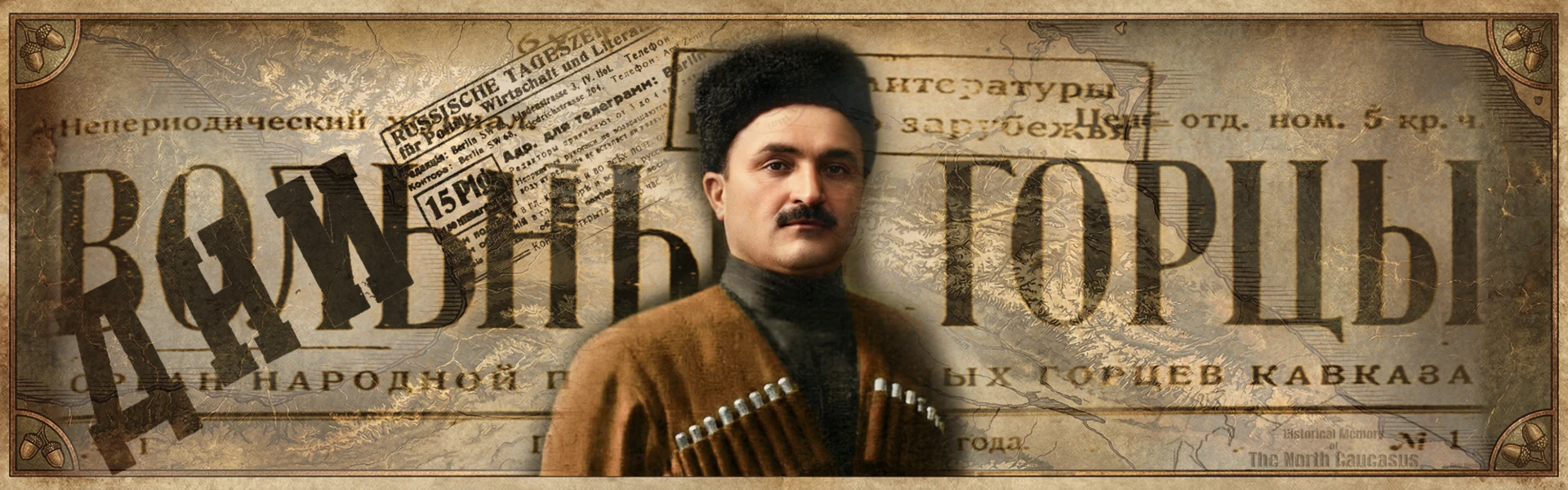
Conversely, in his own correspondence with Polish diplomats and politicians, the very same Said Shamil referred to Ahmed Tsalykkaty as an expendable liability that needed to be purged, actively discrediting him by alleging that he maintained ties with the Russian Social Democratic Labour Party. (Archiwum Akt Nowych Warsaw, Attaches wojskowi 1918-1939, A II_33, f.295). Consequently, the editorship of the party's organ, Free Mountaineers (Volnyie Gortsy), was stripped from Tsalykkaty after the inaugural issue and handed over to Aytek Kundukh. Nevertheless, he continued to contribute articles to the journal. Particularly in his piece titled "Division and Unity," featured in the second issue, he openly targeted Haydar Bammat's Nationalist-Democrat movement and the diplomatic representatives of the North Caucasian Republic in exile. (Ahmed Tsalykkaty, "Razedinenie i obedinenie," Volnyie Gortsy No.2, 1927, pp.8-9.)
"Only he who does nothing makes no mistakes"—but how many mistakes can one make when forced to act under conditions of events changing at a dizzying pace, within the incandescent atmosphere of a revolutionary storm.
Mistakes of the past are forgivable, but only one thing is unforgivable: persisting in them. Mountaineer political figures have committed quite a few errors and blunders in the past; the time is now approaching to cleanse oneself of old sins committed "knowingly and unknowingly" and to embark upon a "new life."
I reiterate, much can be forgiven of the Mountaineers’ intelligentsia; ultimately, the roar of the revolution caught both the Mountaineers and their small intellectual stratum off guard. The entire preceding Tsarist era—which subjugated the Mountaineers for decades, artificially stunted their cultural development, and systematically obliterated their national and political self-awareness in every conceivable way—caused the Mountaineers to grope for this or that line of political conduct not consciously, but rather spontaneously and instinctively. Frequently, this unbridled force raised its menacing waves and crashed in the wrong direction, leaving the finest segment of the Mountaineers’ intelligentsia feeling helpless in the struggle against it.
The Mountaineers’ intelligentsia was thrust into particularly dire conditions. For instance, it lacked the underground and overt political experience possessed by the neighboring Georgian intelligentsia, where, at the dawn of the revolution, a single social democratic party alone boasted a twenty-year history.
Tsarism vehemently opposed the establishment of any form of public life in the North Caucasus—such as zemstvo [self-government] institutions, which could have served as an organizing factor and a school for national-cultural and political work among the Mountaineers, cultivating experienced political cadres by the time the revolution struck.
None of this existed. Following the revolution, the Mountaineers entered political life as a shapeless (amorphous) mass. Why conceal it? This amorphous state persists to this day. Naturally, the currently enforced "dictatorship" of the proletariat is fundamentally incapable of contributing to the organization of the masses and the development of their public self-activity. This is to say nothing of political activity, which is utterly impossible to sustain in a space devoid of fundamental political freedoms, where everything is stifled beneath the crushing weight of the "dictatorship" and the police surveillance of the Cheka.
Those specific blooms of adventurism among various Mountaineers’ figures—which the revolutionary period of Mountaineers’ life proved to be exceedingly rich in—could only flourish upon the fertile ground of this amorphousness within the Mountaineers’ populace.
Is it not true that every Mountaineer who was marginally literate, or sometimes entirely illiterate yet possessed a significant degree of audacity, dared to masquerade as a representative of the people and engage in "Grand Mountaineer politics" not only in the Caucasus, in their homeland, but also to travel abroad? And who out there could possibly discern whether this was genuinely a tribune of the people or a parasite feeding off the body of the nation? Consequently, the revolution, which deprived the Mountaineers of the opportunity for proper representation, especially in the forms it manifested in the North Caucasus, gave rise to a considerable multitude of adventurers, both major and minor.
Amidst the Mountaineers’ chaos, these adventurers felt magnificent.
What a bizarre, Schnitzler-esque dance it was: sheikhs, bandits operating under the banner of Bolshevism or without it, socialists, nationalists, military officers rushing to the Mountaineers’ lands—the Kereselidze detachment in Chechnya—thrill-seekers of all possible nationalities, scoundrels of every stripe—all intertwined in a peculiar amalgamation.
However, this political chaos within the Mountaineers’ milieu could not endure indefinitely. At some point, a process of political crystallization had to commence. This process was already underway when it was abruptly interrupted by the "communist dictatorship"—or, more accurately, forced beneath the surface of public life, blending into the masses. Even then, before the Bolshevik seizure of the North Caucasus, attempts to establish Shariist, revolutionary-democratic (national), and socialist political parties were discernible. Yet all these parties lacked the time to fully take shape before being crushed by the storm blowing from the north, leaving only the so-called Mountaineers’ Communist Party—a mistress of Moscow with no real grassroots support among the people—upon the surface of public life.
One cannot put faith in the socialist construction of the communist overlords. These individuals resemble Molière’s protagonist who mistook prose for poetry, or those "clever folks" who "enter through one door and exit through another." In reality, the "socialist construction" of the communists is the grotesque implementation of a bourgeois-capitalist economy, which will become the dominant system of economic life the very day after the collapse of the current dictatorship. And this hour of collapse is not too distant. It is then that all the undercurrents of Mountaineers’ political life, which were driven underground and preserved there—growing steadily stronger in tandem with the solidification of the bourgeois-capitalist foundations of the current socialist economy—will re-emerge upon the surface, perhaps in a slightly revitalized form.
The Mountaineers’ intelligentsia must comprehend the present and anticipate the future. And this holds equally true for those residing in the Caucasus and those forced to find themselves abroad.
The process of political crystallization, initiated among the Mountaineers’ masses but interrupted by Bolshevik violence, is ongoing. This is an inevitable stage in the political life of the people. Undoubtedly, it is a healthy process that must be taken into account above all else.
If this intelligentsia wishes to optimally overcome the "political chaos" that might resurface in the North Caucasus following the fall of the communists and to paralyze all forms of "adventurism," its primary duty at present is the formalization of political parties rooted in this process of crystallization.
Only after this formalization will the politics of individual figures of the Mountaineers, regardless of their talent, be stripped of their adventurist character; it will no longer be the politics of heroes resolving complex domestic political problems with subtle cunning in the silence of their offices, but rather the politics of parties reflecting the interests of this or that stratum of the Mountaineers.
That is precisely why one cannot help but welcome the emergence of the Popular Party of Free Mountaineers as a momentous event in Mountaineers’ life, propelling it toward the mature process of political crystallization. And, simultaneously, one cannot help but condemn the creation of amorphous organizations such as the Paris Mountaineers’ Center, which claims political representation and was founded on the following principle: "Animals saved on a single branch during a flood, unite!" Crocodiles, bulls, hares, foxes, and wolves are all present. What a marvelous political menagerie!
No, the unification of the Mountaineer intelligentsia for specific objectives, both in exile and in the homeland, can only be realized and become more or less robust once this intelligentsia adopts a party structure.
Enough of this Mountaineers’ chaos!
The Mountaineers’ parties that bear the "Independent Federative Mountaineers’ Republic" on their banners and embrace the "Confederation of Caucasian Republics" forge a bloc of parties pursuing unified fundamental national-political goals. These are the natural allies in the approaching political storms.”
Ahmed Tsalykkaty had now embarked upon a path of no return. He had turned his back on the Nationalist-Democrats—who had embraced him between 1919 and 1923 despite his ruthless attacks during the 1917–1918 period—and allied with Said Shamil and his clique, the very faction actively orchestrating his downfall behind his back.
The letter sent on May 10, 1927, by Murat Khatagogu, chairman of the Revolutionary-Democratic Mountaineers’ Party in Prague, to Haydar Bammat contained highly illuminating details that clarified this entire state of affairs: (IRCICA, Haydar Bammat Archives, Letter from Murat Khatagogu to Haydar Bammat, Prague, May 10, 1927)
[…] It is interesting to note that the "Free Mountaineers" have fiercely concealed Ahmed’s entry into their party from the Mountaineers. I congratulate you on Ahmet Tsalikov's [Tsalykkaty's] article in the second issue of the "Free Mountaineers." I am exceedingly glad that he dedicated his very first article to you. It would have been an injustice on his part to do otherwise. Perhaps now neither you nor Alikhan will be so eager to defend him against justified condemnation. Perhaps now you will be convinced that Ahmed Tsalikov [Tsalykkaty] is merely a mercenary soul ready to serve anyone willing to compensate him. […]
Indeed, realizing that he could no longer attack from the shadows, Tsalykkaty explicitly confessed in a letter sent to Haydar Bammat on June 7 that their paths had definitively diverged: (IRCICA, Haydar Bammat Archives, Letter from Ahmed Tsalykkaty to Haydar Bammat, Prague, June 7, 1927)
[…] You did not reply to my last letter in which I mentioned my desire to relocate to Paris due to the liquidation of the "Russian action" in Czechia (Dado is my witness). But perhaps you never received that letter? Concurrently, you were engaged in a fervent correspondence with Murat and his associates. The National Center completely discarded me from the political scales to court the sympathy of a troupe of "charlatans." Well, that is the National Center's prerogative! I have joined that youth group, which appears more honest to me. Furthermore, I firmly believe that for our normal political development, the establishment of a strong Nationalist-Democrat party—in the truest and most robust sense of the term—is an absolute prerequisite. As a socialist (a "very different harbinger of a very slow spring" for the Mountaineers’ reality), I consider it my duty to assist the youth in realizing themselves and the national interests of our peoples. This is precisely why my pen now belongs to the Popular Party of Free Mountaineers. Who can judge me for this?
It seems to me that your fundamental error is overestimating the significance of all these foreign diplomatic endeavors in the sense of a genuine, rather than performative, recognition of a confederation of Caucasian republics. We must accept our allies exactly as they are. That hour will come (this will be when we stand upon the solid ground of the Caucasus), and the confederation will be a reality, not merely a declaration by politicians detached from the "soil"; otherwise, independent Caucasian republics will not exist anyway.
Your second error is the "carriage of the past." One must make way for the youth. A "changing of the guard" is imperative. You yourself wrote to me that it is necessary to compromise one's pride for the sake of the cause. The "youth" do not trust us "old folks." This is the reality both in the homeland and in exile. Therefore, let them take action. In the person of Said Bey, they have found themselves a leader. Wonderful!
It appears to me that you are mistaken regarding Said Bey. He has matured significantly in political terms. Let him work! His historic name can serve the Mountaineers’ cause. Your attitude toward Said Bey is your third mistake. We Mountaineers must highly, highly value "men of action." […]
[…] I would be deeply saddened if our paths diverge to such an extent that we find ourselves in hostile camps (though, to my knowledge, the sharp edges are being smoothed out—God willing!), but I am progressing along my own path (perhaps "where my wretched fate drags me!"), yet what can one do? To each his own destiny. […]”
Ahmed Tsalykkaty spent the final year of his life growing increasingly isolated in Otwock, a suburb of Warsaw. He passed away on September 2, 1928, due to multi-organ failure exacerbated by diabetes.
Six years following Tsalykkaty's death, the Tsarist monarchist members of the Popular Party of Caucasian Mountaineers, alongside Georgian Mensheviks and Azerbaijani Musavatists, signed a pseudo-confederation pact in Brussels. In an act of political usurpation—frequent examples of which are still observed in society today—they audaciously claimed the mantle of the Caucasian Confederation ideology, an ideal they had fiercely resisted and systematically sabotaged at every opportunity for years. Despite their rigidly centralist mentality, these political usurpers, seeking to co-opt the confederation ideology purely for public appeal, stood in silent tribute to honor the memory of Noe Ramishvili, Ali Mardan Topchubashov, and Ahmed Tsalykkaty at the opening of a conference organized by the Caucasian branch of the Promethean movement in Paris on January 15, 1935. There, they expressed their profound gratitude to Tsalykkaty for his supposed contributions as one of the pioneers of the Caucasian Confederation's establishment. (Georges Mamoulia, Kavkazskaya Konfederatsiya i dvizheniya Prometey, Moscow, 2012, p.101.) In reality, however, neither Tsalykkaty nor Ramishvili had expended the slightest effort toward the realization of a Caucasian Confederation throughout their lives.
The bombastic falsification within Caucasian historiography, which began during those very days, continued for decades and has persisted to the present day. Figures who repeatedly degraded and denigrated the North Caucasian Republic throughout their political careers are portrayed today by certain intellectually impoverished individuals as if they were sincere foot soldiers of the Republic, with eulogies being composed in their honor. Yet the court of history, albeit belatedly, invariably renders its verdict in the light of documentary evidence. There is no escaping the judgment of history. Therefore, bearing in mind what history will ultimately unveil tomorrow, everyone must tread their steps with far greater caution today.

Istanbul, 30 July 2026